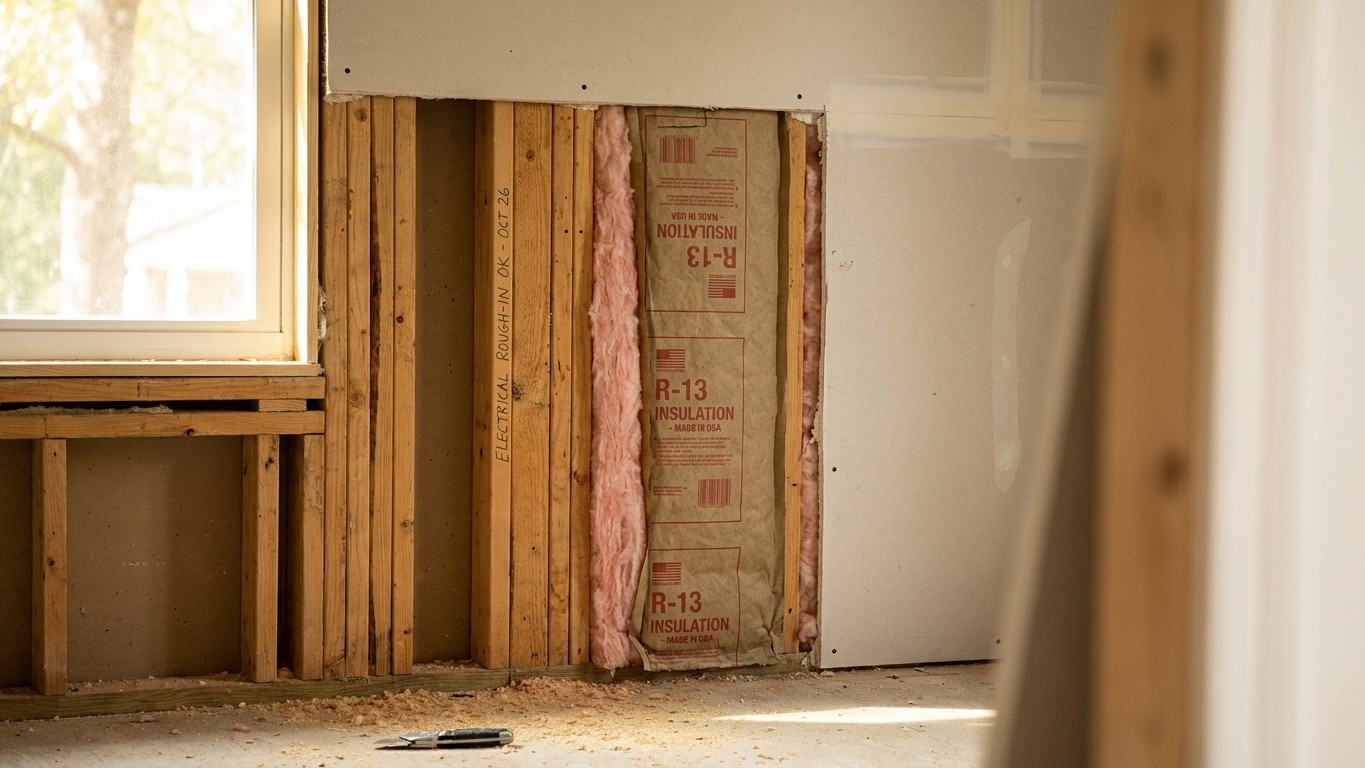

South Dakota’s 66 counties sit entirely outside Climate Zones 1, 2 and 3, which means the 2021 International Residential Code’s exception for warm climates doesn’t apply here. A vapor retarder is required on the interior side of frame walls statewide, though the specific class and installation details still depend on the local building department’s adopted code edition.
What the code asks for in South Dakota

Yes, an interior vapor retarder is required in South Dakota. The 2021 IRC, Section R702.7, states that a vapor retarder of the class given by Table R702.7(2) “shall be provided on the interior side of frame walls.” That’s the baseline rule for the entire country, and it applies here because none of South Dakota’s counties fall into the one carve-out that would remove the obligation.
That carve-out reads plainly: “A vapor retarder shall not be required in Climate Zones 1, 2 and 3.” South Dakota doesn’t have any territory in those zones. Instead, the state splits between two colder zones: 48 counties sit in Zone 6A, and 18 counties sit in Zone 5A, according to the IECC’s Table R301.1. Both zones fall outside the exception, so the practical outcome for the vapor retarder requirement is the same across the whole state, whether a house sits in Rapid City’s orbit or out toward the eastern border near Sioux Falls.
Where the 5A/6A split actually matters is elsewhere in the code, particularly the Insulation tables that set minimum R-values by zone. A builder pulling an insulation schedule needs to know which of the two zones a project falls in. But for the narrower question this page is answering, the split doesn’t produce two different answers. It produces one answer, applied statewide, because neither zone qualifies for the exception.
Worth restating: “not required” in Zones 1-3 doesn’t mean vapor barriers are somehow prohibited there, and the requirement in South Dakota doesn’t mean only one type of material qualifies. The code names three classes by permeance, and which one a wall assembly needs depends on more than just climate zone, it depends on the whole assembly, the cladding, the insulation type, and sometimes local amendments.
None of this settles what should go into a specific wall on a specific lot. The code in force is whatever edition a county or city has actually adopted, which can lag behind the model code by several years, and the local building department is the only party positioned to confirm it. A wall built with the wrong vapor control doesn’t announce the mistake. It rots quietly inside the cavity, and the damage typically surfaces only after the drywall comes down for an unrelated repair, years later.
Why the answer is the opposite in a warm climate
The exception for Zones 1, 2 and 3 isn’t an oversight or a regional discount. It reflects which direction water vapor is actually moving through the wall, and that direction flips depending on climate.
In a cold state like South Dakota, the warm, moisture-laden air is on the inside of the house, generated by cooking, showers, breathing, houseplants. In winter, that indoor air pushes toward the cold sheathing and framing on the exterior side of the wall. A vapor retarder on the interior surface intercepts that vapor before it reaches the cold surface where it would condense. That’s the mechanism the code is protecting against here, and it’s why the requirement holds for both Zone 5A and Zone 6A counties in South Dakota.
In a warm-humid climate, the physics reverse. The humid air is outside, not inside, thanks to air conditioning keeping interior air cooler and drier than the exterior. Vapor now moves from outside toward the interior. If a builder in that climate installs the same kind of impermeable interior vapor retarder that’s standard in South Dakota, they create a cold, impermeable surface in exactly the wrong place. The U.S. Department of Energy’s Building America program describes what happens next in blunt terms: “If the wall contains a vapor retarder on the interior side of the insulation, the water vapor will condense on this cool, impermeable surface,” resulting in “ruined insulation, mold, and structural rot of framing members.”
That’s the entire reason the code writes different rules for different zones. It isn’t bureaucratic caution or a regional preference. It’s a direct response to which side of the wall the water is arriving from. A retarder that protects a wall in Sioux Falls would actively damage a comparable wall in a Gulf Coast climate, and a retarder-free wall that works fine in a humid southern state would leave a South Dakota wall exposed to interior moisture with nothing stopping it from reaching cold sheathing every winter.
The three classes, and why the word matters
The code doesn’t just ask for “a vapor retarder.” It defines three classes by how much moisture they let pass, measured in perms, and the class matters because the wrong one can cause the same kind of trouble described above even within a zone that requires a retarder.
| Class | Example materials | Perm rating |
|---|---|---|
| Class I | Sheet polyethylene, nonperforated aluminum foil | 0.1 perm or less |
| Class II | Kraft-faced fiberglass batts, vapor retarder paint | Above 0.1 up to 1.0 perm |
| Class III | Latex or enamel paint | Above 1.0 up to 10.0 perm |
Polyethylene sheeting is a common shorthand for “vapor barrier,” but it’s a Class I retarder, the tightest of the three. Calling it just “a vapor barrier” without noting the class glosses over the actual disagreement between builders in different climates. A builder in South Dakota’s 6A counties and a builder in a warm-humid zone aren’t disagreeing about whether to have a retarder at all. They’re disagreeing about which class belongs in the wall, and that decision hinges on which direction the vapor is moving, not on regional habit.
Here’s a detail most homeowners miss entirely: ordinary latex paint on interior drywall already functions as a Class III vapor retarder. It’s not a barrier in the sheet-plastic sense, but it does slow vapor diffusion enough to count under the code’s own definition. Anyone who has painted an interior wall with standard latex paint has, without realizing it, already installed the lightest class of vapor control the code recognizes.
One more distinction worth keeping straight: a vapor retarder and an air barrier are not the same thing, even though the same sheet of material sometimes does both jobs. A vapor retarder slows the diffusion of water vapor through a material. An air barrier stops bulk air movement, which carries far more moisture than diffusion ever does. Confusing the two leads to wall assemblies that check one box while leaving the other wide open.
Where the rule stops
The interior vapor retarder requirement doesn’t apply everywhere in a house, even in a state where the retarder is generally required. The 2021 IRC lists specific exceptions:
- Basement walls
- The below-grade portion of any wall
- Construction where accumulation, condensation, or freezing of moisture will not damage the materials
The basement exception is the one most South Dakota homeowners actually run into, since basements are common across both the state’s climate zones. A poured concrete foundation wall behaves differently from an above-grade frame wall. Concrete holds moisture from the pour itself for a long time, and it continues absorbing and releasing groundwater moisture for years afterward. That assembly needs to be able to dry inward, toward the conditioned basement space, because it has nowhere else to dry to below grade. Installing an impermeable interior vapor retarder on a basement wall traps that moisture against the concrete instead of letting it dissipate, which is close to the same problem the DOE describes for warm-humid climates, just triggered by a different moisture source.
This is a large enough topic that it deserves its own treatment rather than a paragraph here. The basement wall vapor barrier guide on this site covers the assembly details, including how above-grade and below-grade portions of the same wall can be treated differently under the same code section.
The third exception, for construction where moisture won’t damage the materials, is intentionally broad and depends on the specific assembly rather than a fixed list of approved methods. It’s also the exception most likely to require a conversation with a local building official rather than a self-diagnosis, since “will not damage the materials” is a judgment call tied to the actual products and design in question.
Who actually decides, in South Dakota
Everything above describes the model code and how it applies to South Dakota’s climate zones. The authority that actually governs a specific project is the local building department, and specifically whichever edition of the code that jurisdiction has adopted. Model codes like the 2021 IRC get adopted state by state, and sometimes county by county or city by city, often with amendments, and often years after the model code itself was published. A jurisdiction in South Dakota may be enforcing the 2021 edition, an earlier one, or a locally amended version, and only the building department can confirm which.
This matters more in a state like South Dakota than it might in a milder climate, because the winter heating load here is substantial. Sioux Falls averages about 7,248 heating degree days a year against a base of 65 degrees Fahrenheit, a figure that measures the cumulative demand for heat across the year rather than any single temperature reading. Compare that to roughly 847 cooling degree days at the same station, and the imbalance is stark: this is a climate dominated by winter heating demand, not summer cooling load. That’s precisely the condition under which an interior vapor retarder does its intended job, stopping indoor moisture from reaching cold sheathing during a long heating season.
None of that changes the basic guidance for an individual homeowner: this page describes the rule and what it depends on, not what belongs in any particular wall. The class of retarder, the treatment of a basement wall, and any local amendments are questions for the building department with jurisdiction over the property. A wall assembly built with the wrong vapor control rarely fails in a way anyone notices right away. The rot happens inside the cavity, out of sight, and it’s usually a renovation or a repair years down the line that reveals what went wrong.