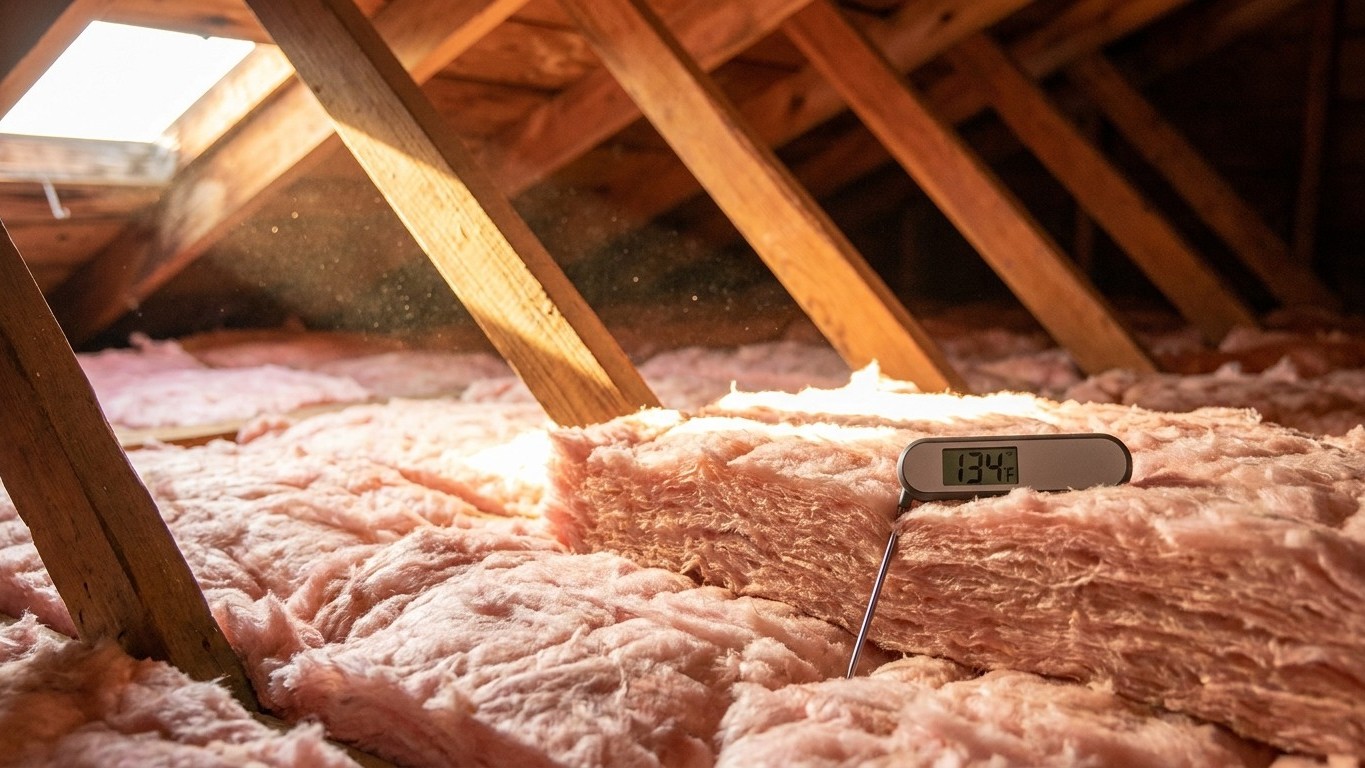

Yes, Insulation keeps an Illinois home cooler, but the state’s summer heat load is moderate rather than extreme. The reference station in Chicago averages just 14 days a year above 90°F, and Illinois itself splits across two climate zones, 5A and 4A. That combination means Insulation still earns its keep against summer heat, but across most of the state it’s the cold months, not the hot ones, that make the investment pay off hardest.
The short answer for Illinois

Insulation resists heat flow in both directions, so yes, it keeps an Illinois home cooler in summer the same way it keeps one warmer in winter. The question worth asking isn’t whether it works here, it’s how much of the year that cooling function actually gets used. Fourteen days above 90°F at the Chicago reference station is not a small number, but it’s not a Southern-summer number either. Compare it mentally to a place where triple digits stretch for weeks, and Illinois looks like what it is: a state where summer heat is a real but limited season, sandwiched between a long shoulder season and a winter that dominates the annual energy bill.
Illinois’s split climate zones tell the same story from a different angle. The 2021 International Energy Conservation Code places 58 of the state’s 102 counties in zone 5A and the remaining 44 in zone 4A. Both zones sit on the colder side of the national divide the IECC draws between heating-dominated and cooling-dominated climates. Neither 5A nor 4A is classified among the hot-humid or hot-dry zones where cooling loads routinely exceed heating loads. That placement is the honest headline here: Illinois is a heating-climate state that also happens to get hot enough, often enough, for insulation’s summer role to matter.
What that means in practice is a shift in emphasis, not a different recommendation. A homeowner in a state with eight or nine hot days a year would get a much smaller summer return from the same attic upgrade, and a homeowner in a state with 60 or 70 days above 90°F would get a much larger one. Illinois sits in between, closer to the modest end. The insulation installed for a cold Illinois winter doesn’t sit idle for the other nine months, it just does less dramatic work when a 90°F afternoon shows up in July than it does when a subzero night hits in January. Fourteen days a year is enough for the attic to matter on the hottest afternoons, but not enough to reorganize the whole insulation strategy around summer alone.
That’s the frame for everything below. The mechanism, the material choices, and the payoff numbers all apply to Illinois, but they apply inside a heating-dominated climate where insulation’s winter job is still the larger one. Readers looking for a state where summer heat drives the insulation conversation should expect a different, more emphatic answer than the one Illinois gives.
What happens above the ceiling
On a sunny summer afternoon, a dark asphalt shingle roof can push the air trapped underneath it far hotter than the outdoor temperature, sometimes by 40°F or more, because the roof deck absorbs solar radiation all day with nowhere for that heat to go but down. Everything below that superheated roof deck, the attic framing, any ductwork routed through the space, stored boxes, and eventually the ceiling drywall itself, sits under that heat load. Without a resistant layer between the attic and the living space, some of that heat migrates downward into the rooms below, working against the air conditioner all afternoon.
Attic insulation is the barrier that slows that downward migration. It’s the same material and the same R-value doing the job in July that it does in January, because insulation doesn’t distinguish between heat trying to leave a warm house in winter and heat trying to enter a cool house in summer. It simply resists heat flow, and in summer that flow happens to run downward instead of upward. That’s the useful, unglamorous fact at the center of this whole topic: there’s no separate “summer insulation” to buy. The attic work done for winter comfort is the same work that blunts the July heat gain.
What ENERGY STAR recommends for Illinois’s zones
ENERGY STAR publishes retrofit insulation levels by IECC climate zone for existing wood-framed homes, and the table below reproduces the rows that apply to Illinois’s two zones. The source table has a merged header: two of the three figures cover the attic, one for a home currently uninsulated and one for a home that already has 3 to 4 inches in place, and the third figure is a separate recommendation for the floor.
| Zone | Attic if uninsulated | Attic if you already have 3-4 inches | Floor |
|---|---|---|---|
| Zones 4A and 4B | R60 | R49 | R19 |
| Zones 6, 5, and 4C | R60 | R49 | R30 |
Illinois’s 44 counties in zone 4A fall under the first row above; its 58 counties in zone 5A fall under the second, grouped with zones 6 and 4C. These are retrofit targets for existing homes, not new-construction code minimums, and they’re the same figures that would appear on a winter-focused insulation page for this state, because the recommendation doesn’t change by season. A reader unsure which of Illinois’s two zones covers their county should check the ENERGY STAR climate zone map rather than guess from a county name, since the two zones’ floor recommendation differs by 11 R-value points.
What homes in Illinois cool with
Survey data from the U.S. Energy Information Administration’s Residential Energy Consumption Survey shows how homes actually keep cool, and it matters for where insulation helps and where it doesn’t. Air-conditioning equipment of some kind is used in 96% of homes surveyed. A central air-conditioning unit accounts for 74% of homes, while 28% rely on individual equipment, a ductless mini-split, a window or wall unit, or a portable unit. Ceiling fans, which don’t cool the air but make occupants feel cooler, are used in 73% of homes. Each of those figures is a share of households surveyed, not a share of every house standing in the state.
The gap between 96% owning some form of air conditioning and 74% running a central system is the story worth noticing. That roughly 22-point difference is the share of homes cooling with individual equipment instead of a whole-house central system, and it changes which insulation job matters most. In a home with central air and ductwork routed through the attic, those ducts sit inside the hottest space in the entire building on a summer afternoon. Ceiling insulation slows heat moving into the living space below, but it does nothing to protect ducts sitting in that superheated attic air above the insulation layer. Sealing and insulating the ducts themselves is a separate, necessary job.
In a home cooling with a window unit, a wall unit, a mini-split, or a portable, there’s no attic ductwork to worry about at all. What matters there is the envelope of the specific room being cooled, its windows, its exterior wall insulation, and how well it’s sealed against the rest of the house. Readers with central air and attic ducts should look at this site’s duct sealing and duct insulation guides as the next step beyond the ceiling. Readers cooling room by room should check the room air conditioner guides for sizing and placement, since insulation alone won’t fix a unit that’s undersized or facing the wrong window.
What the heat asks for that the cold does not
Two tools exist specifically because of summer heat, and neither one is standard insulation advice carried over from winter.
A radiant barrier reflects radiant heat rather than resisting conducted heat the way fiberglass or cellulose does. It carries no R-value and isn’t insulation in the conventional sense, and it earns its keep only under a sun-loaded roof deck in climates where attic temperatures spike hard and often. Illinois, with 14 days a year above 90°F and both its climate zones sitting on the heating-dominated side of the IECC’s divide, isn’t the territory where a radiant barrier is the priority purchase. For a state with a short, moderate summer, the attic insulation levels described above do more work for the money than a radiant barrier would. That calculus flips in states with long, intense cooling seasons, but Illinois isn’t one of them.
Vapor movement is the second summer-specific issue, and it runs opposite to the winter pattern. In a warm, humid climate, moisture-laden air sits outside a cooled, dehumidified house, which is why the model energy code doesn’t require an interior vapor retarder in its warmest, most humid zones, the vapor drive there points inward, not outward. Illinois’s zones 4A and 5A carry different vapor requirements than a Gulf Coast humid-summer zone, and the details depend on the specific assembly and county. Rather than settle that question here, it belongs on this territory’s dedicated vapor barrier page, where the code language for zones 4A and 5A can be laid out properly.
What the work is worth
The U.S. Environmental Protection Agency, through ENERGY STAR, estimates that “homeowners can save an average of 15% on heating and cooling costs (or an average of 11% on total energy costs) by air sealing their homes and adding insulation in attics, floors over crawl spaces, and accessible basement rim joists.” Both numbers matter, and they answer different questions: 15% is the share of the combined heating-and-cooling bill, while 11% is the share of total household energy costs, a broader category that includes things insulation doesn’t touch, like water heating and appliances.
That figure is exactly why a page like this one exists for a state like Illinois. The estimate covers heating and cooling together, as one combined savings figure, not a winter number that happens to carry over into summer as an afterthought. For a heating-dominated state where summer contributes a smaller share of the annual energy picture, the 15% figure still represents real value on the cooling side of the ledger, even if winter savings make up the larger portion of it.
These figures are averages drawn from energy modeling of a typical existing U.S. home, not a guaranteed outcome for any specific house, and the modeling covers a specific set of locations: attics, floors over crawl spaces, and accessible basement rim joists. It doesn’t extend to walls, windows, or doors, and it shouldn’t be blended with other published figures, like ENERGY STAR’s separate “up to 10% on annual energy bills” claim for the same category of work, which uses a different baseline. There’s no federal tax credit tied to this work anymore either; the 25C residential energy efficiency credit closed at the end of 2025, so the case for insulation in Illinois now rests on the energy savings themselves, not a rebate attached to them.