
Yes, Insulation helps against Michigan summer heat, but the state’s short, sharp hot season means the bigger payoff usually shows up on the winter side of the ledger. Michigan runs about 10 hot days a year, not 60 or 90 like the Gulf Coast. Insulation still works the same way in July as it does in January: it resists heat flow, whichever direction that flow is moving.
The short answer for Michigan

Yes, and here is how much of the year it actually matters. At the reference station in Detroit, the average is 10.3 days a year above 90°F, according to NOAA’s 1991-2020 Climate Normals. That is a real stretch of heat, the kind that stresses cooling equipment and wilts a garden, but it is nowhere near the summer load carried by states where triple digits are routine. This is a state where the furnace runs far more months than the air conditioner does.
Where a home sits also matters. Michigan’s 83 counties are split across three IECC climate zones: 44 counties fall in zone 6A, 37 in zone 5A, and 2 in zone 7. That spread puts almost the entire state on the cold side of the country’s climate divide, with a small northern slice (zone 7) even colder than the rest. None of these are warm-humid zones. So the honest framing for Michigan is this: insulation is not optional here, but its main job is holding heat in during a long cold season, and its summer benefit is a secondary, welcome side effect rather than the main event.
That distinction changes what a homeowner should expect. In a state where summer is the longer season, insulation upgrades often get justified primarily by air-conditioning savings. In Michigan, the case for insulation rests mostly on heating bills, and the 10 or so hot days a year get covered along the way, at no extra cost, because the same material blocking outward heat loss in December is blocking inward heat gain in July. A homeowner weighing an attic upgrade purely for a handful of 90-degree days in Grand Rapids or Lansing is asking the wrong question. The right question is whether the attic is doing its winter job, because if it is, the summer performance comes along for free.
None of this means summer comfort is irrelevant. An underinsulated attic in a state with cold winters can still turn into an oven on the hottest afternoons, and that heat radiates down into living space and into ductwork long after the sun goes down. But the framing matters: this is a state where insulation is a year-round asset with a heavy winter emphasis, not a cooling-first investment.
What happens above the ceiling
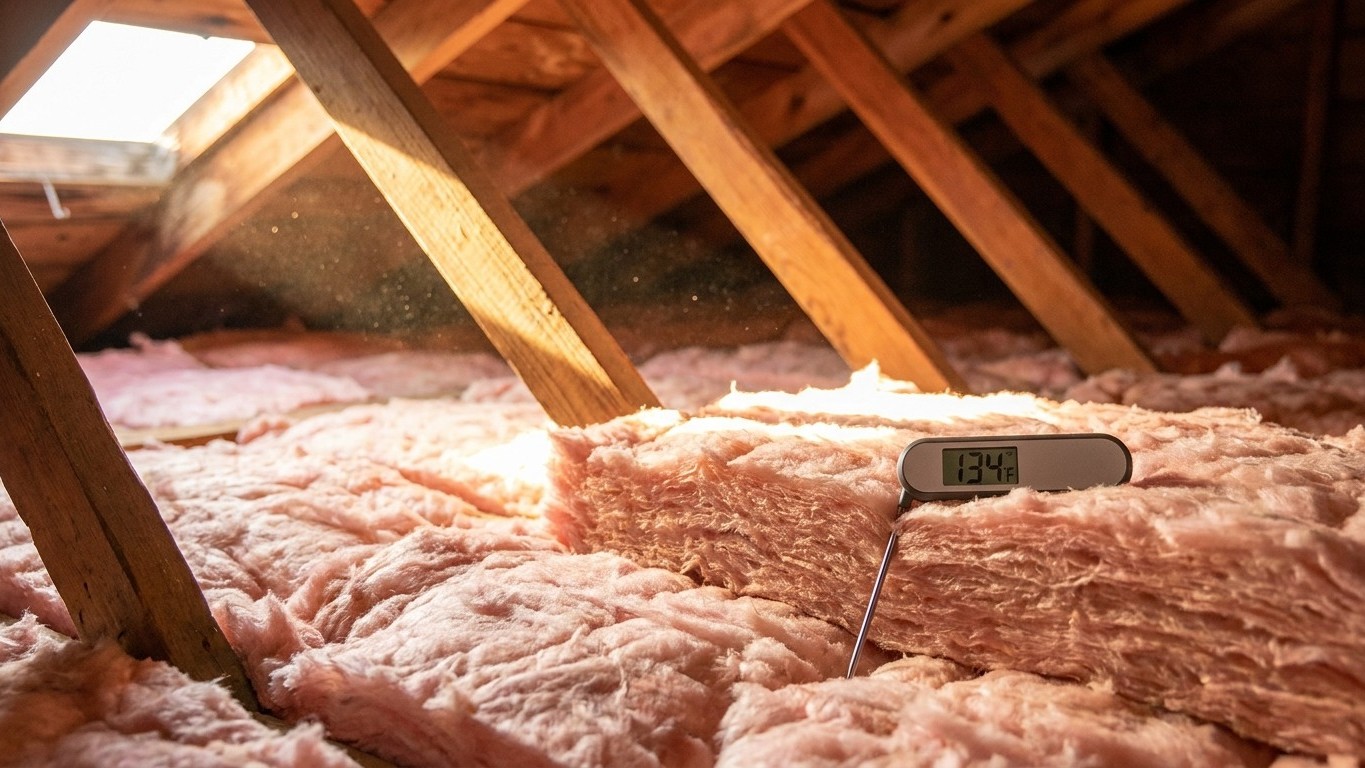
A sun-loaded roof deck absorbs radiant energy all afternoon, and the attic underneath climbs well past the outdoor air temperature, sometimes by 40 degrees or more depending on roofing material and ventilation. Everything under that roof deck sits inside that heat: the ceiling drywall, any ductwork routed through the space, the boxes stored along the joists. That superheated air pushes downward through an underinsulated ceiling and into the living space below, working against the air conditioner or, on milder days, just making upstairs bedrooms uncomfortable.
The useful point is that the insulation doing this job in summer is the same material doing the winter job. It is not a seasonal product swapped in and out. Insulation resists heat flow in whichever direction it is moving, so a well-insulated attic slows the downward push of superheated air in July exactly as it slows the upward escape of furnace-warmed air in January. There is no separate “summer insulation” to install; getting the attic right once serves both seasons.
ENERGY STAR’s retrofit levels for this state’s zones
ENERGY STAR publishes recommended retrofit insulation levels by climate zone, based on the 2021 IECC. These are for adding insulation to an existing wood-framed house, not new-construction requirements, and they apply differently depending on whether the attic already has some insulation. Since Michigan’s counties fall in zones 6A, 5A and 7, both of the following rows from that table are relevant:
| Zone | Attic if uninsulated | Attic if already 3-4 inches | Floor |
|---|---|---|---|
| Zones 6, 5 and 4C | R60 | R49 | R30 |
| Zones 7 and 8 | R60 | R49 | R38 |
Notice the attic numbers are identical across both rows, R60 for a bare attic or R49 for one that already carries a few inches. The difference between the two zones shows up in the floor column, R30 versus R38, reflecting the colder demands of the small zone-7 slice in Michigan’s north. ENERGY STAR does not publish a state-by-state or county-by-county map in text form; it’s issued as a map image, so the correct next step for any homeowner is checking the ENERGY STAR zone map or a county-level IECC table rather than assuming a zone from a region alone. Getting the attic to the applicable level is the one upgrade that pays back in both January and July.
What homes in Michigan cool with
According to the U.S. Energy Information Administration’s 2020 Residential Energy Consumption Survey, 87% of Michigan households use some form of air-conditioning equipment. Of those, 66% use a central air-conditioning unit, and 27% rely on individual equipment instead, a ductless mini-split, a window or wall unit, or a portable. Ceiling fans show up in 69% of homes, doing a lot of the low-cost comfort work during that short hot stretch. Every one of these figures is a share of households surveyed, not a share of houses standing, and none of them should be read as a recommendation, only as a record of what got installed when these homes were built or renovated.
The gap between “uses air-conditioning” (87%) and “uses a central unit” (66%) is the story worth noticing: roughly 21 percentage points of Michigan households are cooling with something other than central air. That is where insulation’s relationship to cooling equipment gets complicated. Where central air runs through ducts routed in the attic, those ducts sit in the hottest space in the entire building, often 30 or 40 degrees hotter than the rooms they’re meant to cool. Ceiling insulation does nothing to fix that; sealing and insulating the ducts themselves is a separate job, and one worth checking on any home where the attic gets noticeably hot in summer.
For the 27% running window units, wall units, portables or mini-splits, the calculation is different. There is no attic duct run to worry about; the room’s own envelope, its windows, walls and the ceiling directly above it, is what determines how hard that unit has to work. A well-sealed, well-insulated room lets a modest window unit keep up on the hottest days; a leaky one overwhelms it. Anyone troubleshooting either setup should look at the site’s duct sealing and insulation guides for the central-air side, and the room air conditioner guides for anything running on individual equipment.
What the heat asks for that the cold does not
Two tools belong specifically to hot climates, and Michigan’s short summer changes how much weight either one deserves here.
A radiant barrier reflects radiant heat away from the roof deck rather than resisting conducted heat the way insulation does. It carries no R-value and it is not a substitute for insulation; it earns its keep specifically under a sun-loaded roof in a climate where that radiant load runs for months at a stretch. With about 10 days a year above 90°F, Michigan is not that climate. A radiant barrier is not the tool for a house here, and adding one on top of proper attic insulation is unlikely to move the needle much given how brief the state’s heat season actually is. The dollars are better spent getting the attic insulation itself up to the levels in the table above.
Vapor moves the other way in summer than it does in winter, which is why the model energy code drops the requirement for an interior vapor retarder in the country’s warmest, most humid zones, where the damp air sits outside the wall rather than inside it. Michigan’s zones (6A, 5A, 7) sit on the cold end of that spectrum, not the warm-humid end, so that particular code exception doesn’t apply here. Vapor control in a cold-climate house follows different rules built around a long heating season, and that is a separate question worth working through on this site’s vapor barrier page for this territory rather than settling here.
What the work is worth
ENERGY STAR’s published estimate is specific: “EPA estimates that homeowners can save an average of 15% on heating and cooling costs (or an average of 11% on total energy costs) by air sealing their homes and adding insulation in attics, floors over crawl spaces, and accessible basement rim joists.” Both numbers matter, and both need their denominator attached. Fifteen percent applies to heating and cooling costs combined; 11% applies to total energy costs, a broader category that includes water heating, lighting and everything else running through the meter.
That figure is exactly why this page treats summer and winter as one question rather than two. The 15% saving is not a winter number that happens to carry over into July, it is a heating-and-cooling number from the start, modeled across the full year. In a state where the hot season is brief and the cold season is long, most of that 15% will show up as lower heating bills, but the modeling includes the cooling side too, which is the honest way to think about attic work in Michigan.
These figures come from energy modeling of a typical existing U.S. home, an average, not a guarantee for any specific house. They also apply specifically to attics, floors over crawl spaces, and accessible basement rim joists, the areas ENERGY STAR modeled, not to walls, windows or doors. A Michigan homeowner checking whether their attic already meets the levels in the table above, and whether air sealing has been done alongside it, is asking the two questions that actually determine whether that 15% is within reach.