
Insulation keeps a Maine home cool, but the honest answer comes with a caveat worth knowing before you buy a single bag of it: this state’s summer is short. Only a handful of days a year push into true heat, so the same insulation that carries a house through a long winter is doing double duty rather than fighting a constant summer battle. It still matters here, just not the way it does further south.
The short answer for Maine

3.8 days a year. That’s how often the thermometer at Portland, the state’s reference weather station, crosses 90 F, according to NOAA’s 1991-2020 Climate Normals. It’s a count of days, not a description of what August feels like statewide, and it’s the number that sizes the whole question: Maine does not have a long, punishing cooling season to defend against.
The climate-zone map backs that up. Under the 2021 International Energy Conservation Code, 15 of the state’s 16 counties sit in zone 6A, and one county sits in zone 7, the coldest zone assigned in the Lower 48 outside a handful of mountain and northern-border pockets. Both zones fall on the cold side of the country’s climate divide. That’s not a guess about where the design priority lies; it’s what the zone map is built on.
What that means for the work you do
In a state built around zones 6A and 7, insulation is fundamentally a winter investment that happens to also help in summer, not the other way around. The material doesn’t know which season it is. Fiberglass, cellulose, or foam resists heat flow in whichever direction it’s moving, and in January that flow is outward, in July it’s inward. But with only 3.8 days a year above 90 F, the dollars saved by resisting that summer inflow are a small fraction of what’s saved keeping heat in through a Maine winter that runs months, not days.
That doesn’t make summer irrelevant. A sunny, humid stretch in July can still turn an under-insulated upstairs bedroom miserable, and the same fix that helps the heating bill helps that bedroom. The point is proportion: don’t expect insulation here to behave like it does in a Gulf Coast state where cooling degree-days dwarf heating degree-days. In Maine, it’s the reverse, and any honest answer to “Does Insulation Keep a Maine home cool” has to say so plainly rather than pretend the state has a long cooling season it doesn’t have.
What happens above the ceiling
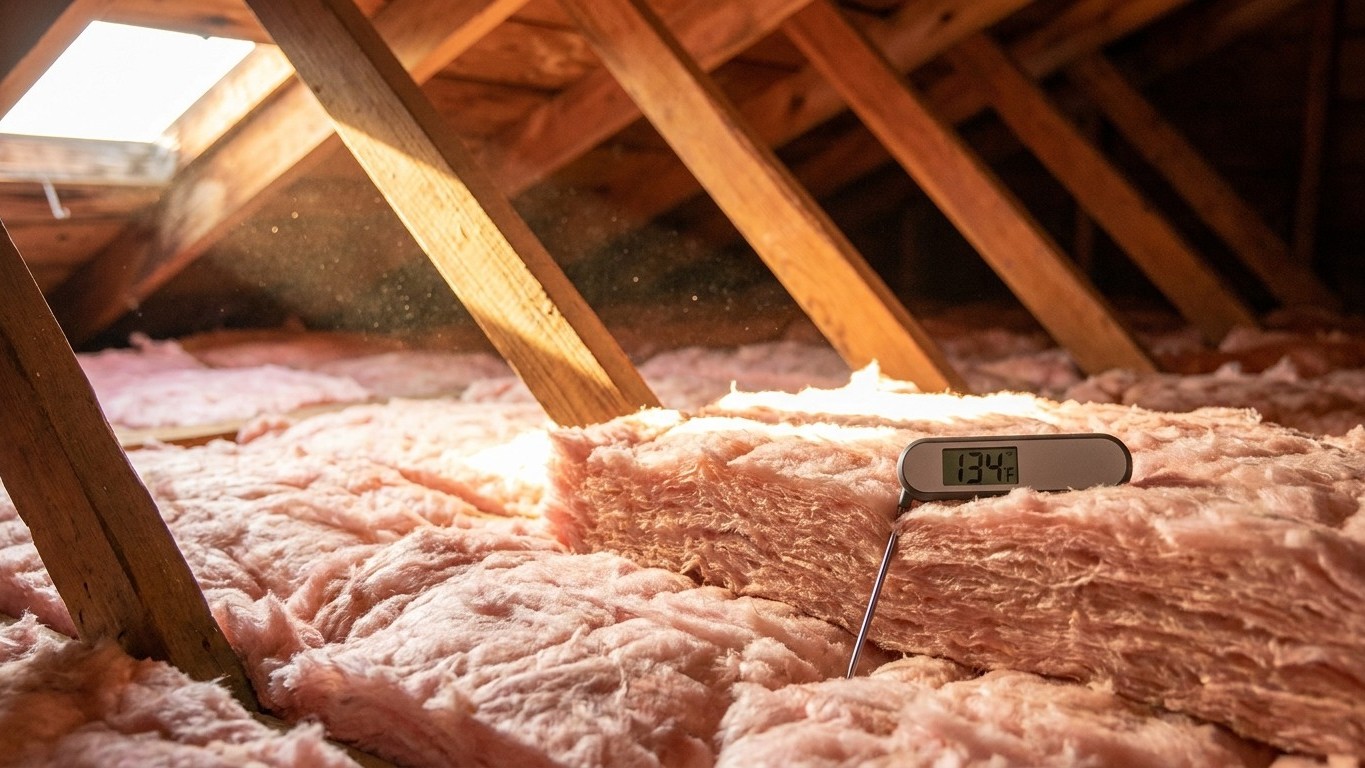
A dark asphalt shingle roof under a clear Maine sky in July can push attic air well above the outdoor temperature, even on a day that never reaches 90 F. That superheated air sits directly above the ceiling insulation, the ductwork if any runs through the attic, and whatever boxes are stored up there. Everything below the roof deck lives under that heat load, whether the ceiling below is a bedroom or the top of a stairwell.
Here’s the part that matters for a state like this one: the insulation doing that job in summer is the exact same material doing the job in winter. It isn’t a seasonal product swapped out twice a year. It’s a resistance to heat flow, full stop, and the flow just happens to run downward into the house on a hot July afternoon instead of outward through the roof on a cold January night. Add attic insulation for winter, and you’ve added it for summer too, at no extra cost.
The levels that apply to this state’s zones
ENERGY STAR publishes retrofit insulation levels for existing wood-framed homes, organized by IECC climate zone. Because Maine’s counties split between zone 6A and zone 7, both rows below are relevant somewhere in the state, and neither should be assigned to a reader without checking a county-level source:
| Zone | Attic, if currently uninsulated | Attic, if you already have 3-4 inches | Floor |
|---|---|---|---|
| Zones 6, 5 and 4C | R60 | R49 | R30 |
| Zones 7 and 8 | R60 | R49 | R38 |
Note that the middle two figures aren’t two different attic recommendations for two different homes at random; they’re the same attic, at two different starting points. An uninsulated attic gets built up to R60. An attic that already has 3 to 4 inches in place gets topped up to R49. The third figure is a separate assembly entirely, a floor over an unheated space. These are retrofit numbers for existing construction, not a new-construction code minimum, and they say nothing about walls. To find which zone applies to a specific county, ENERGY STAR’s own climate zone map is the source to check, not a guess based on a nearby city.
What homes in Maine cool with
Seventy percent of homes here report having some form of air conditioning, according to the U.S. Energy Information Administration’s 2020 Residential Energy Consumption Survey. But only 10% of homes run a central air-conditioning system. The gap between those two figures, 60 percentage points, is the story: most cooling in this state runs through individual equipment rather than a whole-house duct system. Sixty-three percent of homes use a ductless mini-split, a window unit, a wall unit, or a portable unit, and 61% use ceiling fans, often alongside whatever AC they have.
Both figures are shares of households surveyed, not shares of homes standing, and a small sample size in a state’s survey can suppress a figure without that meaning zero households have it.
This equipment mix changes where insulation actually helps and where it doesn’t. In the small share of homes with central air and ductwork routed through the attic, those ducts sit in the hottest space in the building, the same superheated attic described above. Ceiling insulation does nothing to fix that; it’s a separate job, sealing and insulating the ducts themselves. For the much larger share running mini-splits, window units, or portables, there’s no attic duct problem to solve. What matters is the envelope of the specific room the unit serves: how much of that room’s ceiling, walls, and windows are holding heat out versus letting it in. A well-insulated ceiling above a bedroom with a window unit does real work; a well-insulated ceiling above a hallway with no cooling at all does none for comfort, only for the heating bill.
Anyone dealing with attic ductwork or sizing a room unit will get more specific guidance from this site’s duct insulation guides and its room air conditioner guides than from a general insulation page.
What the heat asks for that the cold does not
Two tools belong specifically to hot climates, and neither is a fit here.
A radiant barrier reflects radiant heat rather than resisting conducted heat the way insulation does. It carries no R-value, it isn’t insulation by any measure, and it earns its keep only under a sun-loaded roof deck where reflecting heat before it enters the attic makes a real dent in cooling load. With 3.8 days a year above 90 F, that’s not the situation most Maine homes are in. A radiant barrier isn’t the tool this house needs; the R-value table above is.
Vapor is the second one. In a warm, humid climate, moisture in summer moves from the humid outdoor air toward the cooler indoor air, the reverse of how it moves in winter, which is why the model energy code doesn’t require an interior vapor retarder in its warmest zones. Maine sits in zones 6A and 7, both cold-climate zones where the winter vapor drive, moisture moving from inside toward outside through a cold wall, is the one the code is built around. Whether and where a vapor retarder belongs in a specific Maine wall assembly is a question this page won’t settle; that’s a job for this state’s dedicated vapor barrier page.
What the work is worth
ENERGY STAR’s own estimate: “EPA estimates that homeowners can save an average of 15% on heating and cooling costs (or an average of 11% on total energy costs) by air sealing their homes and adding insulation in attics, floors over crawl spaces, and accessible basement rim joists.”
Both numbers matter, and neither works without its denominator. Fifteen percent is a share of heating and cooling costs together, not either one alone. Eleven percent is a share of total energy costs, a broader number that includes everything else running on a utility bill. This is precisely why the figure fits a state like Maine: it’s not a summer number and it’s not a winter number, it’s a combined one, and it’s the reason a short cooling season doesn’t make the work pointless. The saving on offer was never sold as a cooling-season saving in the first place.
These are averages built from energy modeling of a typical existing U.S. home, not a guarantee tied to any one house’s construction, age, or current insulation depth. The modeling also covers specific locations only: attics, floors over crawl spaces, and accessible basement rim joists. It doesn’t extend to walls, windows, or doors, and it shouldn’t be read as if it does.