
Yes, Insulation keeps a North Carolina home cooler in summer, and the state’s own weather record explains why that matters: the Charlotte reference station logs 35 days a year at 90°F or hotter. That’s not a handful of miserable afternoons, it’s more than a month of sustained heat load pressing down on rooftops, driveways, and eventually, ceilings.
The short answer for North Carolina

Thirty-five days above 90°F puts the Charlotte area in a middle tier of American summer heat: hotter and longer than New England or the Pacific Northwest, milder than the Gulf Coast or the Texas interior. That single number, though, hides a real split inside the state’s own borders. North Carolina’s 100 counties fall into three separate IECC climate zones: 79 counties sit in zone 3A, 16 in zone 4A, and 5 in zone 5A. Those aren’t administrative trivia, they’re the difference between a house that fights heat for a third of the year and one that barely notices it.
In the 79 counties mapped to zone 3A, mostly the Piedmont and coastal plain, summer is the dominant season for energy use. Air conditioners run for months, attics bake under direct sun, and Insulation‘s summer job is as important as its winter one. The 16 counties in zone 4A, a band that includes parts of the foothills and northern Piedmont, still see plenty of 90-degree days but pair them with a colder winter, so Insulation earns its keep in both directions more evenly. The 5 counties in zone 5A, tucked into the higher elevations of the western mountains, are the outlier: summers there are shorter and cooler, and for those homes, insulation’s biggest payoff still leans toward the heating season, even if the odd heat wave still pushes an attic hot.
None of this means insulation is optional anywhere in the state. It means the honest answer changes depending on which of those three zones a house sits in. A place in the Piedmont with 35-plus days above 90°F is fighting a long, humid cooling season where insulation is pulling real weight for a third of the year. A mountain home in zone 5A is fighting a shorter, milder version of that same battle, with winter still doing most of the talking. Either way, the mechanism underneath the roof deck is identical, it’s just the balance of seasons that shifts.
What happens above the ceiling
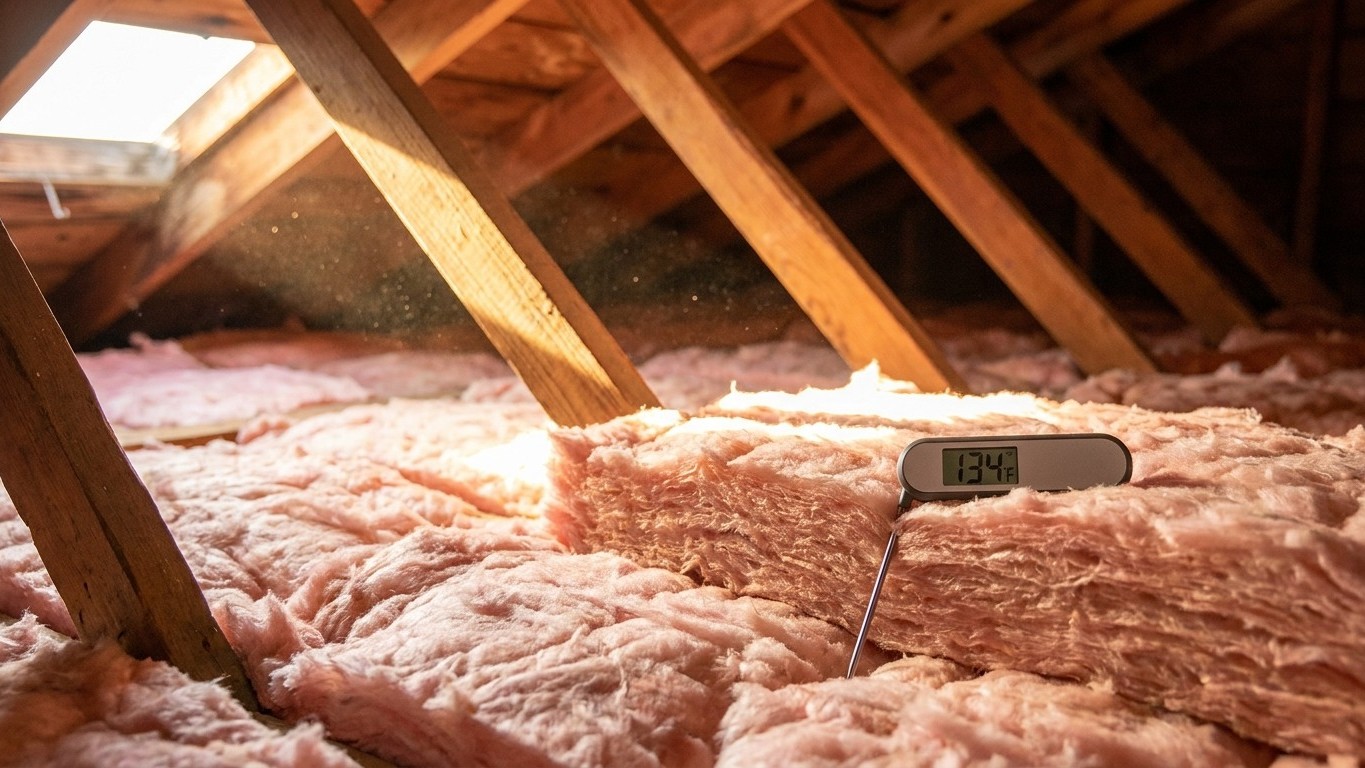
A sun-loaded roof deck in North Carolina doesn’t just get warm, it gets driven well past the outdoor air temperature, sometimes 40 or 50 degrees hotter than the thermometer reading on the ground. That superheated air pools in the attic, sitting directly above the ceiling drywall, the ductwork, and whatever boxes have been stored up there since the last move. Everything below that ceiling is living under a heat source most homeowners never see and rarely think about until the utility bill arrives.
Here’s the part that gets misunderstood: attic insulation isn’t a winter-only product that happens to still be there in July. It’s a resistance to heat flow, full stop, and heat flow doesn’t care which direction it’s moving. In January, warm indoor air is trying to escape upward into a cold attic. In July, that same insulation is doing the opposite job, resisting downward heat trying to invade the living space from a scorching attic above. Same material, same R-value, same physics, opposite direction. That’s why it’s the one upgrade that pulls double duty across both North Carolina seasons rather than serving just one.
What ENERGY STAR recommends by zone
ENERGY STAR publishes retrofit target levels for existing wood-framed homes by climate zone, and because North Carolina spans three zones, the right target differs depending on where a house sits. These figures are for retrofitting an existing house, not new-construction code minimums, and the “attic” column is really two figures: what to add if the attic has no insulation at all, and what to add if there’s already 3 to 4 inches in place. Floor insulation, for spaces like unheated crawl spaces, is listed separately.
| Zone | Attic if uninsulated | Attic if already 3-4 inches | Floor |
|---|---|---|---|
| Zone 3 (covers NC’s 3A counties) | R49 | R38 | R19 |
| Zones 4A and 4B (covers NC’s 4A counties) | R60 | R49 | R19 |
| Zones 6, 5, and 4C (covers NC’s 5A counties) | R60 | R49 | R30 |
No single figure applies to the whole state. A homeowner needs to know which of the three zones their county falls into before shopping for material, and the ENERGY STAR zone map or a county-level table is the place to confirm that, not a guess based on which part of the state feels hottest.
What homes in North Carolina cool with
Statewide, 91% of North Carolina households report using some form of air conditioning, and 84% of all households run a central air-conditioning system. That gap, roughly 7 percentage points, represents the households cooling with something other than central air: window units, wall units, ductless mini-splits, or portables, which together account for 11% of homes. Ceiling fans show up in 83% of homes, doing the less glamorous but real work of making a room feel a few degrees cooler without moving the thermostat.
Those numbers matter for how insulation actually helps, because the two cooling setups have different weak points. In a house with central air and ductwork routed through the attic, that ductwork is sitting in the single hottest space in the entire building, often 130°F or more on a sunny July afternoon. Ceiling insulation slows heat from reaching the living space below, but it does nothing to protect ducts that are physically inside that superheated attic air. Sealing and insulating the ducts themselves is a separate job, and for the 84% of NC homes running central air, it’s frequently the more overlooked half of the equation.
For the households running a window unit, wall unit, or mini-split instead, attic insulation still matters, but the more immediate variable is the envelope of the specific room being cooled: how well that room’s walls, windows, and ceiling resist heat gain on their own, since a mini-split or window unit isn’t fighting the whole house’s thermal load, just one space at a time. Readers running central air through attic ductwork should look at this site’s duct insulation and sealing guides; those cooling with individual units are better served by the room air conditioner guides, where the sizing and placement questions are entirely different from a whole-house system.
What the heat asks for that the cold does not
Two tools show up specifically because a climate runs hot, and neither one has anything to do with keeping a house warm in January.
A radiant barrier is a reflective material, usually foil-faced, installed to bounce radiant heat away rather than resist conducted heat the way insulation does. It carries no R-value and isn’t insulation in any technical sense; its entire job is reflecting the radiant energy pouring off a sun-loaded roof deck before it ever reaches the attic floor. For the 79 counties in North Carolina’s zone 3A, where 35 days a year top 90°F and roof decks routinely run scorching hot, a radiant barrier is a legitimate tool paired alongside adequate attic insulation, not instead of it. For the state’s 5 counties in zone 5A, where summers are shorter and milder, a radiant barrier is much harder to justify. It’s a hot-climate product, and a house that spends most of its energy budget fighting winter cold gets little from a tool built to solve a summer problem it doesn’t really have.
The second hot-climate wrinkle is vapor movement. In winter, moisture in a heated house pushes outward, toward the cold; the model building code responds to that by requiring an interior vapor retarder in cold zones. In a warm, humid summer, the moisture gradient reverses: the damp air is largely outside, trying to push in, which is exactly why the code doesn’t require an interior vapor retarder in its warmest, most humid zones. Getting this direction wrong, installing a vapor barrier meant for a cold climate in a warm-humid one, can trap moisture rather than block it. That’s a decision specific enough to deserve its own answer, and this site’s vapor barrier page for this territory is the better place to work through it.
What the work is worth
ENERGY STAR’s own published estimate is the figure to anchor to here: “EPA estimates that homeowners can save an average of 15% on heating and cooling costs (or an average of 11% on total energy costs) by air sealing their homes and adding insulation in attics, floors over crawl spaces, and accessible basement rim joists.” Both numbers matter, and both come with a denominator worth keeping attached : 15% is a share of heating and cooling costs specifically, while 11% is a share of total energy costs, a broader bucket that includes water heating, appliances, and everything else on the utility bill.
The detail that makes this figure relevant to a summer-heat page rather than a winter one: it’s not split into a heating half and a cooling half. It’s one combined estimate covering both seasons together, which is exactly the point. A homeowner insulating an attic in a North Carolina zone 3A county isn’t buying a winter upgrade that happens to help in summer as a bonus; they’re buying a single improvement whose savings are baked in across both the 35 hot days and the cold snaps on either side of them.
Worth being precise about where that figure comes from. It’s an average drawn from energy modeling of a typical existing U.S. home, not a guarantee tied to any specific house, its age, ductwork condition, or how much insulation was already in place before the work started. And it covers a specific set of locations: attics, floors over crawl spaces, and accessible basement rim joists. It doesn’t extend to walls, windows, or doors, which are separate projects with their own separate payoffs. There’s no price attached to this figure and no payback timeline, and as of this writing the federal 25C tax credit that once applied to insulation work has closed, having ended at the close of 2025.