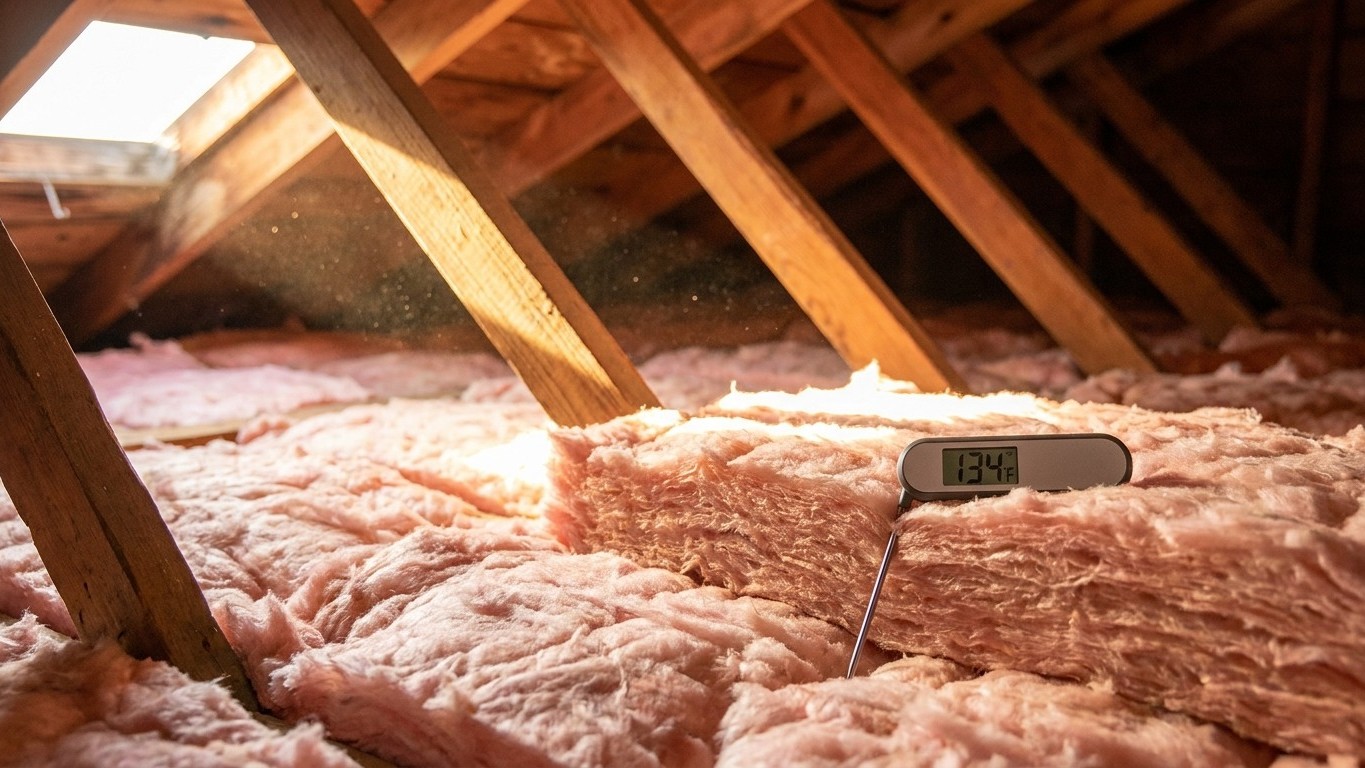

Yes, insulation keeps a Pennsylvania home cooler in summer, but the state’s climate means the bigger payoff often comes from the other six months. Pennsylvania sees a moderate number of 90-degree days each year, and its counties split across two building-code climate zones. That split changes which insulation levels make sense and how much weight the summer side of the ledger really carries.
The short answer for Pennsylvania

At the Philadelphia reference station, the average is 24.0 days a year at or above 90 F, according to NOAA’s 1991-2020 Climate Normals. That’s a real stretch of hot weather, enough to strain window units, spike attic temperatures, and push central air conditioners to run for hours at a stretch through July and August. It is not, though, a desert-length summer. Compare it to states where triple-digit heat runs for weeks and the picture in Pennsylvania looks moderate by contrast.
That number matters because it tells you where the insulation dollar does more work. Pennsylvania’s 67 counties fall into two IECC climate zones: 53 counties sit in zone 5A, and 14 counties sit in zone 4A. Zone 5A is generally classified as a cold climate with a moist regime, meaning winter heating demand tends to dominate the annual energy bill in most of the state. The 14 counties in zone 4A, a mixed-humid zone, carry a more even split between heating and cooling loads.
None of this means summer insulation is wasted money here. It means the honest framing is different from what you’d write for a state where 90-degree days number in the dozens per month rather than per year. In the 53 counties sitting in zone 5A, insulation pays for itself mostly through winters that regularly drop well below freezing, with summer savings as a real but secondary benefit. In the 14 counties in zone 4A, the cooling season carries more relative weight, and attic insulation earns its keep in both directions more evenly across the calendar.
The practical takeaway: don’t buy insulation in Pennsylvania purely as a summer cooling strategy. Buy it because the same material resists heat flow whichever direction that heat is trying to move, and in a state with real winters and a real (if shorter) summer, that two-way resistance is what makes the investment worthwhile across the full year rather than for just one season.
What happens above the ceiling
On a sunny July afternoon, a dark asphalt shingle roof can push the attic deck temperature well past what a thermometer reads in the yard below. That heat doesn’t stay trapped in the rafters. It radiates and conducts downward, through the roof deck, across the attic air, and against the top side of the ceiling insulation, then into the living space below if nothing stops it. Anything stored in that attic, any ductwork running through it, and the ceiling drywall itself all sit under that heat load whether the homeowner ever thinks about it or not.
This is the part worth understanding clearly: attic insulation is not a winter-only product that happens to also help in summer. It is a resistance to heat flow, full stop, and heat flow in January runs upward, out of the warm house into the cold attic, while heat flow in July runs downward, from the superheated attic into the cooled house. The same fiberglass, cellulose, or spray foam batt fights both directions. There is no separate “summer insulation” to buy.
ENERGY STAR levels for retrofitting existing homes
Because Pennsylvania’s counties span two zones, no single R-value applies statewide. ENERGY STAR’s recommended retrofit levels for existing wood-framed buildings, by the zone groupings relevant here, break down as follows. The middle column applies if the attic already has 3 to 4 inches of existing insulation; the first column applies if the attic is currently uninsulated. The third column is the floor, not a second attic figure.
| Zone grouping | Attic if uninsulated | Attic if 3-4 inches already present | Floor |
|---|---|---|---|
| Zones 4A and 4B | R60 | R49 | R19 |
| Zones 6, 5, and 4C | R60 | R49 | R30 |
Pennsylvania’s 14 zone 4A counties fall under the first row above; the 53 zone 5A counties fall under the second. The attic target is R60 in both cases, but the floor target differs, and these figures apply to retrofitting an existing home, not to new construction standards. Neither this table nor this page can tell an individual reader which zone their own county sits in. ENERGY STAR publishes that assignment as a map, and confirming it there before buying material is the safer step.
What homes in Pennsylvania cool with
According to the U.S. Energy Information Administration’s 2020 Residential Energy Consumption Survey, 91% of households in Pennsylvania use some form of air-conditioning equipment. Of that group, 54% use a central air-conditioning unit, while 43% rely on individual equipment: a ductless mini-split, a window or wall unit, or a portable unit. Separately, 69% of households use ceiling fans, which don’t cool the air but do make a room feel more comfortable at a higher thermostat setting.
That gap between 91% overall and 54% central is the detail worth sitting with. It means a meaningful share of Pennsylvania households, roughly 37 percentage points of the households surveyed, are cooling one or two rooms at a time with individual equipment rather than conditioning the whole house through ducts. That’s a different insulation conversation. For a household running a central system, the connection to attic insulation runs through the ductwork itself, not just the ceiling above.
Where central air ducts run through an unconditioned attic, and in much of Pennsylvania’s older housing stock that is exactly where they run, those ducts sit inside the hottest space in the entire building envelope. Ceiling insulation slows heat from moving into the rooms below, but it does nothing to stop a supply duct sitting directly in 130-degree attic air from picking up heat before the cooled air ever reaches a register. Sealing and insulating the ducts themselves is a separate project from insulating the attic floor, and skipping it leaves real cooling capacity lost in transit.
For the 43% of households cooling with a mini-split, window unit, or portable, the calculation is simpler and more local: the insulation and air-sealing quality of that one room’s walls, windows, and ceiling determines how hard that single unit has to work. A well-sealed bedroom with a window unit can hold a comfortable temperature on far less run time than a leaky one. Readers using ducted central air can find more on sealing and insulating that specific system in this site’s duct guides, and readers relying on individual equipment will find more detail in the room air conditioner guides.
What the heat asks for that the cold does not
Two products come up specifically in hot-climate insulation conversations, and neither is a universal recommendation for Pennsylvania.
A radiant barrier is a reflective material, usually a foil-faced sheet installed under the roof deck or across the attic rafters, that reflects radiant heat rather than resisting conducted heat the way standard insulation does. It carries no R-value, and technically it isn’t insulation at all. It earns its place specifically under a sun-loaded roof deck in climates with long, intense summers, where reflecting heat before it ever reaches the attic air makes a measurable difference. Given that Pennsylvania’s climate zones lean toward the colder, heating-dominated end of the spectrum, with only 24 days a year above 90 F at the reference station, a radiant barrier is not the priority tool for most homes here. Attic insulation to the levels above does more for a Pennsylvania household’s year-round energy bill than a radiant barrier would.
Vapor movement is the other hot-climate variable, and it works in reverse of what many homeowners expect. In a warm, humid climate, moisture-laden air sits outside the house for much of the year, pushing inward, which is why the model energy code doesn’t require an interior vapor retarder in the country’s warmest, most humid zones. Pennsylvania’s zone 4A and 5A counties don’t fit that warmest-zone profile, and vapor drive here is more mixed across the seasons than in a Gulf Coast climate. This is a detail worth getting right for a specific house rather than settling with a general rule, and readers should check this site’s Pennsylvania vapor barrier page for guidance suited to these zones before deciding whether to install, skip, or remove an interior vapor retarder.
What the work is worth
The U.S. Environmental Protection Agency, through ENERGY STAR, states it plainly: “EPA estimates that homeowners can save an average of 15% on heating and cooling costs (or an average of 11% on total energy costs) by air sealing their homes and adding insulation in attics, floors over crawl spaces, and accessible basement rim joists.” Both figures matter, and both carry their own denominator. The 15% applies specifically to heating and cooling costs combined, while the 11% applies to total energy costs, which includes everything else running through the utility meter.
That combined framing, heating and cooling together rather than one or the other, is exactly why this figure fits a Pennsylvania conversation better than a summer-only number would. A household in one of the state’s 53 zone 5A counties gets most of that 15% from winter heating savings, given how much of the year is spent fighting cold rather than heat. A household in one of the 14 zone 4A counties sees a more even split between the two seasons. Either way, the estimate covers both, not one alone.
Two caveats matter before treating this as a personal promise. First, it’s an average drawn from energy modeling of a typical existing U.S. home, not a guarantee for any specific house with its own age, air-sealing condition, and duct layout. Second, the sentence names exactly where this modeled work happened: attics, floors over crawl spaces, and accessible basement rim joists. It doesn’t extend to wall insulation, replacement windows, or new doors, and stretching the figure to cover those upgrades isn’t supported by the source. For a Pennsylvania home, that means attic work and rim joist sealing are the two projects the published number actually describes, and they’re a reasonable place to start regardless of which side of the state’s zone line a particular county falls on.