
Yes, Insulation cuts summer heat in Colorado, but how much it matters depends on where in the state you are. Denver’s reference station logs 39.6 days a year above 90°F, a real but moderate cooling season, while the state’s mountain counties barely see that kind of heat at all. Insulation still works both ways, though the payoff tilts differently county by county.
The short answer for Colorado

Insulation slows heat moving into the house in summer the same way it slows heat leaking out in winter, and for most of Colorado that summer job is real but not the dominant one. At the Denver reference station, NOAA’s 1991-2020 climate normals put the average at 39.6 days a year reaching 90°F or higher. That’s roughly five to six weeks of genuine heat load spread across a summer, concentrated from June through August, not a four-month furnace like you’d find in the Gulf states.
What makes Colorado different from a straightforward “hot state, insulate for summer” story is the climate zone map underneath it. The 2021 IECC assigns this state’s 64 counties across four separate zones: 34 counties sit in zone 5B, 13 in zone 7, 12 in zone 6B, and 5 in zone 4B. That’s a genuine four-way split, not a rounding error. Zone 7 counties, mostly the high mountain interior, are cold-dominated territory where the heating bill dwarfs any summer concern. Zone 4B counties, generally lower and warmer, lean closer to a state where summer cooling earns real attention. Zones 5B and 6B sit in between.
None of this means Insulation is optional for the cooler counties. It means the emphasis shifts. In a zone 7 county, the case for insulation is built on winter heating loss first, with summer comfort as a secondary benefit. In a zone 4B county, especially somewhere that regularly clears 90°F, the attic’s role in keeping the house livable in July becomes closer to equal footing with its winter job. Neither camp should assume the other’s answer.
This is exactly why a single blanket statement doesn’t serve every Colorado household the same way. A rancher outside Grand Junction and a homeowner in a mountain valley near the Continental Divide are dealing with different climates under the same state name. The 39.6-day figure describes the Denver station, and it’s a reasonable stand-in for the Front Range corridor where most of the state’s population lives, but it isn’t a promise about a specific county. Anyone deciding how hard to lean into summer-focused improvements should start by checking which of the four zones their own county falls into, since that number is what actually drives the insulation math, not a statewide average.
What happens above the ceiling
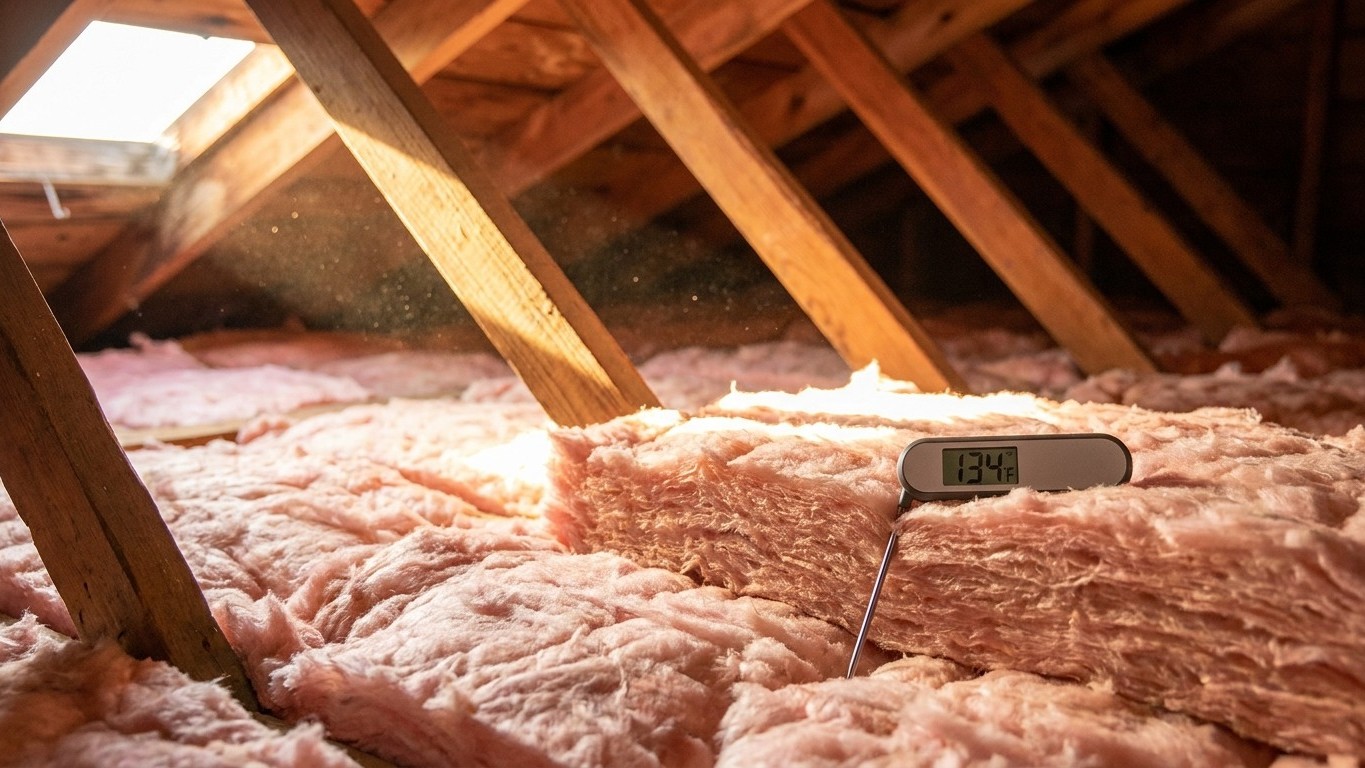
An attic under direct summer sun behaves nothing like the outdoor air around it. Roofing material absorbs solar radiation all day, and the wood deck beneath it can run 40 to 60 degrees hotter than the ambient air temperature by mid-afternoon. That superheated air sits directly above the ceiling of every room below, above any ductwork routed through the attic, and above anything stored up there. Without a real barrier to heat flow, that heat works its way down into the living space, and an air conditioner ends up fighting a battle it didn’t need to fight.
The insulation that resists that downward heat flow in July is the identical material doing the winter job of keeping furnace heat from escaping upward. It isn’t a seasonal product that gets swapped out. Insulation resists heat flow in whichever direction the heat happens to be moving, and in summer that direction is down through the ceiling into the house. That’s the single most useful fact in this whole topic: there’s no such thing as “summer insulation” versus “winter insulation.” It’s the same fiberglass, cellulose, or foam, doing the same resistance job, regardless of which way the thermometer is pointing.
ENERGY STAR’s retrofit guidance for existing wood-framed homes gives specific target levels by climate zone, and because Colorado’s counties fall across three of those zone groupings, it’s worth laying out each one rather than picking a single number:
| Zone | Attic (if uninsulated) | Attic (if you already have 3-4 inches) | Floor |
|---|---|---|---|
| Zones 4A and 4B | R60 | R49 | R19 |
| Zones 6, 5, and 4C | R60 | R49 | R30 |
| Zones 7 and 8 | R60 | R49 | R38 |
Colorado’s zone 4B counties fall in the first row, zones 5B and 6B fall in the second, and zone 7 counties fall in the third. These are retrofit recommendations for existing homes, not new-construction code minimums, and ENERGY STAR publishes the zone map separately rather than as a county list, so the right move is to check that map or a county-level table before buying material. Guessing the wrong row means buying either too little insulation for the winter load or paying for more than a summer-only need would justify.
What homes in Colorado cool with
Insulation doesn’t cool a house by itself. It works alongside whatever equipment is actually running, and the EIA’s Residential Energy Consumption Survey shows what that equipment looks like across households. Of homes surveyed, 82% use some form of air-conditioning equipment, but only 57% run a central air-conditioning system. The remaining 20% rely on individual equipment: a ductless mini-split, a window or wall unit, or a portable unit. Separately, 72% of homes use ceiling fans, which don’t cool the air but do move it, cutting the perceived need for mechanical cooling on milder days.
That gap between 82% overall and 57% central is the detail that actually connects to insulation. In a home with central air and ductwork routed through the attic, those ducts sit inside the hottest space in the entire building, absorbing heat before the cooled air ever reaches a supply register. Ceiling insulation slows heat from moving into the attic and down through the ceiling, but it does nothing to protect ducts already sitting in that superheated space. That’s a separate repair, generally duct sealing and duct insulation, and it’s worth checking this site’s duct guides for what that job involves.
For the 20% running window units, wall units, or mini-splits, the calculation is different. Those systems cool one room or a small zone directly, so what matters is the envelope of that specific space, not the whole-house attic. A well-insulated ceiling and walls around a window unit reduce how hard that single unit has to work, and the site’s room air conditioner guides cover sizing and placement for exactly that scenario. Both paths lead back to insulation, just through different rooms of the house.
What the heat asks for that the cold does not
Two products belong specifically to hot-climate construction, and neither is standard insulation, so they deserve separate treatment rather than getting folded into the attic R-value conversation.
A radiant barrier is a reflective material, usually foil-faced, installed to reflect radiant heat away from the roof deck rather than resist conducted heat the way fiberglass or cellulose does. It carries no R-value at all, because it isn’t insulating in the traditional sense, and it only earns its keep under a roof that’s absorbing serious solar radiation for long stretches of the day. Given that Colorado’s summer heat load, measured at 39.6 days above 90°F at the Denver station, is real but moderate, and given that a substantial share of the state’s counties sit in cold-dominated zone 7 territory, a radiant barrier isn’t the default recommendation here the way it would be for a desert Southwest home baking under near-daily triple-digit sun. For a lower-elevation zone 4B or 5B home with a genuinely sun-loaded roof, it can make sense as a targeted add-on. For a mountain-zone home where winter heating dominates the energy bill, it’s not the tool the house needs.
Vapor movement is the second hot-climate-specific issue, and it works in reverse of what most people expect from a cold climate. In a warm, humid climate, moisture-laden air pushes inward from outside, which is exactly why the model energy code doesn’t require an interior vapor retarder in its warmest zones, the logic runs backward compared to a northern winter. Colorado’s zones don’t fit the warm-humid category the code is describing, and getting vapor direction wrong in the wrong assembly causes real moisture problems, so this is a topic worth settling on this site’s dedicated vapor barrier page for the specific territory in question rather than deciding it in passing here.
What the work is worth
ENERGY STAR’s published estimate on this is specific enough to quote directly rather than paraphrase: “EPA estimates that homeowners can save an average of 15% on heating and cooling costs (or an average of 11% on total energy costs) by air sealing their homes and adding insulation in attics, floors over crawl spaces, and accessible basement rim joists.”
Both numbers matter, and they’re answering different questions. The 15% applies specifically to heating and cooling costs combined, not to the whole utility bill. The 11% applies to total energy costs, a broader denominator that includes water heating, appliances, and everything else running on a home’s energy account. Neither number stands alone without its denominator, and quoting one without the other turns an accurate figure into a misleading one.
The detail worth sitting with is that this figure covers heating and cooling together, as a combined effect, not a winter saving that happens to carry over into summer as an afterthought. That’s the whole point of asking whether insulation matters for Colorado summers in the first place: the same improvement that lowers a January heating bill is doing measurable work in July too, and ENERGY STAR’s modeling treats both seasons as part of one number rather than two separate stories.
These figures come from energy modeling of a “typical” existing U.S. home, an average across a broad sample, not a guarantee for any specific house in Denver, Grand Junction, or a mountain valley in zone 7. The work covered by the estimate is also specific: attics, floors over crawl spaces, and accessible basement rim joists. It says nothing about walls, windows, or doors, and stretching the percentage to cover those upgrades isn’t supported by the source. There’s no price attached to this figure and no federal tax credit tied to it either, since the 25C residential energy credit closed at the end of 2025. What’s left is the plain modeling result: air sealing and insulation in those three areas, averaged across a typical home, working on both ends of the thermostat.