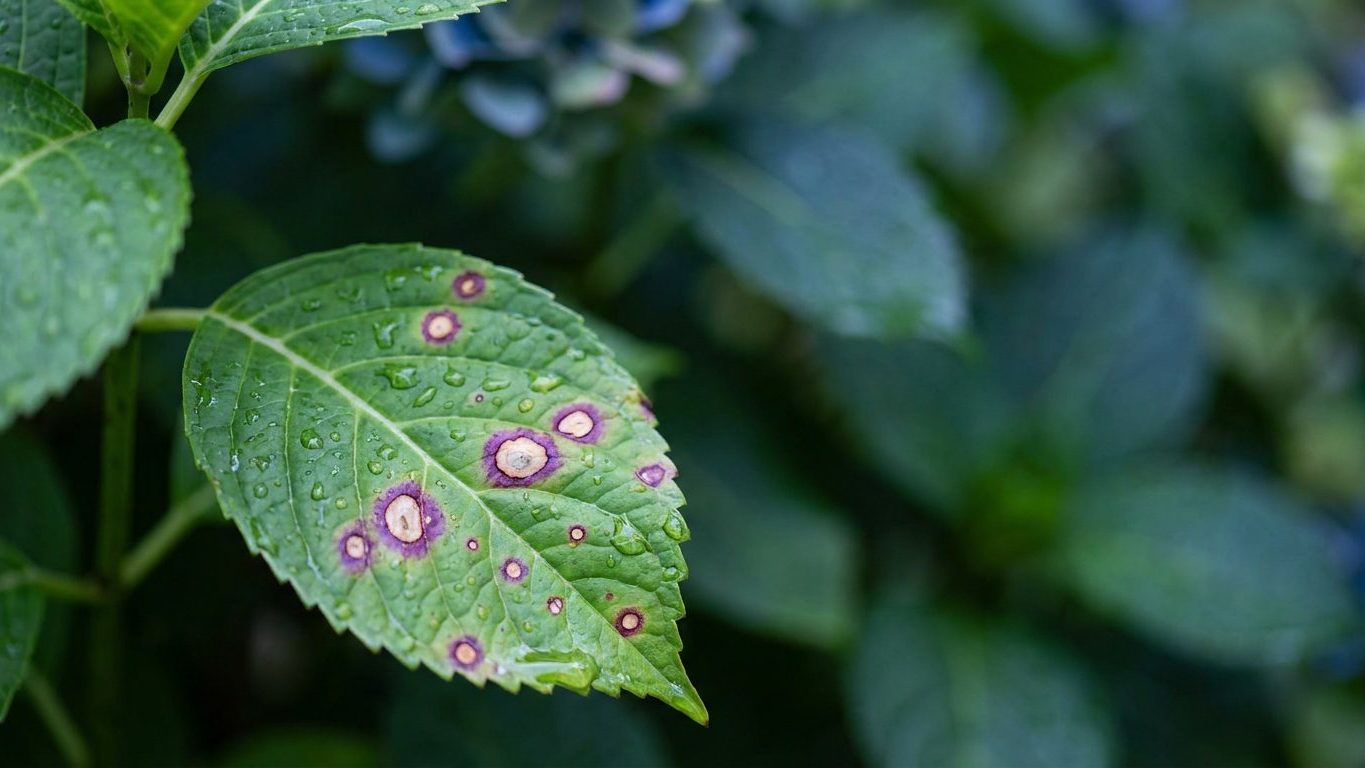

The direct answer: spots that appear first on the lowest, oldest leaves, ringed in purple or reddish-brown with a tan or gray center, and that work their way up the plant over several weeks, describe fungal leaf spot. It disfigures a hydrangea. It rarely kills one. And it almost never calls for anything stronger than sanitation and better airflow.
What you are looking at
This is cosmetic damage, not a plant emergency. It moves in weeks, not days, and a bigleaf or mountain hydrangea can carry a moderate case for an entire season and still bloom. What gives it away is the direction: it starts low and climbs, rather than appearing scattered across the whole canopy at once or hitting the newest growth first.
Early spot on a lower leaf
The first lesion shows up on one of the oldest leaves near the base of the stem, the ones shaded by the rest of the plant and slowest to dry after rain or watering. It starts as a small circular or slightly angular spot, reddish-brown to purple, no bigger than a pencil eraser. The center hasn’t collapsed yet. There’s no powdery coating, no wilting around it, just a discrete discolored dot on otherwise green tissue.
Spot enlarging with the purple ring
Given a week or two of humid weather, that dot widens into a circle a quarter- to half-inch across. The center fades to tan or pale gray as the tissue inside the ring dies, while the outer edge stays a distinct purple or maroon band, sometimes described as a halo. Several spots on one leaf often merge into an irregular blotch with a scalloped edge. On close inspection the center may show faint concentric rings, like a target, or tiny dark specks where the fungus is producing new spores.
Leaves dropping from the bottom up
Heavily spotted leaves yellow around the lesions, then drop, and because the disease started at the bottom, defoliation follows the same order: the lowest leaves go bare first, leaving a hydrangea that looks fine at the top and stripped at the base. Stems themselves stay unaffected, and the flower heads keep their color and shape even on a plant that has lost half its lower foliage.
What it is not
Two other problems get mistaken for this one, and mixing them up means treating the wrong thing while the real issue keeps going.
Powdery mildew
Powdery mildew shows up as a white to gray, flour-like dusting on the leaf surface, sometimes the underside too, and it isn’t confined to older leaves or to the bottom of the plant. It can appear on new growth just as easily as old, and it rubs off on a finger like chalk. There’s no purple ring, no tan center, no discrete lesion at all, just a felted coating over the leaf. Treating a leaf-spot case as powdery mildew means reaching for the wrong product and leaving fallen, infected leaves in place, which is exactly what lets leaf spot rebuild its population for next year.
Bacterial wilt
Bacterial wilt doesn’t spot the leaf at all. Leaves droop and collapse while still mostly green, often on one side of the plant or one stem at a time, and the giveaway is inside the stem: slice a wilting stem crosswise and look for a brown or discolored ring in the vascular tissue just under the bark. That ring means the plant’s water-conducting system is compromised, and there is no fungicide or leaf removal that fixes it. Mistaking this for leaf spot costs a gardener the season spent stripping leaves off a plant whose real problem is inside the stem, where nothing topical reaches it.
Rust, on panicle hydrangea
On H. paniculata specifically, rust produces small orange to rust-colored pustules on the leaf underside, powdery enough to leave orange dust on a finger run across them. Leaf spot’s lesion stays flat and dry, with that purple ring, never a raised powdery pustule. Rust also tends to show up on upper and lower leaves alike rather than following the strict bottom-up pattern that marks leaf spot.
Where it comes from and when it strikes
Fungal leaf spot survives between seasons in fallen leaf debris and in infected tissue left on the plant, which is one reason the disease reappears in the same spot year after year if that litter isn’t cleared. Spores spread mainly by splashing water, rain hitting the soil or old leaf litter and bouncing droplets up onto the lowest leaves first, which is exactly why those leaves get hit before anything higher on the plant. It’s a short-range traveler, not a wind-borne one covering long distances, so a single infected shrub tends to seed itself and its immediate neighbors rather than jumping across a yard.
The weather that lets it take hold is warm and humid, with long stretches where leaves stay wet, whether from rain, dew, overhead irrigation, or heavy morning fog. Extended leaf wetness is the universal threshold fungal leaf spot pathogens rely on; the exact hours vary by species and aren’t published here as a fixed figure, but the pattern holds everywhere the genus is grown, from a shaded bigleaf hydrangea in the Southeast to a panicle type planted in full sun further north. Dense plantings with poor airflow extend that wet period by slowing evaporation, which is why crowded, shaded hydrangeas tend to show the worst cases.
What to do about it now
Pull off and destroy any leaf carrying spots, and rake up Everything that’s already dropped at the base of the plant. Don’t add either to a compost pile that won’t get hot enough to kill the fungus; bag it or dispose of it away from the garden. That single step, removing the infected tissue the fungus needs to survive the winter, does more to change next year’s outcome than any spray applied now.
After that, stop wetting the foliage. Switch from an overhead sprinkler to drip irrigation or a soaker hose at the base, and water in the morning if a hose is the only option, so leaves dry out during the day rather than sitting wet overnight. A two- to three-inch layer of mulch under the plant cuts down on the splash that carries spores up from the soil in the first place.
Pruning for airflow helps too, but the right timing depends entirely on which type of hydrangea is planted and which zone it’s growing in, since bigleaf and mountain hydrangeas set next year’s flowers on the current wood while panicle and smooth types bloom on new growth. That distinction isn’t optional information; get it from the pages specific to your hydrangea type before cutting anything. Fungicide is rarely necessary for a home planting with moderate spotting; it’s worth considering only where the same shrub has lost significant foliage for several years running. There’s no harvest to protect here, since hydrangea leaves aren’t eaten, but it’s worth remembering that bigleaf hydrangea (only that type) is documented toxic in large quantities to pets, horses, and people, so gloves are a reasonable precaution when clearing out a pile of stripped leaves.
Keeping it out next season
Sanitation carries most of the weight against this disease. Raking up and destroying fallen leaves every autumn, rather than letting them sit under the shrub over winter, removes the fungus’s main overwintering shelter. How many years the pathogen can persist in soil or residual debris under specific conditions isn’t a figure published here, so treat sanitation as an every-season habit rather than a one-time fix with a known expiration date.
No specific leaf-spot-resistant cultivar codes are documented in the source used for this guide, so don’t expect a catalogue tag that guarantees immunity. What does help is buying clean stock from a reputable nursery and inspecting leaves for spotting before it ever comes home, since hydrangeas propagate readily from stem cuttings and layering (panicle types also from seed), and an infected cutting brings the problem with it.
Spacing plants so air moves freely between them, and pruning according to the schedule that matches the specific type planted, both shorten how long leaves stay wet after rain. Mulch renewed each spring keeps acting as a splash barrier between soil-borne spores and the lowest leaves, which is where this whole cycle starts over.
Common questions
Will leaf spot kill my hydrangea?
On its own, no. It’s a cosmetic and stress-inducing disease that reduces leaf area and can weaken a plant over several bad seasons in a row, but it doesn’t girdle stems or attack the vascular system the way bacterial wilt does. A hydrangea can lose its lower leaves to this fungus for years and still flower.
Can I still enjoy the blooms on a plant with leaf spot?
Yes. The flower heads aren’t affected by this fungus, and there’s no toxicity concern tied to the disease itself. The only toxicity to keep in mind applies to bigleaf hydrangea specifically, and only in large quantities eaten by pets or people, which has nothing to do with whether the plant has leaf spot.
Does the purple ring mean something different from a plain brown spot?
The purple or reddish-brown margin is one of the clearest identifying marks of this fungal leaf spot, distinguishing it from powdery mildew’s white coating and from the vascular browning seen in bacterial wilt. A plain brown spot with no ring and no consistent bottom-up pattern is worth a second look against those other conditions before assuming it’s the same disease.
Should I prune off the lower branches to stop the spread?
Removing visibly spotted leaves helps, but wholesale pruning of lower branches should follow the timing rules for the specific hydrangea type planted, since cutting at the wrong time on a bigleaf or mountain hydrangea removes next year’s flower buds along with the diseased foliage. Check the guidance for your type and zone before reaching for the shears.