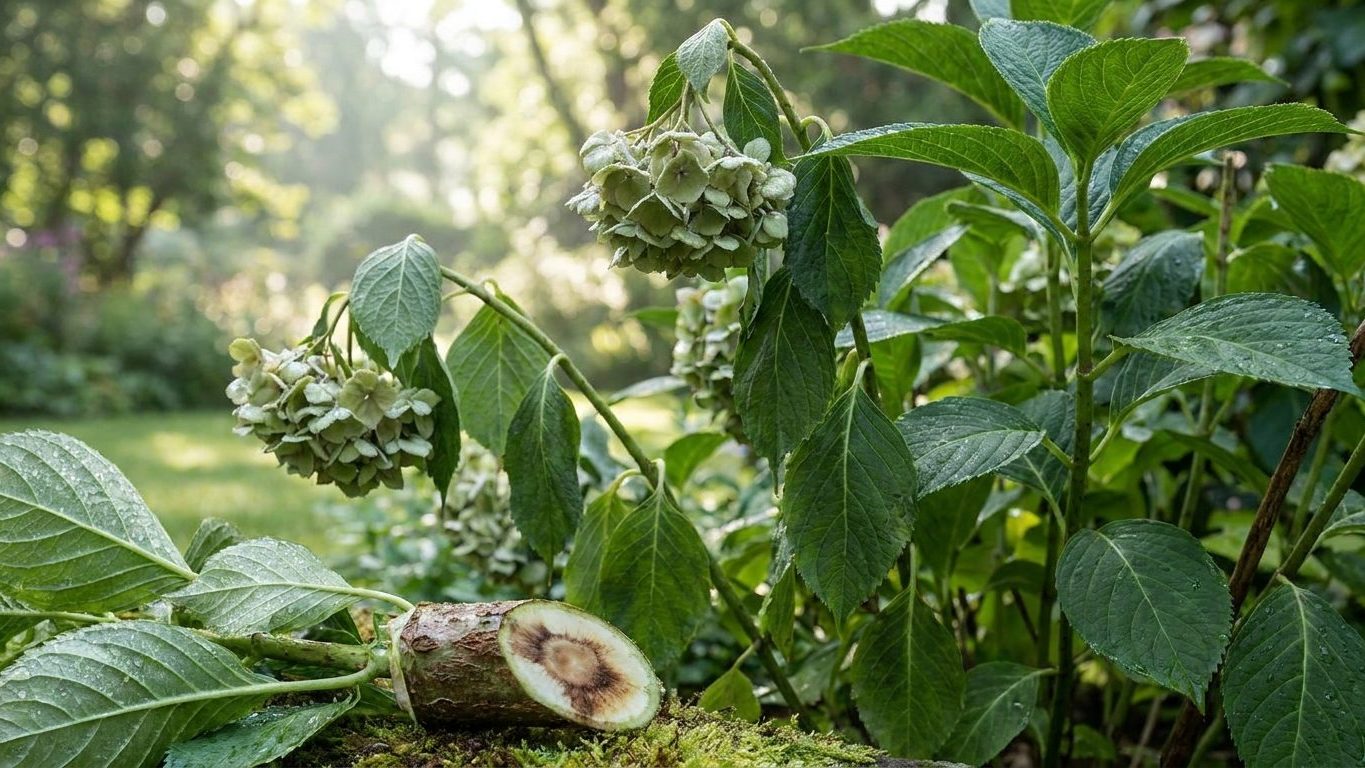

A hydrangea that looks fine on Monday and hangs limp by Wednesday, with leaves still green but stems suddenly unable to hold themselves up, is showing the classic signature of bacterial wilt. It is serious, it does not reverse, and once the vascular tissue is colonized the clock is already running.
What you are looking at
The tell is speed. A fungal leaf spot creeps for weeks; bacterial wilt can take a stem from upright to collapsed in a few days once the weather turns warm and wet. The leaves usually stay green, or only pale slightly, which throws people off because a wilting plant with green foliage does not look like a disease problem at first glance.
Sudden drooping of one or several stems
Look for individual canes that hang over as if the plant were dying of thirst, while neighboring stems on the same shrub still stand fully turgid. The droop is limp and total along the stem, not a curling or twisting of individual leaves.
Leaves that wilt without spotting
The foliage on an affected stem goes dull and soft, sometimes with a slightly grayish or bronzed cast, but without the ringed brown lesions or yellow halos typical of a fungal leaf disease. There is no powdery coating either. The leaf simply loses its ability to hold water.
Discoloration inside the cut stem
Slice through a wilted stem near the base and look at the cut face. A stem killed by bacterial wilt often shows a brown or tan ring or streaking just under the bark, in the water-conducting tissue, rather than a clean white cross-section. This is the single most useful field check available without a lab.
Downward collapse from the growing tip
Once a stem is affected, wilting typically spreads from the younger growth down toward older wood over a matter of days, rather than starting at the base and climbing. On a shrub with multiple stems, expect the disease to move from cane to cane rather than uniformly across the whole plant at once.
What it is not
Three other problems produce a wilted hydrangea, and mixing them up leads to the wrong response, whether that means ripping out a plant that only needed water or, worse, watering a plant that needed to come out of the ground entirely.
Heat or drought stress
A hydrangea that wilts hard in the afternoon sun and looks completely recovered by the next morning is dealing with moisture stress, not disease. The visual difference is timing: drought wilt is reversible overnight once the soil is watered or the temperature drops, while bacterial wilt does not bounce back regardless of how much water is applied. Treating true bacterial wilt as drought means the gardener keeps irrigating a plant that is actually spreading infected sap through its own vascular system, which can make things worse rather than better.
Root or crown rot
Waterlogged, poorly drained soil rots roots directly, and the aboveground wilting that follows can look identical to bacterial wilt from a distance. Pull gently at the base of a wilted stem: with root rot, the plant lifts easily because the roots have gone soft, dark, and mushy, often with a sour smell. With bacterial wilt, the roots below ground are frequently intact and firm, because the damage is happening in the stem tissue above, not in the root system. Mistaking rot for bacterial wilt means a gardener might waste effort trying to sanitize stems when the fix was actually drainage.
A fungal vascular wilt
Fungal wilts that clog the water-conducting tissue can also cause sudden collapse and a discolored ring inside a cut stem, so this is the closest look-alike of the three. The distinguishing field test used by growers for bacterial wilts generally: cut a suspect stem and suspend the cut end in a glass of clear water for a few minutes. A cloudy, milky strand of bacterial ooze streaming out of the cut surface points to bacteria; a clean release with no streaming points toward a fungal cause instead. The distinction matters because the sanitation response, tool cleaning, and disposal urgency differ between the two, even though neither one is curable once established.
Where it comes from and when it strikes
Bacterial wilt organisms generally survive between seasons in the soil, in plant debris left in the bed, or inside infected transplants brought in from a nursery. They do not travel on the wind the way a fungal spore does. Instead they move short distances through splashing water, contaminated pruning tools, and root-to-root contact in crowded plantings, entering the plant through wounds, insect damage, or natural openings at the root or stem base.
Once inside, the bacteria multiply within the water-conducting tissue and physically block it, which is why the wilting is sudden and why watering more does not help. Warm, humid conditions with extended periods of leaf and soil wetness favor this kind of infection, because moisture is what allows bacteria to move through the soil and into a wound in the first place. A stretch of hot days following heavy rain, exactly the combination that also stresses a plant’s defenses, is when bacterial wilt symptoms tend to appear seemingly overnight.
Nematodes and other soil pests that wound roots can open the door for the bacteria to get in, which is one more reason healthy, undisturbed root systems resist infection better than roots that have already been chewed or damaged.
What to do about it now
There is no cure once bacterial wilt has taken hold in a stem’s vascular tissue. Saying that plainly is more useful than suggesting a spray or feed that will not reverse it. The realistic goal is containment, not recovery of the affected stem or plant.
Remove and destroy any stem showing the collapse and internal discoloration described above, cutting well below the visible symptom into apparently healthy tissue, and take the material off the property rather than composting it, since home compost piles rarely get hot enough to kill the bacteria reliably. Disinfect pruning tools between cuts, since a contaminated blade is one of the easiest ways this disease moves from one stem, or one plant, to the next.
Switch from overhead watering to drip or soaker-hose irrigation at the base of the plant, since wetting the foliage and lower stems is exactly the splash mechanism that spreads the bacteria. Thin out crowded stems to improve airflow so the base of the plant dries faster after rain, and apply a layer of mulch to reduce soil splashing onto the lower stems during storms.
Hydrangeas are ornamental shrubs, not a food crop, so there is no harvest to weigh against the disease. The one edibility note that does apply here: bigleaf hydrangea (H. macrophylla) is documented as toxic if large quantities of bark, flowers, leaves, or stems are eaten, a concern for curious pets and children handling plant debris, regardless of whether bacterial wilt is present.
Keeping it out next season
Avoid replanting a susceptible hydrangea in the exact same spot where bacterial wilt killed a stem or a whole shrub; giving the soil several years before reintroducing a hydrangea there reduces the odds of the surviving bacterial population finding a new host immediately. This matters more in beds where multiple Hydrangeas share the same soil and root zone.
No widely marketed hydrangea cultivar carries a documented resistance rating specifically against bacterial wilt, the way disease-resistant vegetable varieties carry letter codes on a seed packet. The more reliable path is cultural: well-drained soil, since standing water stresses roots and creates the wounds bacteria exploit, and adequate spacing between shrubs so each plant dries out fully after rain instead of staying damp against its neighbor.
Sanitize stakes, cages, and any tool that touches multiple stems or multiple plants, since these carry bacterial residue between one growing season and the next. A fresh layer of mulch each year continues to act as a splash barrier, keeping soil-borne bacteria from reaching the lower leaves and stem wounds during heavy rain.
Buy transplants from a nursery source with visibly healthy stock, since infected transplants are one of the primary ways this disease arrives in a home landscape in the first place. Because pruning timing depends entirely on whether a hydrangea flowers on old wood or new wood, and that answer differs by type (bigleaf and mountain hydrangeas on one schedule, panicle and smooth hydrangeas on another), check the guidance for the specific type in the garden before cutting anything back, rather than following one blanket rule for every hydrangea in the bed.
Common questions
Can a hydrangea recover from bacterial wilt on its own?
No. Once the vascular tissue inside a stem is colonized and blocked, that stem will not recover regardless of watering, feeding, or time. The realistic response is removal of the affected wood, not waiting to see if it improves.
Does bacterial wilt spread to other plants in the yard?
It can, through soil splash, shared irrigation water, contaminated tools, and root contact between closely spaced plants. It does not spread on the wind the way many fungal diseases do, which is why sanitation and spacing matter more than fungicide-style treatments here.
Is it safe to compost a hydrangea removed for bacterial wilt?
Home compost piles typically do not reach temperatures reliable enough to kill soil-borne bacteria, so removed material is better bagged and disposed of off the property rather than added to a compost bin that will later go back into the garden.
Will a fungicide help against bacterial wilt?
No. Fungicides target fungal pathogens and have no effect on bacteria. Reaching for one wastes time that would be better spent removing infected stems and switching to base-level watering to slow further spread.