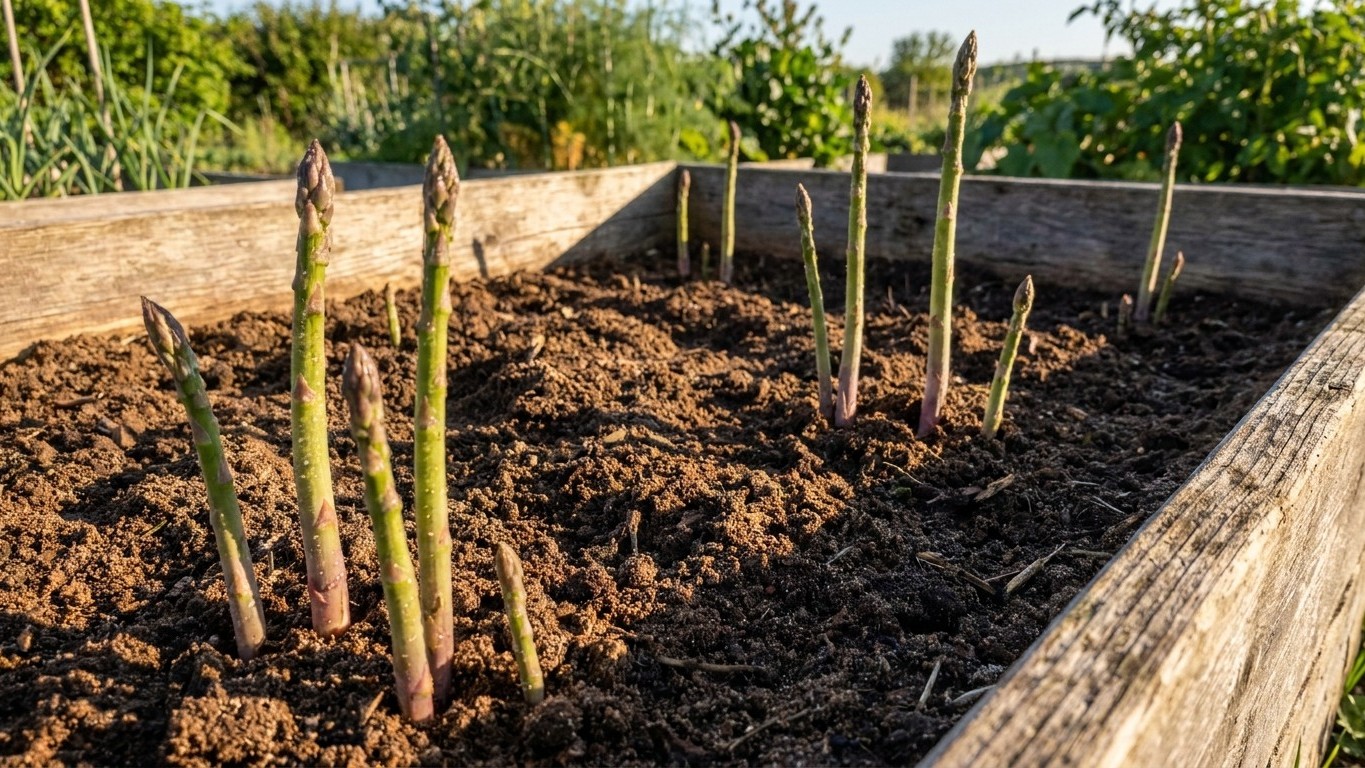

Colorado State University Extension documents ten garden pests common enough across the state to warrant identification sheets, but only five of them ever reach an asparagus bed. Cutworms, seedcorn maggots, flea beetles, grasshoppers, slugs, and spider mites are the ones that matter here, and they show up on a schedule tied to the region’s last spring frost rather than to a fixed month. The other five on the state’s list stick to different crops entirely.
Which pests attack asparagus in Colorado

Colorado State University Extension keeps identification records on ten pests found in home gardens across the state: corn earworm, cutworms and seedcorn maggots, flea beetles (Phyllotreta and Epitrix spp.), grasshoppers (Melanoplus spp.), harlequin bug, slugs, spider mites (Tetranychus urticae), spotted cucumber beetle, squash bug (Anasa tristis), and tomato/potato psyllid. That’s a statewide list, not a crop-by-crop one, and it needs sorting before it means anything for a bed of asparagus.
Five of the ten have essentially nothing to do with asparagus. Corn earworm targets corn ears and tomato fruit, not fern-like foliage. Harlequin bug feeds almost exclusively on cabbage-family plants. Squash bug is a cucurbit specialist, found on squash and pumpkin vines. Tomato/potato psyllid works nightshades, meaning tomatoes, potatoes, and peppers. Spotted cucumber beetle sticks mainly to cucurbit blossoms and corn silk. All five are real, documented Colorado garden pests. None of them belong on a list of asparagus problems.
That leaves five species that can plausibly reach an asparagus planting: cutworms and seedcorn maggots, flea beetles, grasshoppers, slugs, and spider mites. Cutworms sever young growth at the soil line, and seedcorn maggots tunnel into planted material below ground, both a genuine risk to crowns that go into the ground in furrows only 8 inches deep. Flea beetles chew small round holes in soft new growth, ferny top growth included. Grasshoppers are generalist feeders that strip almost any green tissue once their preferred grasses dry out. Slugs work at night on tender emerging spears where soil stays damp. Spider mites colonize the fine, needle-like foliage of established fern, where their webbing is easy to overlook until the plant looks dusty and off-color.
The rule that decides most of this: check what else the insect is feeding on before blaming the asparagus. A grasshopper on the fern and a grasshopper stripping the neighboring bean row are the same insect doing the same thing everywhere green tissue is available; a squash bug on the same bed is a visitor passing through, not a threat to the crop itself.
When each one shows up, and what it does first
The reference station behind these growing-season figures puts the last spring frost between May 1 and May 11, and that window sets the pace for Everything that follows. Crowns go into their furrows in early spring, right around that frost date, and the earliest risk arrives before the fern has even broken the surface. Cutworms sever a young shoot at the soil line overnight, leaving a spear that looks cleanly clipped rather than chewed. Seedcorn maggots work underground during the same stretch, tunneling into the crown itself, so a section of the row simply fails to come up at all.
Once soil warms past that frost window and the first ferny growth appears, flea beetles move in, leaving a scatter of small, round shot holes across the new foliage. Slugs favor the same early, damp period, but they target the tender emerging spears rather than the mature fern, and they leave a slime trail as the giveaway.
Grasshoppers and spider mites both build later in the season, as conditions dry out. The driest summer month, August, averages 1.58 inches of rain, against 1.94 inches in June and 2.14 in July, and that late-summer dry stretch is when both pests tend to peak. Grasshoppers move onto garden fern once their preferred grasses brown off elsewhere in the yard. Spider mites thrive on foliage that’s already stressed by heat and dryness, and an established bed that goes without water through August is the one most likely to show them first, as fine stippling and a faint webbing on the undersides of the fern.
A reader working from a symptom rather than an insect name should match the timing first: damage to a spear or crown right around the frost window points toward cutworms or seedcorn maggots, while damage to established fern late in a dry summer points toward grasshoppers or spider mites.
Telling the damage apart from everything else
Insect damage on asparagus gets confused with several things that aren’t insects at all, and mixing them up wastes a season. The soil series used to represent Colorado, the Seitz series, is well drained with a surface pH around 5.6, slightly acid, but that’s a statewide benchmark, not a reading of any particular garden. Pale, slow-growing fern can come from soil chemistry as easily as from feeding damage, and a soil test settles that question far better than a guess.
A quick comparison
| What you see | Possible pest | Non-pest look-alike | What settles it |
|---|---|---|---|
| Spear or shoot severed cleanly at the soil line | Cutworms | Frost injury or hoe damage | Curled larva found in the soil right at the base, usually at night |
| Crown fails to emerge at all | Seedcorn maggots | Rot from waterlogged furrow | Digging shows tunneling in the crown itself, not soft, mushy rot |
| Small round holes scattered across new fern | Flea beetles | Hail scarring | Hail tears are irregular and one-time; flea beetle holes keep appearing over days |
| Ragged, stripped fern with no slime | Grasshoppers | Wind-whipped foliage | Insects visible on and around the plant, chewing from the margins inward |
| Slime trail near tender spears after a damp night | Slugs | None; the slime trail is diagnostic | Trail alone is enough to confirm |
| Fine stippling, dusty look, faint webbing on dry fern | Spider mites | Plain drought stress | Webbing under the foliage; drought stress alone shows no webbing |
The single check that matters most before treating anything: look for the insect or its direct sign, not just the damage. A gardener who treats for a pest based on a symptom alone, without finding the insect, slime, or web that goes with it, is often just guessing at a nutrient or water problem instead.
What actually works here, and what is a waste of time
On a growing season this short, timing beats almost anything applied after the fact. A floating cover or simple collar set around newly planted crowns, in place before the fern has a chance to emerge, blocks cutworms and slugs during the exact window when crowns are most exposed, right around the May 1 to May 11 last-frost period. That single physical barrier, removed once the fern is established, handles the earliest and most damaging window with no product involved.
Hand-picking works for grasshoppers on a small planting, and it’s most effective started early, before populations build through the dry part of summer. Shallow traps set at soil level catch slugs overnight without needing any chemical control at all. For spider mites, the most useful move is simply keeping the bed watered through the driest stretch: mites build fastest on stressed, dusty foliage, and letting a bed dry out through an August that averages only 1.58 inches of rain is often what invites them in the first place.
What doesn’t help: spraying anything without first confirming which of the five relevant pests is actually present, since a treatment aimed at the wrong insect does nothing but cost time on a bed that’s meant to produce for 10 to 15 years once it’s established. Flea beetle damage on new fern rarely justifies a broad treatment either, since established plants generally outgrow it. This site doesn’t recommend specific products or active ingredients; what’s labeled and legal for use on asparagus changes, and a county extension office is the only source that stays current on that.
Where to check this for your own county
Everything above comes from Colorado State University Extension, and it describes what’s documented at the state level, not what’s necessarily present in any one garden. Pest pressure varies inside a state as large as Colorado: a bed on the eastern plains and a bed at higher elevation can see completely different timing, and even two gardens in the same town can differ depending on what’s growing nearby.
The next step that actually matters is a call or visit to the county extension office, not a broader search for more pest names. County offices affiliated with Colorado State University Extension can confirm whether a specific pest is active locally, check timing against that county’s actual frost dates rather than the reference station’s, and point to what’s currently labeled for use in Colorado if a treatment turns out to be necessary.
A soil test through the same office is worth doing once, given how long an asparagus bed stays in the ground; sorting out a drainage or fertility issue before a bed is set is far easier than fighting it for a decade afterward.
Common questions
Does asparagus have a pest of its own in Colorado?
Colorado State University Extension’s documented list for the state doesn’t include one; the five pests that reach asparagus here (cutworms, seedcorn maggots, flea beetles, grasshoppers, slugs, and spider mites) are general garden feeders, not asparagus specialists.
When is a new asparagus bed most vulnerable?
In the weeks right around the last spring frost, dated May 1 to May 11 for the reference station, when crowns are freshly planted and cutworms, seedcorn maggots, and slugs can damage growth that hasn’t emerged yet.
Do these pests threaten an established bed the same way?
Less so for the below-ground pests, since a mature crown is harder to sever or tunnel into than a first-year planting, but grasshoppers and spider mites can still damage the fern later in the season, and damaged fern weakens the crown for the following year.
What’s the single best protection for a first-year bed?
A physical barrier, such as a cover or collar, set in place before the fern emerges and removed once it’s established, covers the highest-risk window without needing any product at all.