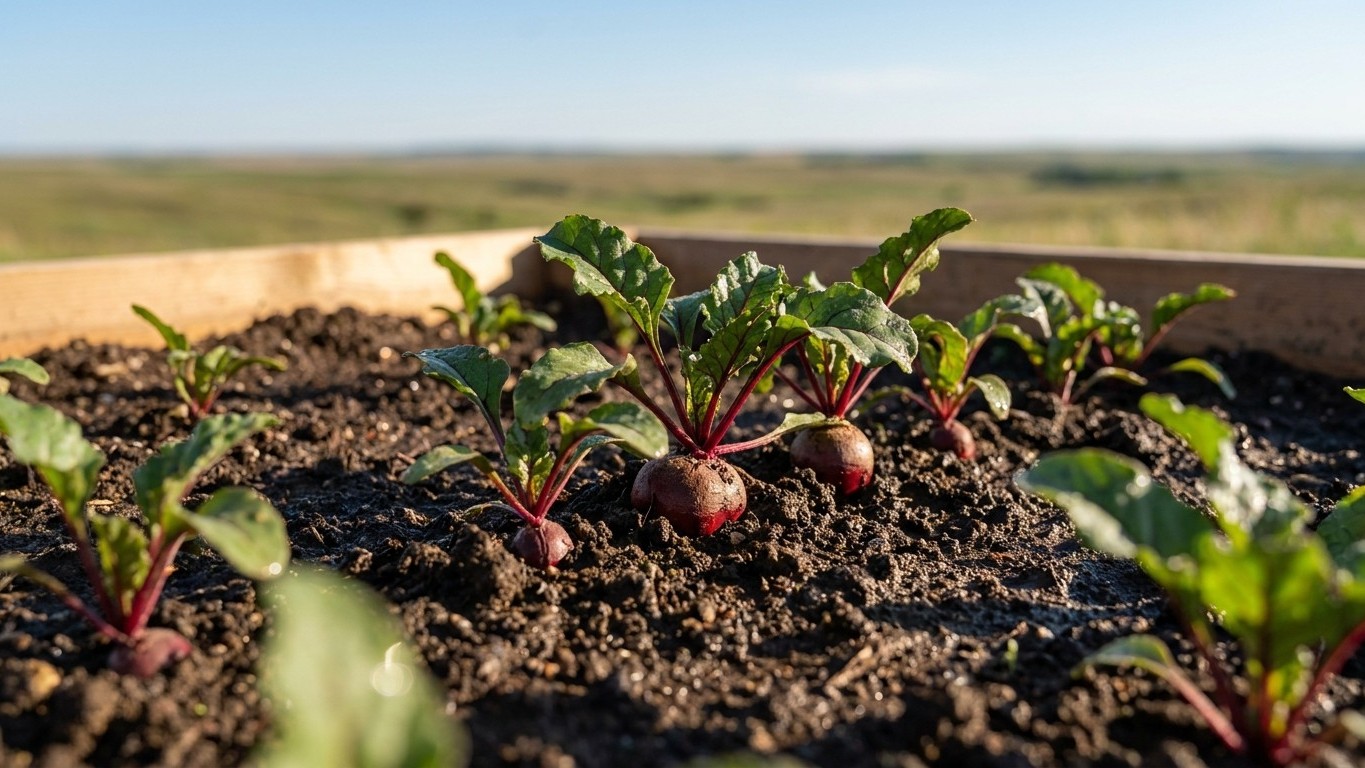

Colorado State University Extension documents ten pest species active in home gardens across the state, and five of them feed on beet: cutworms and seedcorn maggots, flea beetles, grasshoppers, slugs, and spider mites. Each shows up at a different point in the beet’s growth, from the week seed goes into cold spring soil to the stretch of summer heat that follows the region’s short frost-free window. Knowing which one you’re looking at, and when it typically arrives, saves a season.
Which pests attack beet in Colorado

Colorado State University Extension lists ten pests for the state’s gardens: corn earworm, cutworms and seedcorn maggots, flea beetles (Phyllotreta and Epitrix spp.), grasshoppers (Melanoplus spp.), harlequin bug, slugs, spider mites (Tetranychus urticae), spotted cucumber beetle, squash bug (Anasa tristis), and tomato/potato psyllid. Not all of them have any business on a beet row.
Half the list can be set aside. Corn earworm goes after corn ears and tomato fruit, not beet foliage or roots. Harlequin bug is a cabbage-family specialist that targets brassicas like kale and broccoli, and largely ignores beet. Spotted cucumber beetle feeds on cucurbits, beans, and corn silk, not on beet leaves or roots. Squash bug is essentially locked onto squash and pumpkin vines. Tomato/potato psyllid works the nightshade family, tomato, potato, pepper, and rarely touches a beet bed. If you’re seeing damage on beet and one of those five names comes to mind first, look again, because the culprit is probably something else in the garden.
That leaves five documented pests with a real reason to be on a beet plant: cutworms and seedcorn maggots, flea beetles, grasshoppers, slugs, and spider mites. Cutworms and seedcorn maggots target the crop at its most fragile point, the seed and the newly emerged seedling. Flea beetles chew small holes in young leaves. Grasshoppers are generalist leaf feeders that build up as summer goes on. Slugs favor the damp, tender growth of early spring. Spider mites move in during hot, dry stretches later in the season. Five names, not ten, is the list worth watching on a beet crop in this state.
None of this rules out other insects showing up in a Colorado garden bed. It means these five are the ones the state’s own extension research backs for this particular crop, and the rest belong to other rows.
When each one shows up, and what it does first
Beets are direct-seeded, never transplanted, so the clock starts at seeding, not at a nursery start date. Around Denver, the state’s climate data puts the last spring freeze between May 1 and May 11, and that window is the anchor for the whole sequence that follows, even though mountain towns and the western slope run on a different schedule entirely.
The first threat arrives before the seedling is even visible. Seedcorn maggots attack the germinating seed in cool, damp spring soil, and the first sign is a patchy stand, gaps where nothing came up, rather than any visible insect. Cutworms hit right after emergence, in roughly the first two to three weeks, severing tender seedling stems at the soil line overnight, so a healthy row one evening can show toppled seedlings by morning.
Flea beetles typically follow within that same early window, once the first true leaves expand. Their signature is a scatter of small, round shot-holes across the leaf surface, worse on warm, dry afternoons when the beetles are most active and quick to hop away if disturbed.
Slugs work the same early stretch but favor the opposite conditions, cool and damp rather than warm and dry. Ragged holes in seedling leaves, paired with a silvery slime trail, point to slugs feeding at night while the ground is still moist from spring.
Grasshoppers and spider mites both belong to the back half of the season. Grasshopper pressure builds gradually as populations grow through summer, showing up as leaf margins chewed inward in ragged notches, worse once surrounding grass and weeds dry out and hoppers move into irrigated beds. Spider mites show up once real heat sets in. The same beet crop that develops a **woody root once temperatures pass 85 F under water stress** is also the crop where mite populations explode fastest, because hot, dry foliage is exactly what the species favors. Fine stippling on the upper leaf surface, with faint webbing on the underside once numbers build, is the tell.
Telling the damage apart from Everything else
Beet problems that look like insect damage often aren’t. Utah State University Extension notes that water stress in a beet’s first six weeks pushes the plant to bolt, sending up a seed stalk instead of a root, and that heat above 85 F combined with water stress makes the root turn woody and fibrous. Neither of those is pest damage, and neither responds to anything aimed at an insect.
Bolting and woodiness are two separate failures, not one problem with two names. Bolting happens early, from thirst in the first six weeks. Woodiness happens later, from heat layered on top of water stress. Treating them as the same issue, and just watering more, addresses only one of the two.
| Symptom | Possible pest | Common look-alike | What tells them apart |
|---|---|---|---|
| Seeds fail to come up, gaps in the row | Seedcorn maggot | Old seed, cold or waterlogged soil | Dig up an unsprouted seed; maggot damage shows tunneling, rot shows mush with no insect present |
| Seedling stem cut at soil line | Cutworm | Hail, foot traffic, hoe damage | Scratch the soil around the base; a curled larva confirms cutworm |
| Small round holes in young leaves | Flea beetle | Wind-whipped debris, hail | Flea beetle holes are round and clustered; beetles jump when the plant is disturbed |
| Ragged holes plus slime trail | Slug | None close enough to confuse | The slime trail itself is the confirmation |
| Leaf margins chewed inward | Grasshopper | Rabbit or deer browsing | Browsing takes bigger bites higher on the plant; grasshopper notching is finer and scattered |
| Fine stippling, bronze cast, faint webbing | Spider mite | Heat/water stress, nutrient deficiency | Shake a leaf over white paper; moving specks confirm mites, uniform yellowing points to deficiency instead |
A soil test, not a guess, settles anything a table can’t. The state’s representative soil, the Seitz series, runs slightly acid at a surface pH near 5.6 with a loam-to-silt texture, but that’s a statewide reference point, not a reading from any one garden bed, and it says nothing about what’s actually feeding on a specific row.
What actually works here, and what is a waste of time
Colorado’s frost-free season is short enough that timing beats almost anything applied after the fact. A floating row cover set down at the moment beet seed goes into the ground, before the frost-free window even opens in early May, blocks both seedcorn maggot egg-laying and early flea beetle feeding without any product involved. Cover on at seeding, not after the first shot-holes appear, is the difference that matters. Once flea beetles are already established on the leaves, a cover just traps them inside with the crop.
Hand removal works better than most gardeners expect on this short a season. Slugs can be trapped or picked at dusk during the damp early weeks, and grasshoppers, since their numbers build gradually rather than exploding overnight, are manageable by knocking down populations early rather than waiting for a late-summer swarm.
Consistent watering through the first six weeks does double duty. It prevents the bolting Utah State University Extension ties to early water stress, and drought-stressed foliage is also what draws spider mites in the first place, so steady moisture through the hot stretch reduces mite pressure at the same time it protects root quality.
What tends to waste time on a crop this short is any broad, repeated spray schedule started without a specific pest confirmed. This site doesn’t recommend or name products, because what’s labeled for garden use varies by state and changes over time, and only a county extension office can confirm what’s currently approved. Spraying on a calendar rather than in response to an actual sighting burns through a season that’s already tight, and does nothing for a problem that turns out to be woodiness or bolting instead of an insect at all.
Where to check this for your own county
Colorado State University Extension is the source for everything in this list, and its county offices are the next step for anything specific to a particular garden. What’s documented at the state level describes what’s known to occur somewhere in Colorado, not what’s necessarily present in any one yard, and pest pressure shifts noticeably between the Front Range, the western slope, and higher mountain valleys with their own shortened frost-free periods.
A local extension office can confirm a suspected insect from a sample or photo, and can speak to what’s currently approved for use in that county, which this page deliberately does not attempt to cover. The single most useful next step is contacting the extension office for the county where the garden actually sits, before assuming a statewide list applies exactly as written to one backyard bed.
Local timing also varies. A garden at higher elevation than Denver’s official climate station will see its own frost-free window shift later, changing every date discussed above by days or weeks. Anyone unsure how their county’s season compares should ask the local office directly rather than working backward from a statewide average.
Common questions
Do beets in Colorado need a pesticide every year?
Not automatically. Many beet crops in home gardens get through the season with row covers and hand removal alone, especially where seed goes in right at the start of the frost-free window and watering stays consistent through the first six weeks.
Is a chewed beet leaf always a pest?
No. Hail, wind-driven debris, and even foot traffic can tear leaves in ways that look like insect feeding. Round, clustered shot-holes point to flea beetles; ragged tears with no pattern usually point somewhere else.
Woodiness and bolting are also frequently mistaken for pest damage, when they trace back to heat and water stress instead.
Why did my beet seedlings disappear before they even came up?
Gaps in a beet row with no visible seedlings often point to seedcorn maggots feeding on the germinating seed underground, particularly in cool, damp spring soil. Cold or waterlogged soil can cause similar gaps without any insect involved.
Does the same pest list apply everywhere in Colorado?
The list reflects what Colorado State University Extension documents for the state overall. Local conditions, elevation, and microclimate shift which of the five actually shows up in a given garden, so a county extension office remains the best source for what’s active in one specific location.