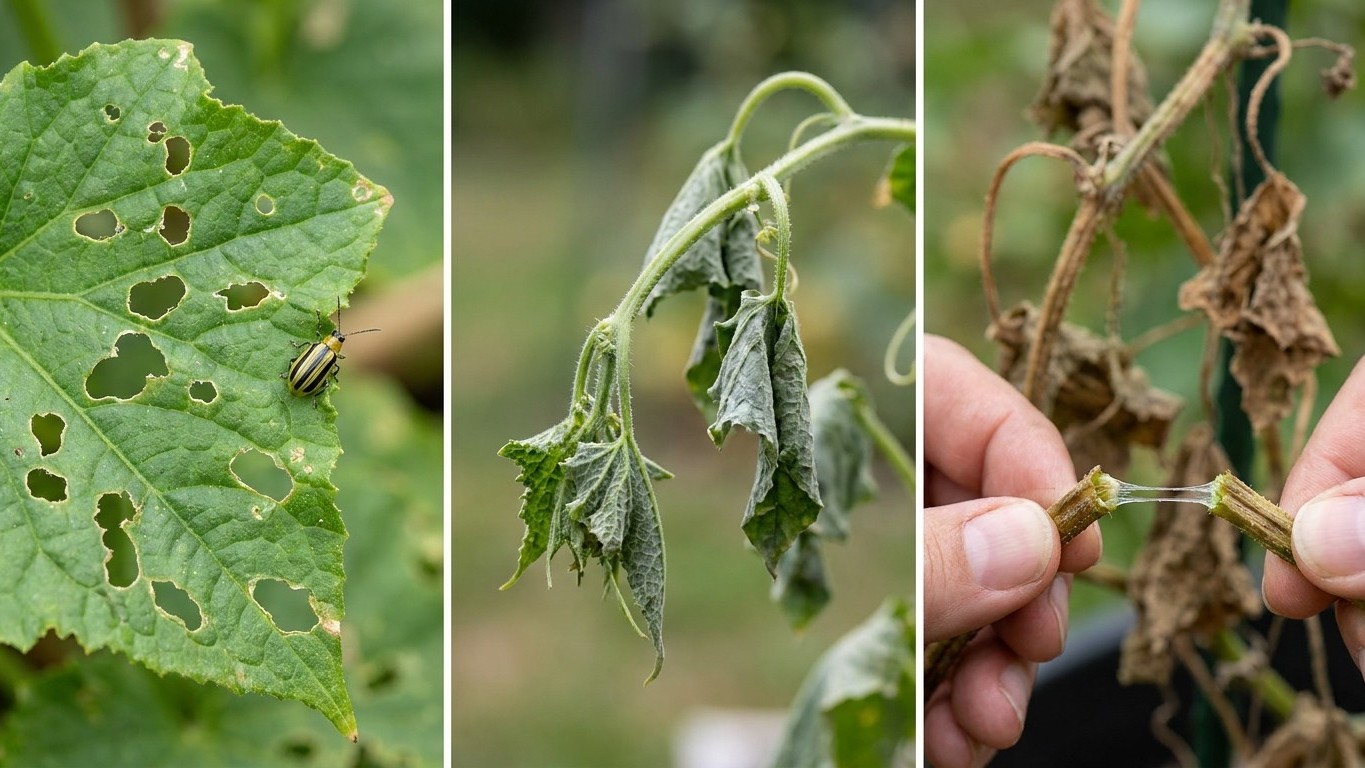

Cucumber beetles chew ragged holes in leaves and gnaw on blossoms, but that’s cosmetic damage a healthy plant usually shrugs off. The real threat travels inside the beetle’s gut: a bacterium that causes wilt, and once a vine is infected, nothing sprayed on afterward reverses it. The chewing is the symptom you notice first. The wilt is the reason the whole plant can collapse by midsummer.
What is actually going on

Both the striped cucumber beetle and the spotted cucumber beetle carry a bacterium called Erwinia tracheiphila in their digestive tract and in their frass. When a beetle feeds on a cucumber leaf or a young stem, it leaves behind wounds contaminated with bacteria, and the plant’s own vascular system does the rest, pulling the pathogen through the tissue that carries water. Within days to a couple of weeks, the bacteria clog that plumbing. A single leaf wilts first, usually at the tip of a runner. Then it spreads backward toward the crown until the whole vine is down, often before a gardener has connected the wilting to a beetle seen a week earlier.
The giveaway, if you want to confirm bacterial wilt rather than drought stress, is to cut a wilted stem near the base and press the two cut ends together, then slowly pull them apart. A thin, sticky thread of sap stretching between the pieces points to the bacterium; a clean break points somewhere else, usually water stress or a root problem. This is a field test, not a lab one, but it’s the one home gardeners actually use.
Why cucumbers specifically
Cucumbers sit near the top of the susceptibility list among cucurbits. Summer squash and pumpkins tolerate the same bacterium far better in most trials, which is part of why a mixed cucurbit bed can look selectively devastated, with cucumber vines down and squash nearby looking fine. Within cucumbers, university trials have found some variation in tolerance between types, but it is not absolute, and it shifts by region and by growing season. Rather than chase a specific cultivar name here, the honest answer is that pickling types, slicing types, burpless types, and both bush and vining growth habits can all get infected, and the types that have shown better field tolerance where you garden are worth asking your state extension office about directly, since that is exactly the kind of local variety trial data a general guide cannot responsibly invent.
Seedlings and young transplants carry the highest risk, both because their tissue is tender enough for beetles to prefer it and because a wilt infection at that stage can take down a plant that hasn’t yet built the root reserves to fight back. A mature, established vine that picks up a light beetle population in August is in a very different position than a two-leaf seedling that gets hit in May. That difference is the entire reason timing matters more here than in most other pest problems.
In the garden
The window that matters most runs from the moment seeds or transplants go into the ground through the start of flowering. Beetles emerging from overwintering sites in spring go looking for the earliest, tenderest cucurbit foliage they can find, and a bare, uncovered seedling bed is exactly what they’re hunting for. What happens at each stage, and what tends to go wrong, breaks down fairly predictably.
| Stage | What to do | What happens if you miss it |
|---|---|---|
| Before seedlings emerge or transplants go in | Have floating row cover or another physical barrier ready to install the same day plants go in the ground | Beetles find the seedlings within the first few days, before the plant has any resistance built up, and the earliest infections tend to be the most damaging |
| Cotyledon to first true leaves | Keep the cover sealed at the edges with soil or pins, and check under it every couple of days for beetles that snuck in before it was closed | A gap at the edge lets a handful of beetles in, and because the cover then traps them with the plant, the damage can be worse than having no cover at all |
| Just before flowering | Remove covers so pollinators can reach the blossoms, and start scouting daily in the cool of the morning when beetles move slowly | Covers left on through flowering block bees along with beetles, and fruit set drops even though the plant looks pest-free |
| Once wilting or beetle feeding appears | Pull and destroy any plant showing the sticky-sap wilt symptom, and reduce beetle numbers around remaining plants through scouting and hand removal or an approved treatment applied to the plant, not the soil | Leaving a wilting plant in place gives beetles a source of already-infected sap to spread to healthy neighbors, turning one loss into several |
Yellow sticky cards set just above plant height help track when beetles arrive in a given season, which matters because the population doesn’t build gradually, it tends to show up in a wave once the weather warms enough. Gardeners who scout daily for that first wave and act on it, rather than waiting until visible chewing damage accumulates, are working with a much smaller, much more manageable problem than gardeners who notice beetles only after several are established. For general planting timing that lines up with this window, the site’s cucumber growing guide is a useful companion to this page.
What it depends on where you are
How bad a cucumber beetle season gets is only partly a matter of what you do in your own garden. Season length changes how many beetle generations can complete in a year, and a longer, warmer growing season generally supports more overlapping generations, meaning pressure builds rather than tapering off after an early spring wave. Summer heat affects how fast the bacterium itself moves once a plant is infected, and warm, humid conditions tend to speed wilt progression compared to cooler, drier stretches. Rainfall patterns matter too, both because beetles are less active during heavy, sustained rain and because wet soil after transplanting can stress young plants in ways that make them less able to tolerate any additional feeding damage.
None of that is something a general guide can responsibly pin down without knowing where you’re reading this from. A gardener in a short-season northern climate is dealing with a genuinely different beetle calendar than one in a long, hot, humid southern season, and the number of beetle generations, the timing of the first spring emergence, and even which of the two beetle species dominates locally all shift by region. This is exactly the kind of detail your state’s cooperative extension service tracks year to year, often publishing seasonal alerts when beetle emergence or wilt outbreaks are running ahead of or behind a typical year.
The practical move is to treat this page as the mechanism, and your local extension office or state-specific resources as the calendar. If this site has a page for your state’s cucumber growing conditions, that’s the place to check for the timing detail this page deliberately leaves out. Pairing the general reasoning here with locally verified timing is a better combination than either one alone, since a national guide that guessed at your last frost date or your typical July humidity would be guessing wrong for a large share of its readers.
The mistake that costs the most
The single costliest mistake is treating the early chewing damage as the problem to solve, and responding only once it’s visible. By the time holes in the leaves are obvious enough to prompt action, the beetles responsible have often already had days of contact with the plant’s tissue, which is exactly the exposure window that lets bacterial wilt take hold. A gardener who waits for damage before doing anything is, without realizing it, waiting until after the moment that mattered most.
The fix isn’t a better reaction, it’s an earlier one. Protection has to be in place before beetles arrive, not after they’re seen, which means covering seedlings and transplants from the day they go into the ground rather than from the day beetles show up. It also means accepting a short window of reduced pollinator access is worth it in exchange for keeping the most vulnerable stage of the plant’s life shielded, and removing that cover deliberately once flowering starts rather than leaving it on out of habit or forgetting it’s there.
The second half of the same mistake is holding onto a wilting plant out of reluctance to lose it. Once the sticky-sap test confirms bacterial wilt, that plant is not coming back, and every day it stays in the ground is another day it can serve as a source of infected sap for beetles to carry to its neighbors. Pulling it promptly, rather than waiting to see if it recovers, is often the difference between losing one plant and losing a row. None of this requires knowing a specific variety name or a product label, just the sequence: cover early, watch daily, remove fast. Whichever type of cucumber you’re growing, pickling or slicing, bush or vining, that sequence is the same, and it’s worth checking your state extension’s cucumber pages for any local refinements before the season starts, not after the first vine wilts.