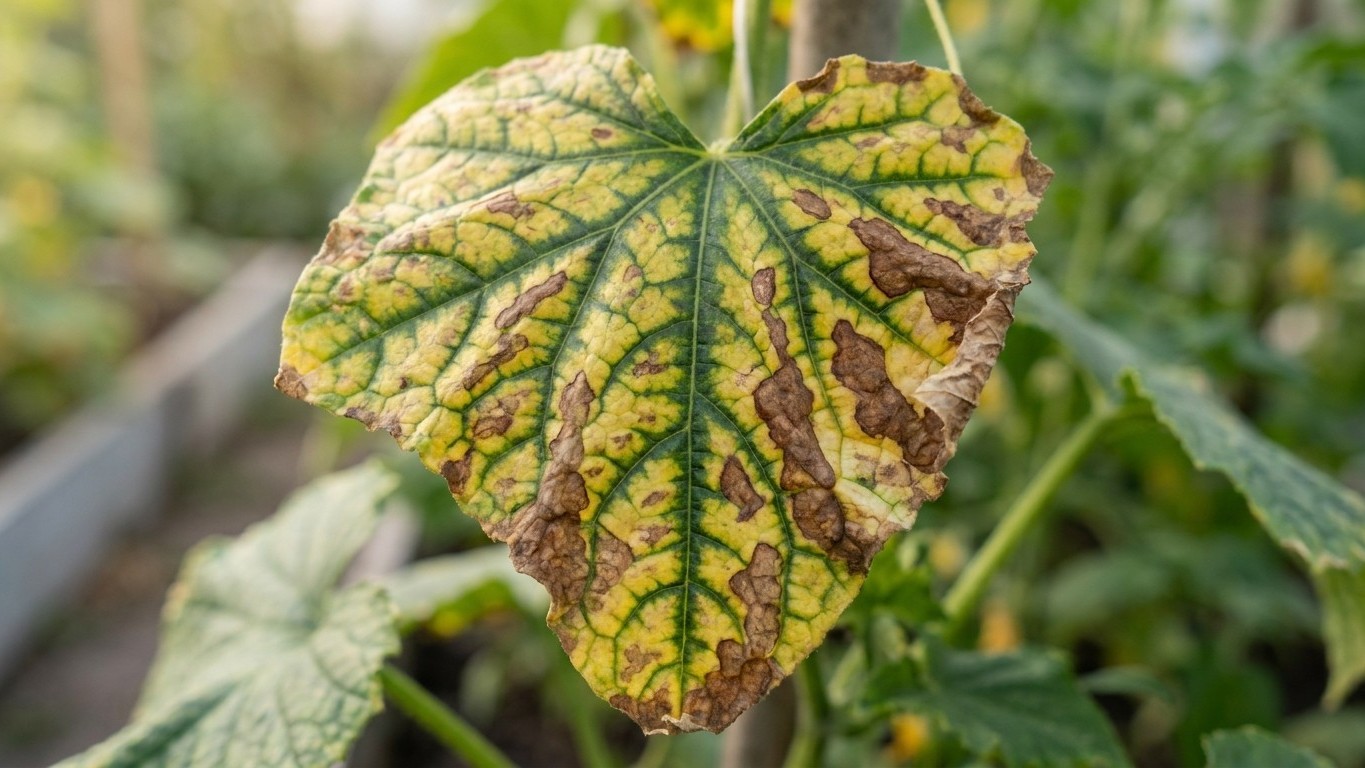

Downy mildew is the cucumber disease that actually ends a growing season, not just spots the leaves. It’s caused by a water mold, not a true fungus, and it spreads fastest in humid, wet weather, turning leaves yellow then brown within days. Once it establishes, there’s no cure, only damage control and prevention for next time.
What is actually going on

The thing to understand here is that downy mildew works from inside the leaf. The pathogen, Pseudoperonospora cubensis, is an oomycete, a water mold more closely related to algae than to the fungi that cause most plant diseases. That distinction matters because it changes how the disease looks and how it behaves. Instead of spreading in round, fuzzy blotches the way many fungal diseases do, downy mildew produces angular patches bounded by the leaf veins. The veins act like fence lines the pathogen can’t easily cross, so the infection fills in one vein-bordered cell of tissue at a time, giving the leaf a stained-glass-window pattern of yellow squares and rectangles.
Gardeners routinely confuse downy mildew with powdery mildew, and that confusion is expensive. Powdery mildew is a true fungus that sits on the leaf surface as a white, dusty coating; it slows a plant down but rarely kills it outright. Downy mildew is systemic-acting within the tissue, spreads by wind-blown spores that need moisture on the leaf to germinate, and can defoliate a planting inside two weeks under the right weather. One disease is an inconvenience. The other one, left unmanaged, is often the reason a cucumber patch simply stops producing in mid-summer.
Why the plant type you chose matters
Not every cucumber reacts the same way. Pickling types, slicing types, burpless varieties, parthenocarpic (seedless, greenhouse-style) selections, and both bush and vining growth habits carry different levels of natural tolerance to downy mildew, and breeders have been actively working on this trait for years because commercial growers lose real money to it. The tolerance available in each category changes from one breeding program to the next, and which selections perform well shifts by region and by growing season. Rather than naming a specific variety here, the honest move is to point toward your state’s cooperative extension service, which runs regional variety trials and publishes updated tolerance ratings for what actually holds up against local downy mildew pressure. That list changes more often than most garden articles do.
In the garden
Telling downy mildew apart from powdery mildew on sight comes down to one question: does the damage respect the leaf veins? Powdery mildew doesn’t care about veins at all; it just spreads across the surface. Downy mildew is boxed in by them, which is why the angular shape is the whole diagnosis. Look at the underside of a suspect leaf too. Downy mildew produces a faint gray-to-purple, almost fuzzy growth on the underside directly beneath those yellow angular patches, especially after a humid night. Powdery mildew shows nothing but white coating, top and bottom alike.
| Sign | Downy mildew | What happens if you misread it |
|---|---|---|
| Leaf pattern | Angular, yellow, boxed in by veins | Treated as a nutrient deficiency, the gardener waits and feeds the plant while the disease spreads unchecked for another week |
| Underside texture | Faint gray-purple fuzz after humid nights | Missed because it’s checked at midday when the fuzz has dried and disappeared, delaying diagnosis by days |
| Speed | Whole plant can go from a few spots to bare stems in under two weeks in humid weather | Treated like slow-moving powdery mildew, the gardener applies a powdery-mildew remedy that does nothing against a water mold |
| Weather trigger | Needs free moisture on the leaf surface, favored by humidity, dew, and overhead watering | Continued overhead watering in the evening keeps leaves wet overnight, which is exactly the window the pathogen needs to infect |
| Spread pattern | Often shows up first on the oldest, lowest leaves, then moves upward | Gardener inspects only the top of the plant, where fruit is forming, and misses the outbreak until it’s already climbed halfway up the vine |
Two practical habits follow directly from that table. First, water at the base of the plant, in the morning, so leaves dry out before evening rather than staying wet overnight. Second, check the underside of the oldest leaves on a regular walk-through, not just the top growth where the fruit is. A plant that looks fine from three feet away can already be losing the fight underneath.
What it depends on where you are
How much of this is a national problem versus a local one deserves an honest answer: the pathogen itself doesn’t change from state to state, but the pressure it puts on a garden depends heavily on season length, summer humidity, and rainfall pattern, and this page has no way of knowing which climate a given reader is gardening in. Downy mildew spores don’t survive winter in most of the country the way some other plant pathogens do; instead, they tend to move northward each growing season on wind currents from warmer regions where the pathogen overwinters on living host plants. That means the timing of first arrival, and the intensity of the outbreak, shifts year to year and region to region in a way no single article can predict months in advance.
A humid, warm coastal or Southern climate with frequent summer rain creates conditions the pathogen thrives in for a longer stretch of the season. A dry inland climate with low humidity may see little to no downy mildew pressure most years, even though the same cucumber plants would be vulnerable if conditions changed. Local topography plays a role too: gardens in low-lying areas with poor air movement tend to hold moisture on leaf surfaces longer after dew or rain, which extends the daily window the pathogen has to infect.
Because of that variability, the most useful thing this page can do is point rather than predict. Cooperative extension services track regional downy mildew activity through the growing season and issue alerts when spores are detected moving into a state, often well before symptoms show up in a home garden. Pairing that regional tracking with the variety information mentioned earlier, from the same extension office, gives a far more accurate picture than any national average could. Other guides in this cucumber series cover watering habits and site selection in more general terms; treat those as the baseline, and treat your local extension bulletin as the correction for what’s actually happening in your specific climate this particular season.
The mistake that costs the most
The single costliest mistake is waiting for certainty before acting. Downy mildew moves fast enough that the days spent confirming a diagnosis, comparing it to photos online, deciding it’s probably nothing, are the same days the disease uses to move from a few lower leaves to the whole plant. By the time the angular pattern is unmistakable and the underside fuzz is obvious even at midday, a meaningful portion of the leaf canopy is often already too damaged to recover, and leaf canopy is what feeds the fruit. A cucumber plant that loses its leaves early doesn’t just look bad, it stops filling out the fruit already on the vine.
The fix isn’t a product, it’s a change in posture. Act on suspicion, not confirmation. If a cucumber plant shows angular yellowing on the lower leaves during a stretch of humid weather, treat that as downy mildew until proven otherwise, not the other way around. That means adjusting watering immediately (base-level, morning only), improving airflow around the planting by thinning crowded growth, and removing the worst-affected leaves to slow the spread rather than leaving them on the plant to keep producing spores. It also means checking with the local extension service right away rather than after the outbreak is confirmed everywhere on the plant, since many states track and announce downy mildew’s regional arrival before it shows up in most gardens.
None of that guarantees the planting survives intact. Downy mildew earned its reputation because even a fast, correct response sometimes isn’t fast enough once conditions turn humid for a stretch. But the gardeners who lose the least are the ones who treat the first angular yellow patch as the whole warning it actually is, not as a wait-and-see spot on one leaf. The next planting benefits from that same lesson too: choosing a pickling, slicing, or burpless type with better regional tolerance, based on current extension trial data rather than last year’s memory, is the one decision made before the season even starts that pays off the most once summer humidity arrives.