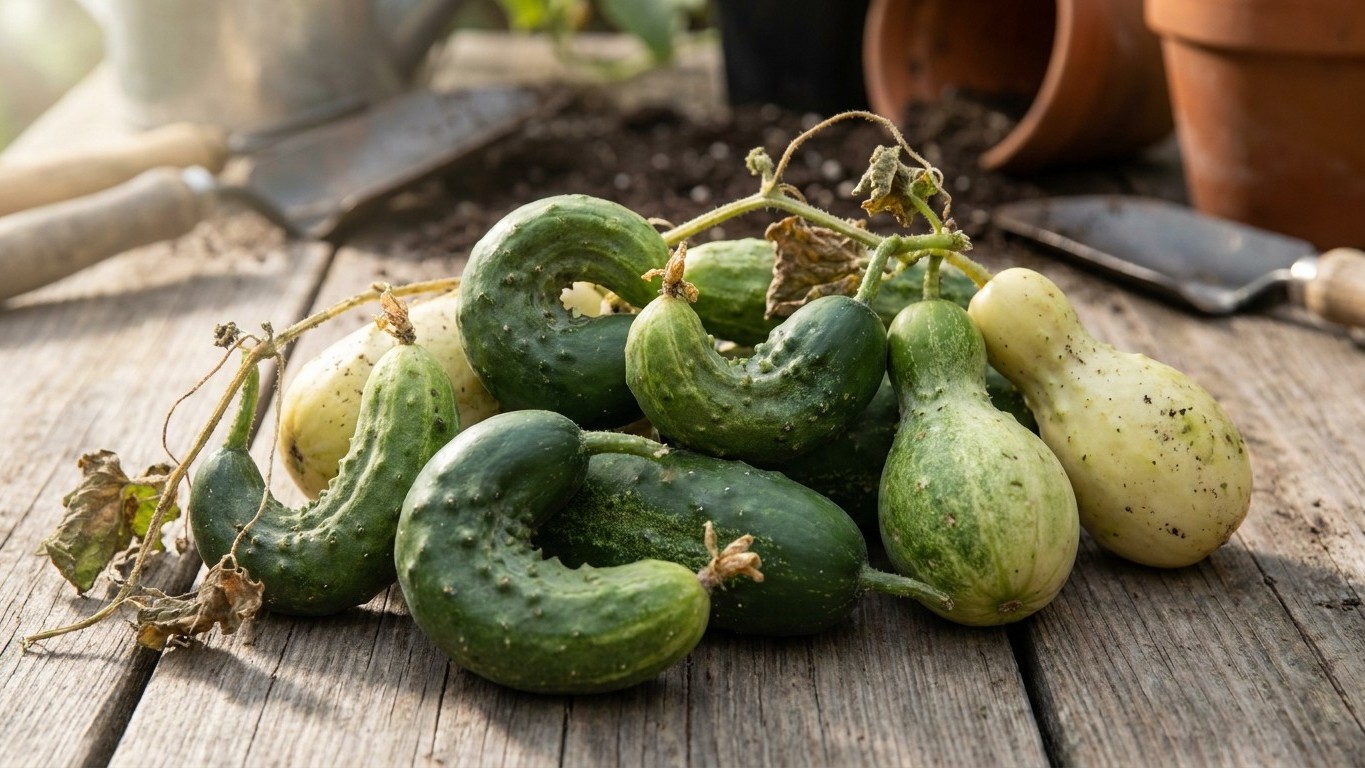

A misshapen cucumber isn’t sick, and it isn’t a sign of bad seed. It’s a fruit that grew through a rough patch, whether that’s a dry spell, a skipped pollen delivery, or a nutrient gap, and the shape it ends up with is basically a record of what happened to it on the vine.
What is actually going on

A cucumber fruit swells from the base of a female flower, and it only fills out evenly if two things happen on schedule: full pollination and steady water. Miss either one, even for a day or two, and the fruit keeps growing, just unevenly, which is why the deformities are so consistent and so readable once you know what to look for.
Cucumber flowers come in two types, male and female, and most open-pollinated types need bees or other insects to move pollen between them. A cucumber has dozens of ovules inside, each one needing its own grain of pollen to develop into a seed, and each developing seed pulls in the sugars and water that plump up the flesh around it. When pollination is partial, the seeded end of the fruit fills out normally while the poorly pollinated end stays narrow, which is why you get that classic bowling-pin or tadpole shape. A cucumber that curls into a hook is often telling you the same story from a different angle: growth was stronger on one side than the other, frequently because pollen distribution was lopsided across the ovary.
Water tells a different kind of story. Cucumber fruit is something like 95 percent water, and it grows fastest in the first week or so after the flower is pollinated. A dry stretch during that window slows the fruit down; when watering resumes, growth picks back up, but the narrow, stalled section in the middle never catches up to the diameter on either side of it. That’s the hourglass or pinched-waist cucumber, and it’s a watering record more than a genetic one.
Nutrient gaps add a third layer. Cucumbers pull hard on potassium once they start setting fruit, and a shortfall commonly shows up as a fruit that tapers to a narrow, pale point at the blossom end even when pollination was fine.
Type matters here too. Parthenocarpic types, often sold as burpless slicers for greenhouse or high tunnel growing, set Fruit Without Pollination at all, so they sidestep the pollination-driven shapes entirely, though they’re still vulnerable to water-driven ones. Standard pickling and slicing types, whether bush or vining, depend on insect pollination and will show both kinds of deformity. Your state’s Cooperative Extension Service publishes trial results on which types perform well locally, and that’s a better source for variety selection than any general guide can be.
In the garden
Once you know the mechanism, reading the fruit is mostly pattern matching. The table below covers the shapes gardeners run into most often, what they usually mean, and what tends to go wrong when the wrong fix gets applied.
| Shape | Likely cause | What happens if you misread it | What to do instead |
|---|---|---|---|
| Narrow, shriveled tip; wide, seeded base | Partial pollination | Gardeners often blame the seed and switch varieties, when the real issue is pollinator visits | Check for bee activity during the morning bloom window; consider hand-pollinating a few flowers to compare |
| Pinched “waist” in the middle | A dry period followed by a soaking | People assume disease and start treating leaves, but the fruit shape doesn’t come from foliage problems | Move to a regular, even watering schedule rather than letting soil dry out between waterings |
| Curved or hooked fruit | Uneven pollination across the ovary, or a fruit growing against a trellis wire, leaf, or another cucumber | Growers sometimes pull and discard the whole plant, assuming a genetic fault | Check for physical obstructions along the vine and improve pollinator access; the fruit is usually still fully edible |
| Tapered, pale point at the blossom end | Potassium shortfall during fruit set | Mistaking this for a watering problem leads to more irrigation, which doesn’t correct the nutrient gap | Have soil tested and correct potassium levels based on the results, rather than guessing |
| Bulbous, oversized blossom end tapering to a thin stem end | Pollen concentrated at one end of the flower during fertilization | Often blamed on cross-pollination with other cucurbits, which doesn’t actually change cucumber shape in a single season | Improve pollinator diversity in the garden rather than isolating plants |
Notice that almost none of these fixes involve spraying anything. The deformities are structural, tied to timing and resources during fruit development, not to a pathogen you can knock back with a product. The one exception worth flagging is chronic, severe curling paired with mottled or streaked fruit skin, which can point to a virus spread by insects rather than a shape problem alone. That combination is worth a call to your local extension office rather than a guess.
What it depends on where you are
How often you’ll see misshapen fruit, and which shape shows up most, has a lot to do with your regional climate, and this page can’t tell you which climate you’re gardening in. Season length affects how much of your fruiting window falls during periods of heat stress, which reduces pollen viability and slows bee activity. A shorter growing season also means less room to recover from an early setback: a cool, wet spring that delays bee activity in a short-season area eats into fruiting time that a longer season could absorb.
Summer heat changes the pollination math directly. Cucumber pollen loses viability above a certain temperature threshold, and extended heat waves during bloom can produce a run of poorly pollinated, tapered fruit even in a garden that’s otherwise well tended and well watered. Regions with intense, sustained summer heat tend to see more of this pattern than regions with milder summers, and the timing of it shifts depending on when your local bloom period falls.
Summer rainfall patterns drive the water-stress shapes just as directly. A region with unpredictable, spotty summer rain will produce more hourglass and pinched fruit than a region with steady rainfall or reliable irrigation, simply because the soil moisture swings are bigger and more frequent. Sandy soils, which drain fast and are common in parts of the Southeast and the Mountain West, tend to amplify this effect compared with heavier clay soils that hold moisture longer between waterings.
None of that adds up to a single national answer, which is why the more useful move is local. This site’s state-level cucumber pages cover the growing conditions and timing that apply where you garden, and your state’s Cooperative Extension Service goes even further, with trial data on which types have performed well in local soil and heat conditions. The USDA’s Cooperative Extension System directory is the fastest way to find the office covering your county.
The mistake that costs the most
The single costliest mistake is treating misshapen fruit as a symptom to spray for instead of a signal to read. Gardeners see a curved or pinched cucumber, assume something is attacking the plant, and reach for a fungicide or insecticide on a hunch. That doesn’t fix anything, because the deformity isn’t coming from a pathogen, and it burns time and money on a treatment aimed at the wrong problem while the actual cause, usually inconsistent watering or thin pollinator activity, keeps affecting every fruit that sets afterward.
The cost compounds because it’s not a one-time miss. A watering schedule that swings between bone-dry and soaked will misshape fruit all season long, not just once, so the gardener who never identifies the real cause ends up with a summer’s worth of hourglass cucumbers while still hunting for a disease that was never there. Meanwhile the fix, watering on a consistent schedule and mulching to buffer soil moisture between waterings, costs nothing and takes less effort than any spray program would.
The better habit is to look at the shape first and ask two questions before doing anything else: has watering been consistent over the past two weeks, and has there been steady pollinator activity during the morning bloom window? Those two questions cover the overwhelming majority of misshapen fruit. If both check out and the fruit is also showing streaked or mottled skin, that’s the point to involve your local extension office rather than guess further. For everything else, whether you’re growing a pickling type for a first backyard crop or a vining slicer trained up a trellis, the fix is almost always steadier water and better pollinator access, not a product from the shelf.