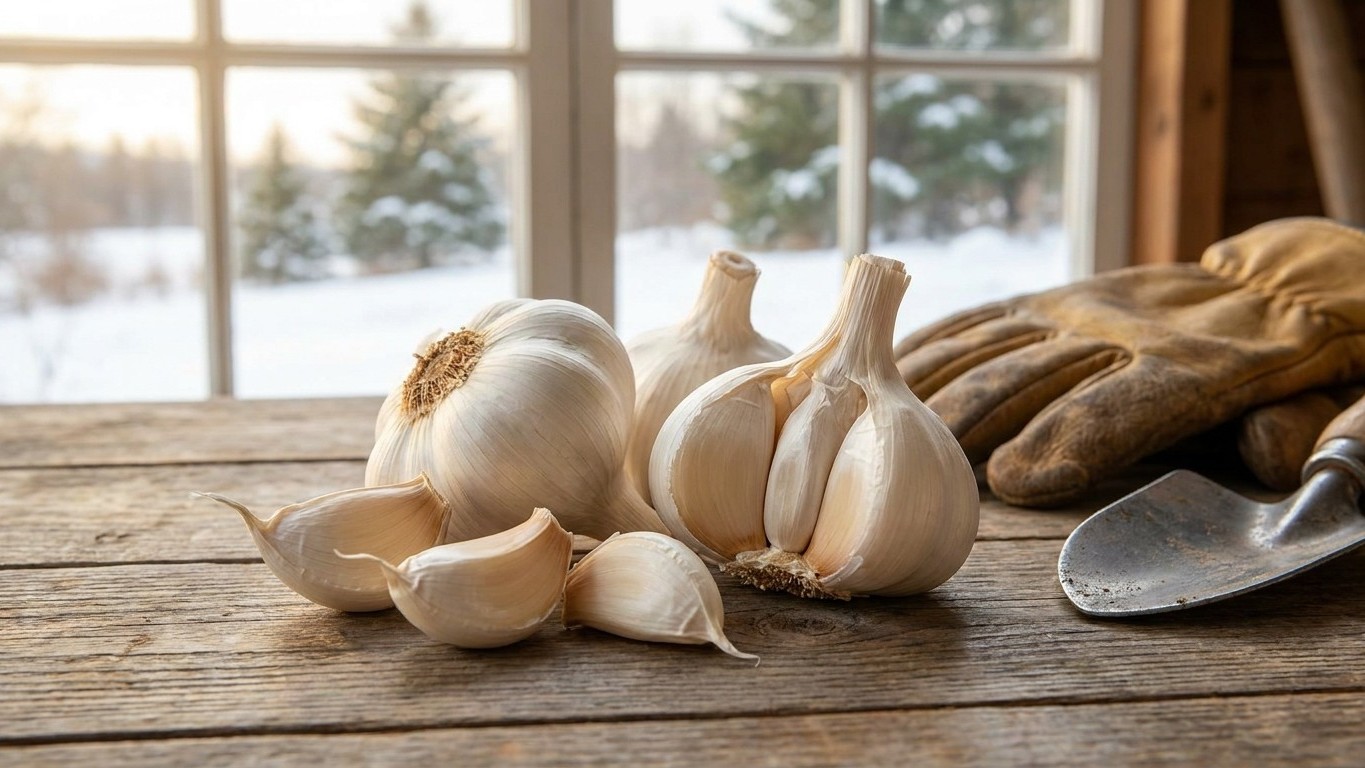

Garlic in Minnesota comes out of the ground by leaf color, not by a date circled on the calendar: once the lower leaves have browned and dried while the upper ones hold green, the bulb is done sizing. From there, it needs a stretch of curing in a dry, shaded, airy spot before you trim it and put it away, and the whole process is shaped by a growing season that runs shorter in the north than in the Twin Cities area.
When garlic is ready to lift in Minnesota
The signal that matters is the plant itself, not the weather forecast. As a garlic bulb finishes filling out, the lowest leaves on the stalk turn brown and papery while the leaves above stay green. That’s the plant pulling its energy down into the bulb rather than pushing it up into foliage. Pull one test bulb, brush off the dirt, and look at the wrapper. If it’s still tight with distinct cloves forming underneath, you’re close. If the wrapper has started to split or the cloves look loose and separated, it’s overdue.
Where this fits inside Minnesota’s growing season depends heavily on which part of the state a garden sits in. NOAA’s 1991-2020 Climate Normals put the first fall freeze for the Twin Cities somewhere between October 11 and October 23, based on the 30 to 70 percent probability band for a 32°F freeze. That’s a midpoint, not a promise: in roughly one year out of two, the first freeze lands later than that window, sometimes well later. Garlic harvest itself happens months before that date, in the warm stretch of summer, but the length of the frost-free season on either end of the year is what gives southern Minnesota gardens more time to build a full bulb than gardens further north.
South versus north
Northern Minnesota doesn’t get its own published freeze-date range here, but the general pattern is well known among growers in that part of the state: the season closes in tighter on both ends, about two to three weeks earlier in fall and later in spring compared with the Twin Cities. That shorter window can nudge bulb sizing and the leaf-browning signal a little earlier in the calendar too, even though the underlying rule, watch the lower leaves, doesn’t change.
| Region | Frost timing reference | What it means for garlic |
|---|---|---|
| Twin Cities / southern Minnesota | First fall freeze midpoint: October 11–23 (NOAA NCEI 1991-2020 Normals) | Longer frost-free stretch; more buffer for bulb development |
| Northern Minnesota | Not separately published here; runs roughly two to three weeks tighter at both ends | Shorter season overall; watch leaf browning a bit earlier |
Because variety and planting date shift the calendar too, the leaf test beats guessing off a regional average every time. Local guidance from University of Minnesota Extension (extension.umn.edu) is the place to check for county-level nuances if a garden sits near the state’s edges.
Curing it, and where to hang it here
Curing is the step that turns a freshly pulled bulb, still full of moisture, into something that keeps. Skip it or rush it, and garlic that looked perfect at harvest goes soft or moldy within weeks in storage. Done right, curing dries down the outer wrapper and tightens the neck so the bulb seals itself off from rot and moisture loss.
Right after digging, don’t wash the bulbs. Shake off loose soil and set the whole plant, roots, stalk, and all, somewhere out of direct sun with good airflow. A garage, a covered porch, or a shed with the door propped works, as long as rain and direct sunlight can’t reach it. Minnesota summers bring humidity swings that can slow this down, so airflow matters more here than in a drier climate: a small fan or simply spacing bulbs apart so air moves between them helps prevent the kind of trapped moisture that invites mold.
Bundling versus laying flat
Garlic can cure either tied in small bundles and hung from a rafter or beam, or laid out in a single layer on a screen or slatted rack. Bundling saves space and works well in a garage with exposed joists; laying flat is easier to check for problem bulbs along the way, since you can walk the row and pull anything that’s gone soft before it spreads mold to its neighbors. Either method needs the same conditions: shade, airflow, and time.
Garlic is cured when the outer wrapper has gone papery and the neck where the stalk meets the bulb has tightened and dried, no longer soft or green. Snip the roots close to the base and trim the stalk down, leaving an inch or so if you plan to store bulbs loose, or leave it longer if you’re planning to braid softneck varieties. At that point the dirt on the outer wrapper can be brushed off gently; don’t scrub it, since the papery layers are the bulb’s main protection once it’s in storage.
Storing it through a Minnesota winter
Once cured, garlic wants the opposite conditions from curing: cool, dark, dry, and steady rather than airy and bright. A basement corner, an unheated but frost-protected closet, or a pantry away from an exterior wall all work better than a spot near a furnace or a window that gets afternoon sun. What garlic doesn’t want is a location that swings hot and cold or picks up moisture from a humid basement, since both encourage sprouting or rot long before the last bulb gets used.
The refrigerator is worth avoiding for whole storage runs. Cold, humid refrigerator conditions can trigger early sprouting in garlic, which is the opposite of what a Minnesota household wants heading into a long winter when the goal is stretching a harvest as far into the cold months as possible. A dry pantry shelf, mesh bag, or open basket that lets air circulate around the bulbs works better than a sealed container or plastic bag, which traps moisture against the wrappers.
Softneck and hardneck side by side
Minnesota gardens grow both softneck and hardneck garlic, and they don’t behave identically once cured. Softneck varieties generally hold longer in storage and are the type usually braided, since their pliable stalks lend themselves to it. Hardneck varieties, more common in colder climates because of their winter hardiness, tend to have a shorter storage window and a stiff stalk that doesn’t braid, so they’re usually stored loose in mesh bags or baskets instead.
Checking stored garlic every few weeks catches problems early. A bulb that’s gone soft, sprouted, or developed a moldy smell should come out of storage immediately, since one compromised bulb sitting against its neighbors in a bag or basket can spread trouble to the rest of the batch faster than it would sitting in the open.
What goes wrong here
Most garlic failures in Minnesota trace back to timing rather than bad luck. Pulling bulbs too early, before the lower leaves have browned, gives small, underdeveloped cloves with wrappers too thin to protect them in storage. Waiting too long has the opposite problem: the wrapper splits, cloves separate, and the bulb is far more exposed to soil moisture and rot organisms in the ground, which shortens its storage life before it’s even out of the dirt.
Among pests, University of Minnesota Extension documents onion maggot (Delia antiqua) as a concern for allium crops in the state, and it’s the one worth watching for in a garlic bed specifically, since garlic belongs to the same plant family as onions. Larvae feeding at the base of the plant can weaken or kill young growth and create entry points for rot organisms later, which is one more reason a healthy, well-timed harvest matters: a stressed bulb going into curing is more vulnerable than one that finished the season strong.
On the storage side, the two recurring problems are moisture and temperature swings, not pests. A basement that’s too humid encourages mold on the papery wrappers even after a proper cure. A pantry shelf near a heat source or an exterior wall that gets cold snaps and warm spells in the same week stresses stored bulbs and shortens how long they keep. Neither problem shows up overnight, which is exactly why a periodic check of the storage spot, not just the garlic itself, catches trouble before an entire batch is lost to a spot that seemed fine back in October.
Common questions
How do I know garlic is ready without pulling every bulb to check?
Watch the lower leaves on a handful of plants across the bed. Once several across the row show the same lower-leaf browning pattern with green still up top, pull one test bulb to confirm the wrapper and clove separation look right before digging the rest.
Can I cure garlic indoors if I don’t have a garage or shed?
A spare room, covered porch, or even an interior space with a fan running and the door cracked for airflow can work, as long as it stays out of direct sun and doesn’t get humid. The requirements are shade, air movement, and time, not a specific type of building.
Does Minnesota’s freeze date affect when I harvest garlic?
Not directly. The fall freeze window from NOAA (October 11-23 for the Twin Cities area) matters more for fall planting timing than for the following summer’s harvest, which is governed by leaf browning, not frost. It does help explain why the growing season, and available time for bulb sizing, runs shorter the farther north a garden sits in the state.
How long does properly cured garlic keep in storage?
No fixed number is published here, and it varies by type, with softneck varieties generally outlasting hardneck ones in storage. Checking bulbs periodically and pulling any that soften, sprout, or develop a moldy smell is a more reliable practice than counting on a set number of months.