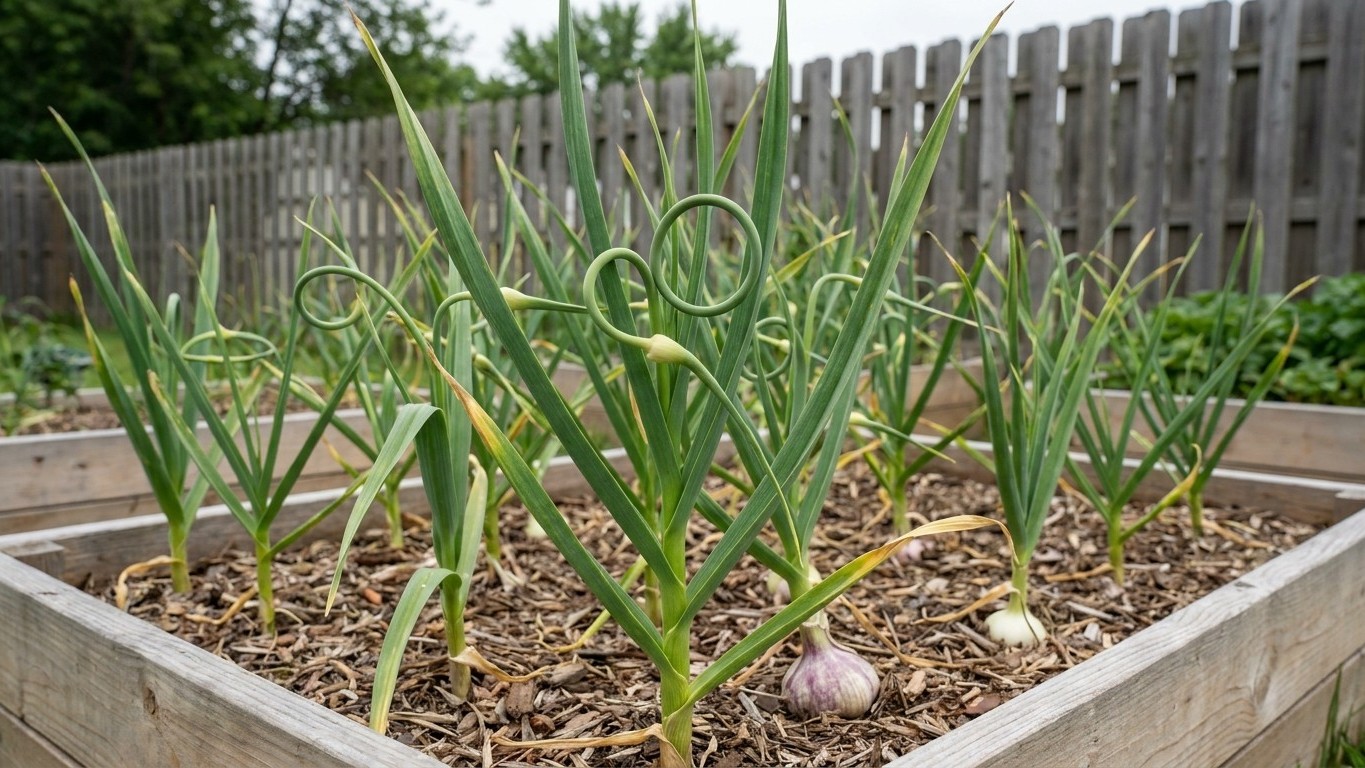

Mid-September to early October is when garlic goes into Minnesota ground, whether you’re planting a hardneck bred for brutal winters like German Red or a softneck like Inchelium Red that’ll outlast it in the pantry. That window isn’t arbitrary — it’s four to six weeks counted backward from Minneapolis’s first fall frost, which lands between October 11 and October 23 in an average year. Garlic doesn’t need warm weather to grow; it needs cold soil and time to root before the ground shuts down for winter.
The short answer for Minnesota

Plant garlic in Minnesota between mid-September and early October. That window applies to every clove-splitting cultivar sold for the north, hardneck or softneck, because the arithmetic behind it doesn’t change with the variety: garlic needs time to grow roots before the ground locks up, not time to grow leaves.
The date is anchored on the first fall frost, not on the calendar. NOAA’s NCEI 1991-2020 Climate Normals put that frost, measured at Minneapolis, between October 11 and October 23. Remember that a frost date is a midpoint, not a guarantee: in one year out of two, the real first hard freeze falls later than that whole window, and in the other it falls earlier.
Garlic planted in fall needs about four to six weeks of active root growth before the soil freezes solid enough to stop it. Roots grow at soil temperatures the top growth can’t handle, so a clove set out in mid-September keeps building roots well past the point when frost has browned everything else in the garden. Count back four to six weeks from the frost window and you land in mid-September to early October, which is why the same date works whether you’re planting a hardneck type bred for cold winters, such as German Red, Chesnok Red, or Duganski, or a softneck that stores longer in the kitchen, like Inchelium Red or Lorz Italian.
Planting earlier than mid-September risks green top growth pushing through before winter, which then gets damaged by hard freezes and costs the plant stored energy it needs come spring. Planting after early October risks the opposite: cloves that haven’t rooted before the ground freezes, which shows up the following summer as small, uneven bulbs. For everything before that step, see Growing Garlic in Minnesota.
Working it out for your own garden
The mid-September to early October window above is built on one weather station: Minneapolis. Minnesota runs about 400 miles north to south, with the Iron Range, the Arrowhead along Lake Superior, and the farm country near the Iowa border all keeping different clocks. Redo the arithmetic for your own spot rather than trusting a single statewide date.
Step one: find your local first frost window
Start with a frost record from a station near you rather than the Twin Cities figure, since NOAA’s 1991-2020 normals are specific to the station they’re measured at, not to the whole state. UMN Extension’s county offices keep local growing-season data and can point you toward the nearest reliable record.
Step two: count back four to six weeks
Garlic needs that stretch of time to grow roots before the soil freezes hard enough to stop it. If your local frost window runs two to three weeks earlier than Minneapolis’s October 11 to October 23, as it does across much of northern Minnesota, shift your planting window earlier by the same amount rather than sticking to the Minneapolis dates.
Step three: adjust for what the map doesn’t show
A single published frost date is a starting point, not the last word for your yard. A few things move the real number:
- Elevation: low spots collect cold air overnight and frost first
- Nearby water: a large lake holds heat longer, delaying frost close to shore
- Open exposure: an unsheltered garden loses heat faster overnight than one against a building or windbreak
Treat any single published date as a starting point, then watch your own garden for its pattern across a couple of seasons before you trust it. A soil thermometer pushed four inches down tells you more than a calendar page: garlic roots best while the soil is still in the 50s Fahrenheit, cooling but not cold. If your soil is holding on to summer warmth into the window above, you have some room to wait. If it’s already dropped further, get cloves in the ground rather than waiting for a date to arrive on paper.
What changes across Minnesota
A single planting date never describes the whole state, and Minnesota’s geography stretches that point further than most. The Twin Cities and the farmland to the south sit in the mildest part of the state and are the basis for NOAA’s Minneapolis normals used above. Move north or east and the numbers shift.
| Region | How it differs from Minneapolis | What that means for planting |
|---|---|---|
| Twin Cities and southern Minnesota | Reference point for NOAA’s 1991-2020 Minneapolis normals; the mildest part of the state | Mid-September to early October as calculated above |
| Arrowhead and the North Shore of Lake Superior | The lake itself moderates temperature swings right along the shoreline | Watch your own site rather than assuming an inland date applies close to the water |
| Iron Range and far northern Minnesota | Runs two to three weeks tighter at both ends of the growing season | Shift the whole window two to three weeks earlier, into late August through mid-September |
The Iron Range shift matters most for anyone tempted to use a single statewide planting date off a seed catalogue. A grower near Duluth working from a Twin Cities date is planting into a season that closes weeks sooner, and a clove set out in early October there may not get the root growth it needs before the ground gives out. The North Shore complicates the picture further: the immediate shoreline runs milder than inland sites just a few miles back from the water, so two gardens in the same county can carry genuinely different windows.
The mistakes this climate punishes
Planting too shallow for a real winter
Minnesota’s winters aren’t marginal for garlic. The state runs about 30.4 weeks a year with mean temperatures below 40°F, according to University of Georgia Extension’s cold-requirement guidance (Circular C854), which comfortably clears the six to eight weeks of cold a clove needs to split into individual cloves rather than staying a single round bulb. That means the risk here isn’t too little cold, it’s the freeze-thaw cycle acting on cloves set too close to the surface. Plant at the depth recommended for your variety and cover with mulch heavy enough to hold soil temperature steady, or repeated freezing and thawing will heave cloves partway out of the ground over winter.
Planting too late to root
The other end of the same mistake is waiting too long. A clove planted after the early-October end of the window here hasn’t had the four to six weeks of root growth it needs before the ground freezes solid, and a garlic plant that goes into winter with no root system often doesn’t come up in spring, or comes up small and weak. If a stretch of warm fall weather tempts you to wait, remember that half of all years bring the real first hard freeze earlier than October 11, not later.
Starting with the wrong seed stock
September, when garlic actually gets planted here, is also one of four months in the growing season where UC IPM’s Pest Management Guidelines for Onion and Garlic (UC ANR Publication 3453) put average air temperatures inside the range where both white rot (Sclerotium cepivorum) and Fusarium basal rot (Fusarium oxysporum f. sp. cepae) are active, alongside May, June and July. That’s an air-temperature range applied to a soil-borne disease, soil lags air by weeks and a monthly average hides a lot of daily swing, but it’s still a reason to start with clean, certified seed stock rather than bulbs saved from a bin of unknown origin. Southern blight and pink root need warmer soil than Minnesota’s growing season usually delivers, with no month here reaching either disease’s published optimum, but a cooler climate makes a disease less active, not absent, so the same clean-stock rule covers all four.
Checking this against your county
Everything above is calculated from one station’s data. For a figure specific to your county, use UMN Extension rather than a statewide rule of thumb: UMN Extension keeps county-level offices that track local frost and growing-season records more precise than a single Minneapolis reading. Ask for the local first-fall-frost data and redo the four-to-six-week count above with that number in place of the Minneapolis range.
This is also a good point to settle on a variety if you haven’t already. Garlic Varieties That Suit Minnesota Winters covers which hardneck and softneck types handle the state’s cold, and pairs with the planting window here once you know your local frost date.
Common questions
Can I plant garlic in spring instead of fall in Minnesota?
You can, but expect much smaller bulbs. Garlic needs a cold period before it will split into separate cloves, and a fall-planted clove gets a full winter of that cold before it starts growing in spring. A spring-planted clove misses most of that chilling and often just grows as a single round, undivided bulb.
What if I miss the window and it’s already into November?
Get it in the ground anyway if the soil isn’t frozen, and mulch heavily right away. It may not root as fully before freeze-up as a mid-September planting would, but a thick mulch layer buys the clove some protection and time. If the ground is already frozen solid, hold the cloves in a cool, dry spot and wait for a normal spring planting, accepting the smaller-bulb tradeoff above.
Do I really need to mulch garlic over a Minnesota winter?
Yes, and treat it as standard practice rather than insurance for a bad year. Snow cover acts as natural mulch, but its timing is unreliable from year to year, and a bare, exposed bed during a cold snap with no snow down yet is exactly when frost heave does the most damage to shallow-planted cloves.
Can I just plant garlic from the grocery store?
You can, but it’s a gamble worth skipping. Grocery garlic is rarely sold with a variety name, is often not suited to a northern climate, and carries no guarantee it’s free of the soil-borne diseases discussed above. Certified seed garlic from a supplier that names its cultivars costs more but tells you what you’re actually planting.
Some gardeners also time this by the Moon: when to plant garlic by the moon, as almanac tradition rather than fact.