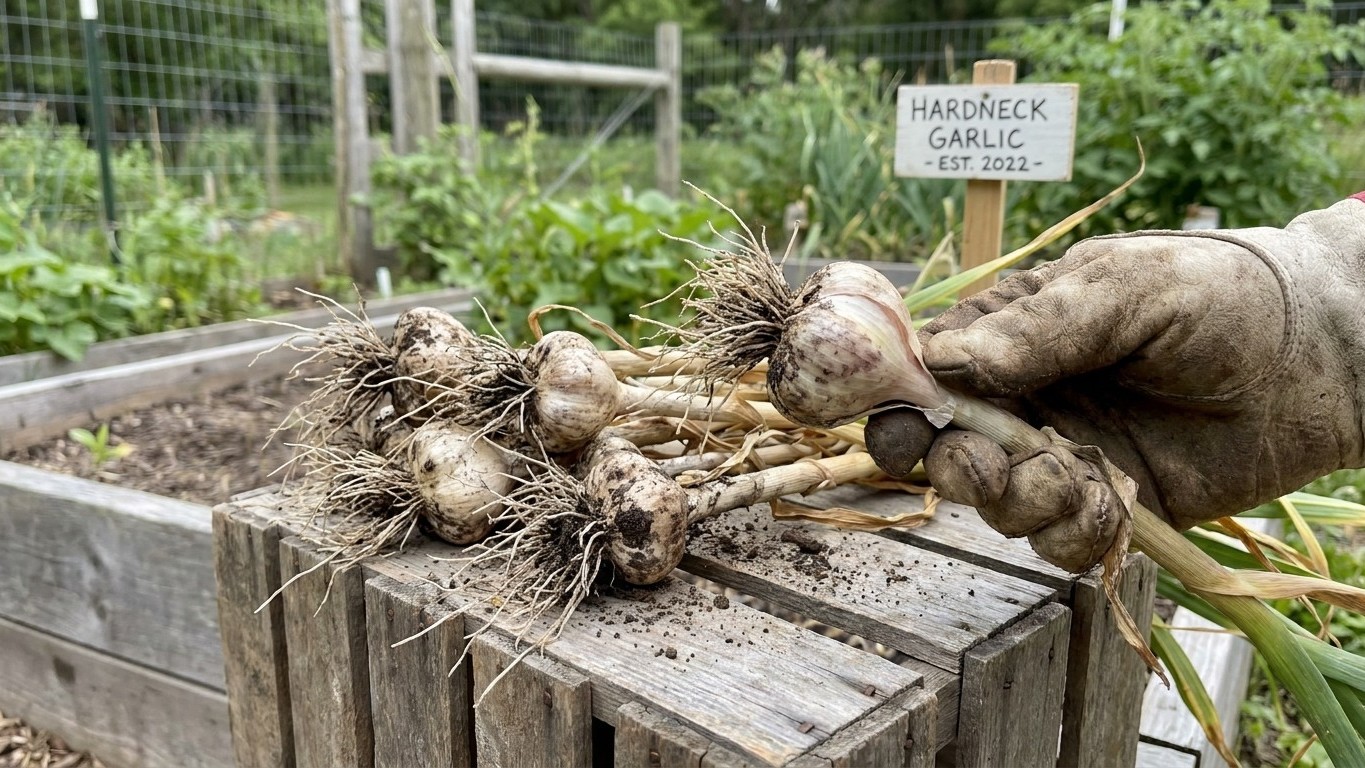

Minnesota gives garlic more cold than it needs, not less. NOAA’s 1991-2020 Climate Normals put the first fall freeze at Minneapolis between October 11 and October 23, and the state’s winters run cold and long enough afterward to satisfy garlic’s chilling requirement several times over. Plant cloves in the weeks before that freeze window, choose a hardneck cultivar for most of the state, and mulch heavily once the ground starts to firm up.
Will garlic get the cold it needs in Minnesota

Minnesota’s chilling requirement isn’t the question here — it never was. The state blows past the six-to-eight-week threshold garlic needs before the ground even finishes freezing solid, from the Iowa border clear up to the Canadian line. So the refrigerate-your-cloves advice you’ll see floated for warmer states doesn’t apply north of here. What actually matters in Minnesota is narrower and easy to miss: exactly when that first fall freeze lands, and how much tighter the window gets the further north you garden.
Minnesota clears the requirement easily
Minnesota is not a state where this is in question. Once the first fall freeze arrives, which NOAA’s NCEI data places between October 11 and October 23 at the Minneapolis reference station, the state settles into a winter that holds well below 40°F for months, not weeks. Every part of Minnesota, from the Twin Cities south to the Iowa border and north toward the Canadian line, comfortably exceeds the six-to-eight-week threshold. This is one of the few garlic-growing questions in this state that does not require a caveat by region.
The caution runs the other direction here. Minneapolis sits in the mildest part of the state’s climate. Northern Minnesota’s growing season runs two to three weeks tighter at both ends of the year, according to the same NOAA dataset, which means northern growers see their first hard freeze earlier and their ground freeze solid sooner. That does not threaten the chilling requirement, since the north has cold to spare, but it does compress the planting window, as explained in When to Plant Garlic in Minnesota, which is worth weighing alongside Garlic Varieties That Suit Minnesota Winters, the broader guide growers rely on when choosing what to plant.
Where the two-option advice actually applies
The refrigerate-or-go-softneck choice that garlic guides usually mention belongs to states without Minnesota’s winter. A grower in a much warmer state, such as coastal or southern Mississippi, often has to refrigerate seed cloves for six to eight weeks before planting to fake the chill their winter will not provide, or plant only softneck types that need little cold at all. Growing Garlic in Mississippi covers that workaround in detail. In Minnesota, skip it. The only exception worth flagging is an unusually sheltered urban microclimate, a heated raised bed, or a season with a very late freeze, where a grower planting extremely late might want to double-check soil temperature with a thermometer before assuming the clock has started.
When to put the cloves in
Garlic planted in fall needs enough time before the ground freezes to grow roots, but not so much time that it pushes tall green shoots above ground before winter. Root growth without top growth is the target. The anchor point is the first fall frost, not a fixed calendar date, because frost timing varies by several weeks across a state this size.
NOAA’s 1991-2020 Climate Normals put that first fall freeze at Minneapolis between October 11 and October 23. Taking the midpoint of that window, around October 17, as a rough planting reference, garlic goes in the ground roughly three to five weeks ahead of it. That works out to a planting window of mid-September to early October for the cultivars listed below, all of which carry that same set-out range. The midpoint is not a safe date to plan around on its own. The actual freeze in any given year can land anywhere in that October 11 to October 23 range, and a grower who waits for a specific day risks planting too late.
What shifts the date locally
Minneapolis is the mild end of Minnesota’s climate. Northern counties see frost arrive two to three weeks earlier by NOAA’s data, which pulls the whole planting window forward by roughly the same margin. A large body of water changes things too. Lake Superior’s North Shore holds heat longer into fall than inland sites at the same latitude, which can push the safe planting window a bit later right along the shoreline, while low-lying fields and river bottoms nearby often collect cold air and frost earlier than the surrounding high ground. A grower on a frost-prone low spot should treat the earlier end of any date range as the more realistic one.
Which types suit Minnesota
Garlic splits into two groups, and in Minnesota the split matters more than in most places. Hardneck garlic produces a stiff central stalk, a smaller number of large cloves per head, and it wants a real winter to perform well. Softneck garlic braids well, stores far longer in the pantry, and tolerates mild winters that never fully vernalize a clove. Minnesota’s winter leans hard toward the first group, which is also why most of the varieties worth ordering here are hardneck.
Hardneck for most of the state
Hardneck cultivars that suit Minnesota’s cold include German White, German Red, Duganski, Chesnok Red, Bavarian Purple, Blue Music, Georgian Crystal, and Georgian Fire, along with Fall Festival and Ivan. All of these set out mid-September to early October in this climate, per their catalogue timing, and all produce a scape in early summer that should be cut so the plant’s energy goes into the bulb rather than any flowering structure. A grower in an equally cold-winter state, such as Vermont, ends up choosing from largely the same hardneck list for the same reason. See Growing Garlic in Vermont for how that comparison plays out further east.
Softneck where storage matters more than cold hardiness
Softneck varieties on this list, Early Red Italian, Inchelium Red, Italian Late, and Lorz Italian, still grow fine in Minnesota. Their advantage is not cold tolerance, since the state has cold to spare regardless of which type is planted, but storage life. A softneck head cured properly tends to hold up in a pantry for six to nine months or longer, well past what most hardneck heads manage before they start sprouting or drying out.
| Type | Cold requirement | Typical storage life | Example varieties |
|---|---|---|---|
| Hardneck | Needs a real winter chill to divide well and produces a scape | Often 4 to 6 months | German White, Chesnok Red, Duganski |
| Softneck | Tolerates mild winters, performs fine in a cold one too | Often 6 to 9 months or more | Inchelium Red, Lorz Italian |
Soil and bed preparation
Garlic sits in the same bed for nine to ten months, through freeze-thaw cycles, snowmelt, and spring rain, before it’s lifted the following summer. Drainage matters more than any other single factor. A clove sitting in saturated soil over winter rots long before any fungal disease gets involved, and once the ground is frozen there is no fixing a waterlogged bed until spring thaw, by which point the damage is done.
Work compost or well-rotted manure into the bed a few weeks before planting, not the same week, so it has time to settle rather than sitting in loose pockets around the cloves. A raised bed or a slightly mounded row helps shed excess water in a wet fall or during snowmelt, and it warms a little faster come spring, which matters for early root and shoot growth. Loosen the soil to a full spade’s depth if it has any compaction, since garlic roots dig down eight inches or more over the growing season and hit trouble in a hardpan.
Test soil pH before planting if it has not been checked recently. Garlic does best in soil that is neither strongly acidic nor strongly alkaline, and a county extension soil test is the only reliable way to know where a given bed stands rather than guessing from the crops grown there before. Clear the bed of the previous season’s onion or garlic residue as well, since leftover plant material is one of the more common ways disease carries over from one planting to the next.
What the climate here favours, and what it does not
UC IPM’s Pest Management Guidelines for Onion and Garlic, UC ANR Publication 3453, publish the temperature ranges that several major garlic diseases need to become active. Comparing those published ranges against Minnesota’s growing-season air temperatures shows where this climate opens a door and where it mostly keeps one closed.
What’s in range here
White rot, caused by the fungus Sclerotium cepivorum, has a published range of 50 to 75°F. Minnesota’s growing-season mean air temperature falls inside that range in four months, September, May, June, and July, and one of those four sits right at the pathogen’s published optimum. Fusarium basal rot, caused by Fusarium oxysporum f. sp. cepae, has a wider published range of 59 to 90°F, and Minnesota’s growing season falls inside it in the same four months. That means both diseases have real windows of opportunity here, September on one end of the season and the late-spring to midsummer stretch on the other.
What stays outside its optimum
Southern blight and pink root fare differently. Southern blight‘s published optimum is 86 to 95°F, and no month of Minnesota’s growing season reaches a mean air temperature inside that range by this data. Pink root’s optimum sits at 75 to 85°F, and the same is true there: no growing-season month averages that warm. Neither of those figures means the disease cannot occur. Outside its optimum, a pathogen is simply less active, not absent, and both diseases spread readily on infected seed stock or contaminated soil regardless of what the local climate is doing.
One distinction matters for reading all four of these figures correctly: the published thresholds are soil temperatures, and the numbers above are air temperatures. Soil lags air by weeks and swings far less day to day, so a warm September afternoon does not mean the soil around a newly planted clove has caught up to it. Treat this section as a description of tendency across the season, not a forecast of infection, and treat clean, disease-free seed garlic as the actual first line of defense regardless of what the thermometer says.
Getting it through the winter
A Minnesota winter is exactly the environment mulch is built for, and skipping it is one of the more common ways a first-time grower loses part of a planting. Mulch buffers the soil against the deep freeze-thaw cycles that heave cloves partway out of the ground over winter, exposing them to cold air and drying wind they were never meant to face.
Lay mulch, typically straw or shredded leaves, once the ground has started to cool but before a hard freeze locks it up, generally after the first light frosts but ahead of any sustained deep freeze. A generous layer, several inches deep once settled, insulates the soil enough to keep temperature swings gradual rather than sharp. A shallow-planted clove is the one most at risk from heaving, since a couple of freeze-thaw cycles can walk it right up toward the surface over a winter, so planting at a proper depth to begin with does as much work as the mulch itself.
Come spring, pull mulch back gradually rather than all at once, once new growth is visibly pushing up and the hardest freezes have passed. Leaving it too thick too long into spring keeps the soil cold and wet longer than the plant wants, and can encourage rot at the base of the shoot in a wet spring. Pulling it entirely too early, on the other hand, exposes new growth to a late cold snap right when it is most tender.
Harvest and curing here
Garlic tells a grower when it is ready far more reliably than any date on a calendar does. The signal is in the leaves: when the lower third to half of the leaves have browned and died back while the upper leaves are still green, the bulb is generally at or near full size. Pulling too early, while most leaves are still green, means small, underdeveloped cloves. Waiting too long, until nearly all the leaves have died back, risks the wrapper splitting and the cloves separating in the ground, which ruins storage life even if the flavor is fine.
Curing is where a lot of a good harvest gets lost, and Minnesota’s humid summer air makes it less forgiving than a dry climate would. Cure in a warm, shaded, well-ventilated spot, never in direct sun, and give the bulbs real airflow rather than piling them in a bin. A box fan running nearby for the first week or two makes a real difference in a humid stretch, since stagnant damp air around the bulbs is exactly what invites mold and soft rot before the papery skins have finished drying.
Plan on roughly three to four weeks of curing before trimming roots and tops and moving the harvest into long-term storage, checking periodically for any bulb that feels soft or shows mold, and pulling it out before it affects its neighbors. A fully cured bulb has tight, dry, papery skin and a firm neck. Anything still soft-necked or damp at that point needs more time before it goes into storage.
Local help
Frost dates, soil types, and disease pressure all shift across a state as long as Minnesota, and the figures here are anchored to the Minneapolis area specifically. For county-level planting dates, soil testing, and current disease alerts, contact UMN Extension at extension.umn.edu, which maintains county offices across the state with local horticulture staff.
Common questions
Can I Plant Garlic in spring instead of fall in Minnesota?
Not with any expectation of a normal crop. Garlic needs a sustained cold period after planting to divide into cloves, and spring planting skips that window entirely, usually producing a single small, undivided bulb rather than a full head. Fall planting, timed to the first frost window, is the standard approach in this climate.
Why did my garlic come up as one round bulb with no cloves inside?
In a climate as cold as Minnesota’s, this is rarely a cold problem and more often a clove-size or timing problem. Very small seed cloves, cloves planted very late in the fall, or crowded spacing can all produce an unsplit round instead of a divided head, even with plenty of winter chill behind it.
Do I need to refrigerate garlic cloves before planting here, like growers do in warmer states?
No. Refrigerating cloves before planting is a workaround for climates that do not get cold enough on their own, and Minnesota’s winter far exceeds the chilling requirement without any help. Save that step for a much milder climate, or for softneck varieties grown somewhere they will not otherwise get enough cold.
Is northern Minnesota too cold or too short-season for garlic?
No, though the timing window is tighter. Northern Minnesota’s frost arrives roughly two to three weeks earlier than at the Minneapolis reference station, which shifts planting a bit earlier in fall, but the crop itself handles the colder winter without issue as long as it’s mulched.
How much mulch do I actually need for a Minnesota winter?
Enough to keep the soil temperature from swinging sharply through repeated freeze-thaw cycles, which is what heaves shallow-planted cloves out of the ground. A generous, settled layer of straw or shredded leaves laid before the ground locks up hard, and pulled back gradually in spring once new growth appears, handles this in most gardens.