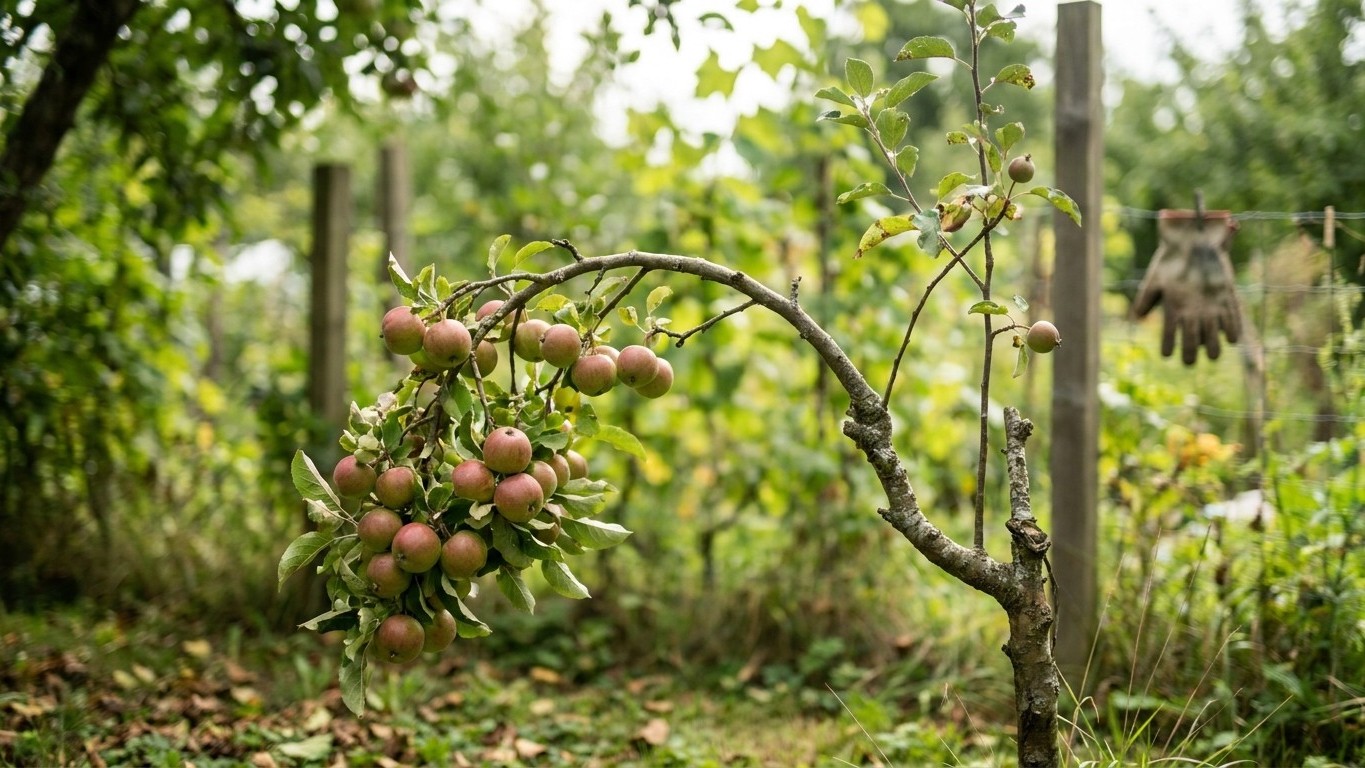

Most Nova Scotia apples come off the tree between late August and mid-October, with the exact week set by variety and by how close the tree sits to the average frost date, not by a spot on the calendar. A hardy keeper like Northern Spy can sit in a cold, humid basement well into spring, while a Gravenstein picked the same week is best eaten within a month. The gap between those two outcomes is the whole story of growing apples here.
When apples are ready to pick in Nova Scotia
Growers don’t wait for a date. They wait for the fruit to tell them: the ground color under the blush shifts from green to yellow-green, the seeds turn from white to brown, and the apple lets go of the spur with a gentle twist instead of a tug. Commercial orchards check starch levels with an iodine test, but for a backyard tree those three signs are enough to get the timing right within a few days.
What sets the window for Nova Scotia specifically is the average first fall frost, which lands around October 18 at Halifax Stanfield International Airport, the reference station used by Environment and Climate Change Canada for the province’s 1981-2010 climate normals. Most apple harvest wraps up before that date. Early varieties like Gravenstein and Jersey Mac are typically done by late August, well ahead of any frost risk. Mid-season apples such as McIntosh and Cortland come off through September. The late keepers, Northern Spy among them, often hang on the tree right up to that mid-October frost line, since ripe apples tolerate a light touch of frost far better than open blossoms ever could.
A province is not one climate
The Annapolis Valley, the heart of Nova Scotia’s commercial apple industry in Kings and Annapolis counties, warms faster in spring and holds heat longer in fall than the coastal South Shore or the Halifax peninsula, where ocean air keeps temperatures more stable but cooler overall. An orchard near Kentville can be a week or more ahead of a tree growing near Lunenburg. If you’re timing harvest by feel rather than by a fixed date, watch your own tree’s ground color and seed color rather than a neighbour’s calendar three counties over.
The other date that matters, even though it comes months earlier, is the average last spring frost of May 7 at the same Halifax station. That’s a mean, not a guarantee: in roughly half of all years, frost arrives after that date. Since bloom timing sets the whole countdown to harvest, a late, cold spring pushes the entire season back, and a warm one pulls it forward. Treat both frost dates as the midpoint of a window, not a line you can plan against with confidence.
Which ones keep, and which must be eaten
Storage life has almost nothing to do with how good an apple tastes off the tree and everything to do with its cell structure and skin. Thin-skinned, high-moisture varieties break down fast once picked. Dense, thick-skinned varieties with lower respiration rates can sit in a cold room for months without much change.
| Variety | Typical harvest window | How it keeps |
|---|---|---|
| Gravenstein | Mid-to-late August | Short-lived, best eaten or processed within a few weeks |
| McIntosh | Mid-to-late September | Moderate keeper, softens over a couple of months in cold storage |
| Cortland | Late September | Moderate keeper, holds texture and browns slowly once cut |
| Honeycrisp | Late September to early October | Good keeper when refrigerated, loses crispness faster at room temperature |
| Northern Spy | Early-to-mid October | Long keeper, often the last apple in a cellar come spring |
Hardiness and chill are different questions
It helps to separate two things that get mixed up constantly: whether a tree survives winter, and whether it flowers properly the following spring. Survival comes down to cold hardiness, how much freeze the wood and graft union can take. Flowering comes down to winter chill, the number of cold hours the tree needs to break dormancy correctly.
In Nova Scotia’s climate, with a coldest-month average daily minimum of -10.4°C at the Halifax reference station, nearly every apple variety sold here accumulates far more chill than it needs. Chill accumulation isn’t the limiting factor the way it can be in a mild coastal US climate, where low-chill varieties are chosen precisely because winters don’t get cold enough to satisfy a standard apple’s dormancy needs. Here, the real filter is the opposite problem: whether the rootstock and graft union can survive a hard winter intact, particularly away from the moderating effect of the coast, where inland valleys and higher ground run noticeably colder.
Storing them through a Nova Scotia winter
The traditional root cellar exists in Nova Scotia for a good reason: the province’s own winter does most of the refrigeration for free, provided the space is built to hold a steady temperature rather than swing with the outdoor air. Apples store best between 0°C and 4°C at 90 to 95 percent humidity, cold enough to slow ripening almost to a stop, but not so cold that the fruit freezes and turns mealy once thawed.
Why an unheated shed is riskier than it sounds
That -10.4°C average daily minimum for the coldest month is a mean, which means colder nights happen regularly within a normal winter. An uninsulated outbuilding or unheated garage can easily drop below freezing for stretches long enough to damage stored fruit, especially near an exterior wall or on a top shelf where cold air pools. A basement root cellar, partly below grade and insulated from the coldest outdoor swings, holds a far steadier temperature than any shed exposed directly to that outdoor minimum.
Layering matters too. Apples stored loose in perforated bags or wrapped individually in newspaper, set in single layers rather than piled deep in a bin, stay firmer longer because bruised or damaged fruit releases ethylene gas that speeds up softening in everything around it. A Northern Spy or Cortland picked without bruising and stored this way, in a cellar that holds close to 2°C to 4°C, can realistically last from October harvest into the following spring. A Gravenstein treated the same way still won’t outlast a few weeks, because its short storage life is built into the variety, not into how it’s kept.
What goes wrong here
Nova Scotia’s cool, damp maritime air is generous to apple scab, a fungal disease that thrives in exactly the kind of humid spring conditions common in the Annapolis Valley and along the coast. Left unmanaged, scab doesn’t usually kill a tree, but it disfigures the fruit and shortens its storage life considerably, since scabbed skin breaks down faster than clean skin.
Blossom timing carries its own risk tied directly to that May 7 average last frost. Because it’s a mean date, a frost arriving after it, which happens in roughly half of all years, can catch trees in full bloom and wipe out a season’s fruit set before harvest timing even becomes a question. There’s no way to move a fixed bloom date on an established tree, so the practical response is watching local forecasts closely through late April and early May rather than assuming the season is safe once the calendar flips to May.
On the storage side, the two most common failures pull in opposite directions. Fruit kept too warm, in a heated basement or a kitchen pantry, ripens and softens within days instead of months. Fruit kept in an outdoor structure that dips below freezing during a cold snap, consistent with that -10.4°C coldest-month average, comes out mealy and bruised once it thaws, even if it looked fine going in. Humidity that’s too low shrivels the skin; humidity that’s too high without ventilation invites mold. The Nova Scotia Department of Agriculture publishes general orchard and crop guidance at novascotia.ca/agri, though growers looking for variety-by-variety storage benchmarks specific to this province should note that level of detail isn’t published there, and general horticultural guidance is the best available substitute.
Common questions
When should I pick apples in Nova Scotia if I want them to last through winter?
Pick late-season varieties like Northern Spy as close to their natural ripening stage as possible, usually early-to-mid October, and handle the fruit without bruising it. Bruised apples, regardless of variety, break down far faster in storage.
Is Nova Scotia’s winter too cold for apple trees?
No. A coldest-month average daily minimum of -10.4°C is well within the range most apple varieties tolerate, and it’s cold enough to fully satisfy winter chill requirements. The bigger local concern is graft and rootstock survival in an unusually severe cold snap, particularly away from the coast.
How worried should I be about a late spring frost hitting my blossoms?
Reasonably worried. The average last frost at the Halifax reference station is May 7, but that’s a midpoint, meaning frost arrives later than that in about half of all years. Blossoms are far more frost-sensitive than ripe fruit, so a frost in early-to-mid May can affect fruit set even after the calendar suggests the risk has passed.
How long will apples keep without a refrigerator in Nova Scotia?
In a cold basement or root cellar held near 0°C to 4°C with high humidity, hardy keepers like Northern Spy or Cortland can last several months into winter. Short-keeping varieties like Gravenstein won’t hold more than a few weeks regardless of storage conditions, since their limited storage life is a trait of the variety itself.