
Apples in Pennsylvania come off the tree anywhere from early August to late October, and the calendar tells you almost nothing on its own. What decides the pick date is the tree’s stage relative to two anchor points: the last spring frost window and the first fall frost window at your location. What decides how long the fruit lasts afterward is the variety’s density and skin thickness, not how it was grown. A soft August apple is gone in two weeks. A dense October apple can outlast the snow.
When apples are ready to pick in Pennsylvania
Growers who rely on the date on the wall get burned almost every year, because bloom timing shifts with the spring. In Philadelphia, the reference station for southeastern Pennsylvania, the National Weather Service’s cooperative station data (NOAA NCEI, 1991-2020 Climate Normals) puts the 30-70% probability window for the last 32°F freeze at March 29 to April 6. That window is what sets bloom, and bloom is what sets the harvest clock roughly 100 to 160 days later depending on variety. The northern tier and the Alleghenies run two to four weeks later in spring than Philadelphia, so growers in those regions push bloom, and every stage after it, back on the same margin.
The signal that actually matters at picking time isn’t the month, it’s the fruit itself. Background skin color shifting from green to yellow or cream, seeds turning brown instead of white, and the stem separating from the spur with a gentle twist rather than a tug are the three checks worth doing on a handful of fruit before committing to a full pick. A starch-iodine test, where you slice an apple and dab the cut surface with iodine solution, shows this even : starch stains dark, and the pattern of clearing from the core outward tells you how close the fruit is to peak eating maturity versus peak storage maturity. Apples pulled for storage are picked slightly starchier, and slightly firmer, than apples pulled to eat that week.
Two separate cold thresholds are worth knowing, because they answer different questions. Winter hardiness, meaning whether the tree survives the season at all, is set by how cold it actually gets. In Philadelphia, the mean daily minimum of the coldest month runs 26.0°F (NOAA NCEI Climate Normals, 1991-2020), which is comfortably within range for the apple varieties sold at Pennsylvania nurseries. Winter chill, meaning the accumulated cold hours a tree needs to break dormancy and flower evenly, is a separate filter entirely. Pennsylvania’s winters generally deliver enough chill for standard apple varieties without effort, which is a different situation from the milder mid-Atlantic and southern states, where growers sometimes have to pick low-chill selections specifically because a mild winter under-delivers chill and leaves trees flowering thin and uneven.
The first fall frost in Philadelphia falls in the November 5 to November 16 window (same NOAA NCEI source), which gives most mid- and late-season varieties enough runway to finish on the tree. Growers at elevation or in the northern counties are working with a shorter window on both ends, and should treat any published harvest date for the state as a Philadelphia-area estimate to be adjusted, not a fixed target.
Which ones keep, and which must be eaten
Storage life tracks two things: when in the season the variety ripens, and how dense and thick-skinned the flesh is. Early apples that ripen in August and early September tend to have softer flesh and a faster metabolism after picking, both of which push sugars and texture past their peak within a couple of weeks even under refrigeration. Apples that ripen from mid-October through the first fall frost window tend to have firmer flesh built to survive on the tree through cooler nights, and that same density is what lets them hold for months in a cold, humid space.
This isn’t a hard rule for every named variety, since breeding has produced early apples with decent shelf life and late apples that are better eaten fresh. But as a working pattern for planning a harvest and a storage plan, the season a variety ripens in is the single best predictor available to a home grower without lab data.
A rough grouping by harvest timing
| Ripening window (Philadelphia-area) | Typical flesh | Realistic use |
|---|---|---|
| Early (late July to early September) | Soft, high moisture | Eat fresh, sauce, or short fridge storage of a couple of weeks |
| Mid-season (September into early October) | Moderate density | Fresh eating and baking; several weeks in cold storage |
| Late (mid-October through the first frost window) | Dense, thick skin | Best candidates for long cold storage, often into winter |
The practical takeaway for someone picking their own tree, or filling a bushel at an orchard, is to sort as you pick. Anything bruised, split, or with insect damage at the calyx should go into the “eat this week” pile regardless of variety, because damaged skin lets in the decay organisms that will spread to whatever sits next to it in storage. A single soft or leaking apple in a box of otherwise sound fruit is the most common reason a home storage batch fails early, well before the calendar month you expected trouble.
Storing them through a Pennsylvania winter
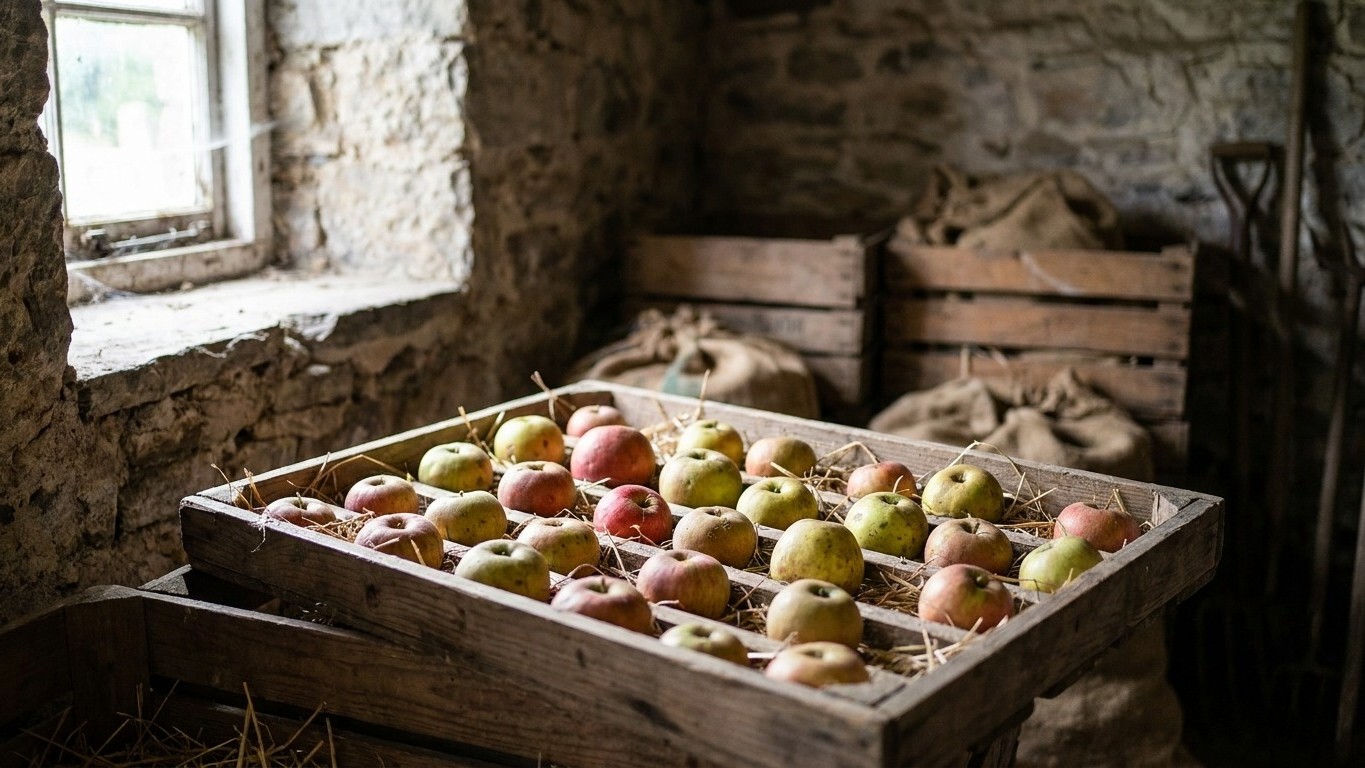
Long storage comes down to temperature, humidity, and airflow, in that order of importance. Apples held near 32°F to 34°F with high humidity, in the 90 to 95% range, will stay firm and lose the least moisture. A standard kitchen refrigerator gets close on temperature but usually runs too dry, which is why apples stored loose in the crisper drawer shrivel faster than apples stored in a perforated plastic bag that traps some humidity around the fruit without sealing in the ethylene gas they give off.
An unheated basement, root cellar, or attached garage can substitute for refrigeration in Pennsylvania, but the state’s own winter cold is a double-edged tool here. With Philadelphia’s coldest-month mean daily minimum at 26.0°F, an uninsulated garage or an unheated porch can dip below freezing on plenty of nights across a full winter, and apples that actually freeze solid turn mealy and brown once thawed. The safer version of a cold-storage setup is an insulated but unheated space, such as a basement corner away from the furnace, where temperatures stay cold but don’t swing below the mid-20s. Growers in the northern tier and at elevation, where winter nights run colder still, need more insulation margin than a Philadelphia-area grower to keep a home storage spot in the safe range rather than the freezing range.
Check stored apples every couple of weeks rather than assuming they’re fine until you need them. Pull anything showing a soft spot, a wrinkled patch, or a sweet fermenting smell, since those are the early signs of the same spoilage that will otherwise spread through a box. Keeping apples away from potatoes and other ethylene-sensitive produce, and away from anything already ripening fast, slows the chain reaction that ethylene gas triggers in a shared storage space. Penn State Extension, the land-grant extension service for the state, publishes seasonal growing and storage guidance for home and commercial growers at extension.psu.edu, and it’s the closest thing to a county-level resource for adjusting these general figures to a specific location.
What goes wrong here
The single most common loss in a Pennsylvania orchard, backyard or commercial, is a warm stretch in late March followed by a hard freeze in early April. Since the state’s last spring frost window runs March 29 to April 6 in the Philadelphia area, a run of 60-degree days ahead of that window can push blossoms open early, and the frost that follows can kill the open flowers outright, cutting the year’s crop before it starts. There’s no variety trick that fully avoids this in Pennsylvania’s climate, since the state doesn’t have the kind of consistently mild winter that would make an early-flowering, low-chill variety worth the trade-off; here, the safer play is standard-chill varieties that flower on the normal schedule, accepting that an unusually warm early spring is a genuine risk rather than something to design around.
The second common failure is picking on the calendar instead of the fruit. An apple pulled two weeks before it’s actually mature won’t ripen properly off the tree, and one left two weeks too long turns mealy and drops fruit rot risk in storage. Skipping the twist test and the background-color check, and going by a date printed on a nursery tag instead, is how a lot of home growers end up with a disappointing batch despite doing everything else right.
The third is storage temperature swings, particularly freezing fruit in an unheated space during a cold snap, or leaving apples in a warm mudroom where they soften in days instead of months. Both mistakes trace back to the same gap: treating “cold storage” as a single setting rather than a range that needs checking against actual overnight lows for the specific location.
Common questions
What month do apples ripen in Pennsylvania?
There’s no single month; ripening runs from late July for the earliest varieties to late October for the latest, and the exact date shifts with how early or late spring bloom fell, plus whether the orchard sits in the milder southeast or the colder northern tier and Alleglonies.
Do apples keep ripening after they’re picked?
Apples continue to soften and convert starch to sugar after harvest, which is why fruit picked slightly early for storage still reaches good eating quality over time, but they won’t develop the full color and sugar level of fruit left to mature fully on the tree.
Can stored apples freeze over a Pennsylvania winter?
Yes, in an uninsulated space. With the Philadelphia area’s coldest-month mean daily minimum at 26.0°F, an unheated garage, porch, or shed can dip below freezing on many winter nights, and apples that freeze solid turn soft and brown once they thaw.
Where can I find harvest timing specific to my county?
Penn State Extension publishes regional growing guidance for the state at extension.psu.edu, and it’s the most reliable place to adjust the general Philadelphia-area dates in this guide to conditions further north or at higher elevation.