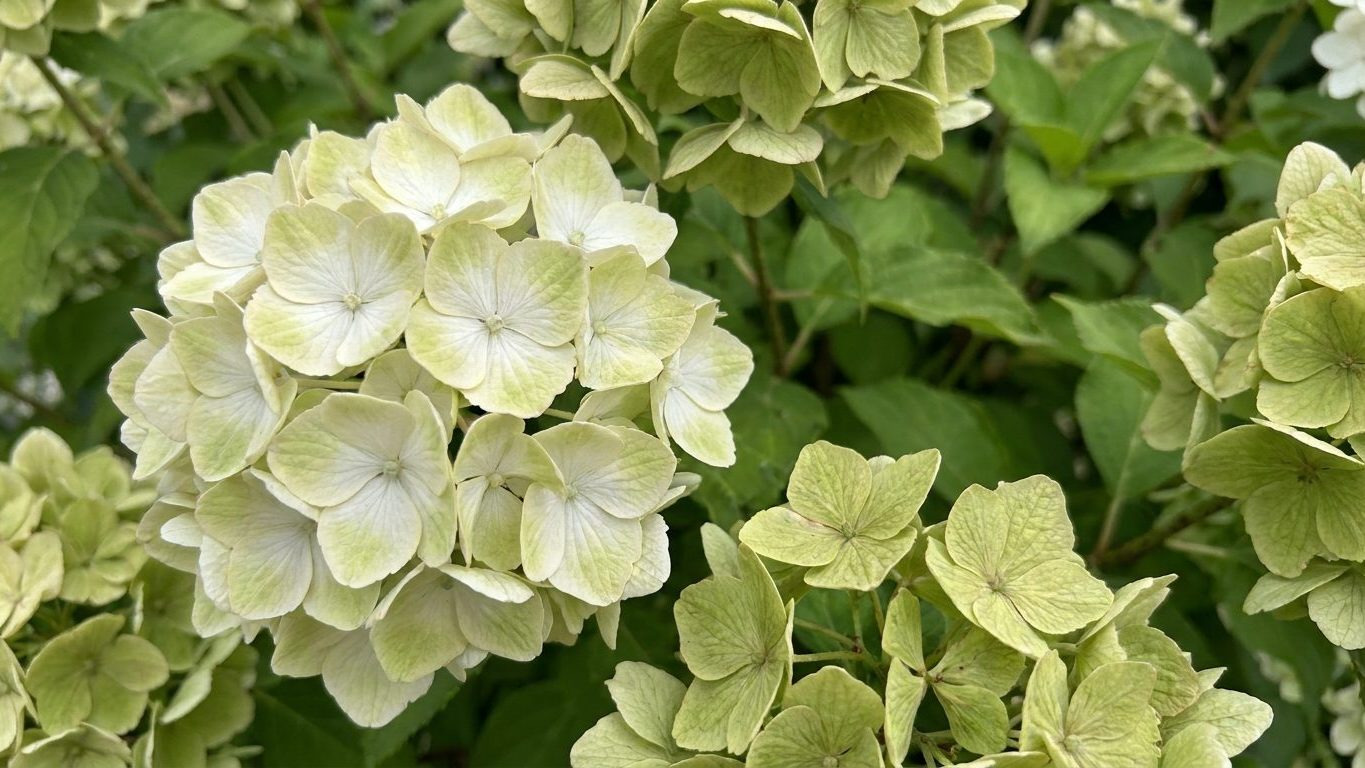

Green hydrangea flowers are almost always a natural aging shift, not a disease. As blooms mature past their peak, the sepals start producing chlorophyll, and white or pale flowers pick up green tones from the edges inward. It matters most because gardeners assume something has gone wrong with soil pH, and that assumption sends them down the wrong fix.
What you are looking at
Look closely at the individual sepals, the papery petal-like structures that make up the flower head, not the leaves. Green shows up first at the base or the outer edge of each sepal, then spreads inward as the bloom ages through summer into fall. On a panicle hydrangea, a bloom that opened pure white in June can carry green streaks by August and finish the season almost entirely lime-green or dusty rose. That progression, white to green to pink or tan, is the normal life cycle of the flower head, not a symptom.
What this is not: leaf spot, powdery mildew, and bacterial wilt all attack the foliage, not the flower sepals, so if the green color is confined to the blooms and the leaves look clean, disease is off the table. Powdery mildew leaves a white, dusty film on leaf surfaces. Leaf spot shows as distinct brown or purple-ringed lesions on foliage. Bacterial wilt causes leaves and stems to collapse. None of these produce a uniform green tint spreading across an otherwise healthy flower head.
Which types show it most
| Type | Blooms on | Color behavior |
|---|---|---|
| Panicle (H. paniculata) | current season’s growth | white/cream fades to green, then pink or tan as it ages, regardless of soil |
| Smooth (H. arborescens) | new wood | same aging pattern, whatever the soil |
| Oakleaf (H. quercifolia) | old wood | same aging pattern, whatever the soil |
| Climbing (H. petiolaris) | old wood | same aging pattern, whatever the soil |
| Bigleaf / mop-head (H. macrophylla) | old wood | color tied to pH (blue/pink/purple); green appears mainly on white cultivars as blooms age past peak |
| Mountain (H. serrata) | old wood | color tied to pH like bigleaf; green aging is less common but can occur on white forms |
What actually causes it
The mechanism is straightforward: chlorophyll builds up in the sepals as the bloom passes maturity. Sepals are modified leaves, and like leaves they can produce green pigment, especially once the anthocyanins that gave the flower its white, pink, or blue color start to break down late in the season. This is a seasonal, age-driven change, and for four of the six common types, it has nothing to do with soil pH. The genus source is direct on this point: panicle, smooth, oakleaf and climbing hydrangeas go white, cream, pink or green as the season ages, whatever the soil.
Here is where the common explanation goes wrong. Soil pH controls color only for bigleaf and mountain hydrangeas, and only along the blue-purple-pink spectrum: blue below about pH 5.5, pink above about pH 6.5, purple in between. Green is not part of that scale. So a gardener who sees green blooms on a panicle hydrangea and rushes to test soil pH, or adds aluminum sulfate hoping to “fix” the color, is solving a problem that does not exist for that plant. The green is simply the flower aging on schedule.
If you need to tell causes apart, use timing and type together. A white panicle bloom greening in late summer, on schedule with the rest of the shrub, is normal aging. A bigleaf or mountain hydrangea flower turning green while still young, out of step with its neighbors, or paired with wilting leaves or leaf spots, points to a separate stress or disease issue and deserves a closer look at the foliage, not the flower color chart. High-phosphorus fertilizer is a separate story: it locks up aluminum in the soil and pushes blue bigleaf flowers toward pink, which is a feeding decision showing up as a color shift, not the greening pattern discussed here.
What to do now
If the green tint is on a panicle, smooth, oakleaf, or climbing hydrangea, there is nothing to fix. The bloom is doing exactly what it is supposed to do at this point in the season, and leaving it in place lets it finish its natural transition to green, pink, or tan, which many gardeners actually value for late-season interest and dried-flower use. Cutting the truss now only sacrifices weeks of color you would otherwise get for free.
If you are seeing green on a bigleaf or mountain hydrangea and the flower is small, early, or accompanied by damaged foliage, that individual truss will not turn a different color no matter what you do this season. Once a flower head has started to green and shrivel, it will not recover its original hue. The move is to focus on the buds still forming and the plant’s overall condition rather than trying to rescue the one bloom already past its point of change.
Check the leaves while you are at it. Aphids, scales, mites, and nematodes are named as occasional pests on hydrangeas, though the source calls them rarely a problem, and deer are the pest most likely to leave visible damage, since they browse the foliage and buds. If leaves show chewing damage alongside the greening flowers, deer browsing, not the flower’s natural cycle, is worth addressing separately.
One safety note if there are kids or pets in the yard: only bigleaf hydrangea is documented as toxic, and only in large quantities, causing nausea, stomach pain, vomiting, and sweating in people, dogs, cats, and horses. A green, aging flower head is no more or less risky than a fresh one; the toxic principle is in the bark, flowers, leaves, and stems throughout the plant’s life, not something triggered by the color change.
What does not work
Adding aluminum sulfate to “bring back” a green panicle or oakleaf bloom does nothing, because those types do not respond to soil pH at all. You will acidify the soil for no visible benefit to the flower color, and on a plant that was never part of the blue-pink-purple system in the first place.
Coffee grounds and citrus peel scattered around the base of the plant are a widely repeated fix, but the pH shift they produce is very small, far too small to move a bigleaf hydrangea’s color reliably, let alone reverse a panicle hydrangea’s natural greening. What actually shifts bigleaf and mountain flower color is available aluminum in the soil, released under acidic conditions, and kitchen scraps are not a controlled or consistent way to deliver that.
Foliar sprays marketed to “green-proof” or “color-lock” hydrangea blooms do not stop the sepals from producing chlorophyll as they age. The greening is an internal pigment shift tied to the flower’s maturity, not a surface deficiency a spray can correct.
Lime added to soil that already sits in the neutral-to-alkaline range will not push a bigleaf hydrangea toward a different color if the soil was never acidic to begin with, and it certainly will not affect greening in panicle, smooth, oakleaf, or climbing types, since their aging color has no connection to soil chemistry. Pruning off green blooms early in the hope that a fresh flush will stay white also fails: the next flush will follow the same seasonal pattern once it reaches the same age.
Preventing it next time
The single change that matters most is adjusting your expectations by type before the season starts, rather than reacting to green blooms after the fact. Know whether your shrub is a panicle, smooth, oakleaf, or climbing hydrangea, all of which will green with age no matter what you do, versus a bigleaf or mountain hydrangea, where color is governed by soil pH and aluminum availability instead.
For panicle types specifically, some gardeners time major cuts for arrangements to the point just before green starts showing, catching blooms at peak white or cream. Since panicle hydrangeas flower on the current season’s growth, this doesn’t require worrying about last year’s buds the way it does with old-wood types.
For bigleaf and mountain hydrangeas, keep soil drainage consistent and mulch over the shallow root system; both macrophylla and paniculata are shallow-rooted and benefit from it. This keeps aluminum uptake steady, which stabilizes flower color and reduces the odd green streaking that can show up on stressed, unevenly watered plants. Avoid high-phosphorus fertilizer near blue bigleaf hydrangeas if you want to keep that color, since it locks up the aluminum the plant needs.
Leave spent flower heads standing into winter where practical. It doesn’t prevent greening, since that’s a normal stage of the bloom’s life, but it lets dead hollow stems serve as nesting sites for native bees, and the plant should be cut back to 12 to 24 inches only once those stems have started to disintegrate.
Common questions
Is a green hydrangea flower dying?
Not necessarily. Green is a normal late-stage color for panicle, smooth, oakleaf, and climbing hydrangeas, and the bloom often stays attractive through fall in that state. On bigleaf or mountain hydrangeas, greening usually means the individual flower has passed its peak, though the plant itself is fine.
Can I turn a green flower back to white or pink?
No. Once chlorophyll builds up in the sepals, that particular flower head will not return to its earlier color. New buds forming later will open in their normal color and follow the same aging pattern in turn.
Does soil pH cause hydrangea flowers to turn green?
No, not for panicle, smooth, oakleaf, or climbing hydrangeas, which green with age regardless of soil. Soil pH only governs the blue-pink-purple spectrum in bigleaf and mountain hydrangeas, and green is not part of that pH-driven range.
Should I cut off green flowers?
Only if you dislike the look. It does not harm the plant to leave them, and on panicle hydrangeas especially, the green-to-pink or green-to-tan transition is often left in place for late-season and dried-arrangement interest.