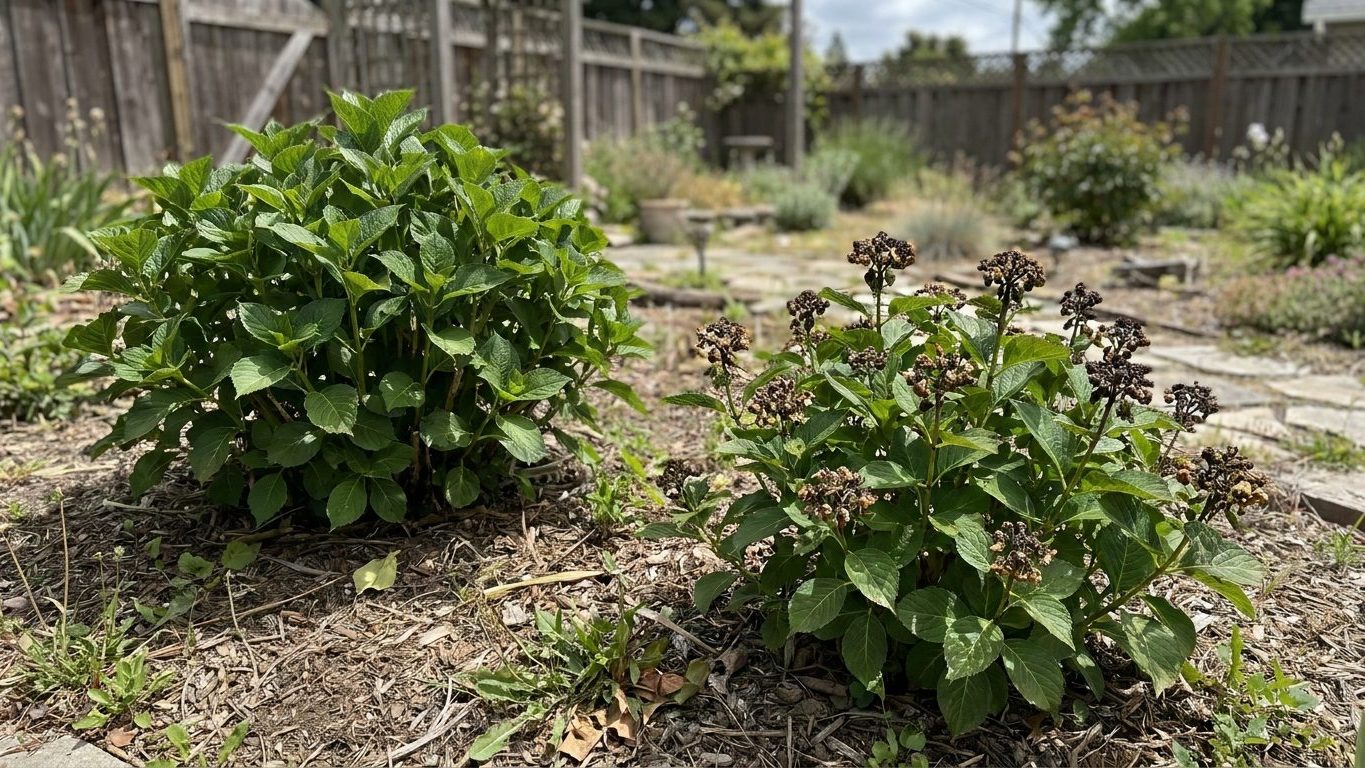

A hydrangea with plenty of green leaves but no flowers is not dying. It usually means the flower buds were removed, frozen, or never had enough light to form in the first place, and the fix depends entirely on which type of hydrangea is standing in front of you.
What you are looking at
Start by looking at where the flowers should be and what state the buds are in, because “no bloom” actually covers three different pictures. The first is a plant that looks perfectly healthy, has plump green leaves and vigorous new stems, but simply produces no flower buds anywhere, on old or new wood. The second is a plant that did form buds, visible as small tight clusters at the stem tips in spring, but those buds turned brown or black and shriveled before opening. The third is a plant that flowered fine last year and this year has fewer, smaller trusses, or blooms only near the base while the top stays bare.
Each picture points somewhere different. No buds at all, on a plant with lots of new growth, usually means the wood carrying last year’s buds was cut off or the plant sits in too much shade. Blackened buds that never opened point to frost damage on old-wood types, since those buds form the previous summer and sit exposed through winter and early spring. Sparse or lower-only blooms often mean deer have browsed the upper stems, which shows up as ragged, torn stem ends rather than the clean cut of pruning shears.
What this is not: it is not the same as a slow bloomer that simply flowers later in the season, and it is not always disease. Bud blight, named specifically on panicle hydrangea, causes buds to fail and brown in a way that can look identical to frost damage, so if you have a panicle hydrangea with dead buds and no obvious frost event, disease belongs on the list of suspects too. Powdery mildew, leaf spot and bacterial wilt affect foliage more than flower buds directly, so a leafy but spotted plant with no blooms usually has a separate, unrelated cause for the missing flowers.
What actually causes it
The single biggest reason a hydrangea fails to bloom is that the answer depends entirely on which type you have, and most bad advice online ignores that split. Bigleaf, oakleaf, mountain and climbing hydrangea all set their flower buds on old wood, meaning the buds that should open this spring were actually formed the previous summer. Cut the plant back in fall, winter or early spring, and you cut off next year’s flowers along with the stems. This is the single most common cause of a mop-head or oakleaf hydrangea with lots of leaves and zero blooms.
Panicle hydrangea and smooth hydrangea (the Annabelle type) work the opposite way: they flower on the current season’s growth, so a hard cut in late winter does not remove flowers, it just resets the plant. If one of these types is not blooming, wrong-season pruning is far less likely the cause; look instead at light and fertilizer.
The myth worth killing here is that a hydrangea skips a year “for no reason” or because it is unhealthy. It almost never is. For old-wood types, a late frost after the buds have swelled is a completely mechanical cause, killing tissue that was already formed months earlier and that the plant cannot regrow in time for that season. Too much shade is another quiet cause: bigleaf hydrangea wants dappled sun or partial shade and tolerates deep shade, but deep shade tends to trade flower production for foliage. Heavy nitrogen fertilizer pushes the same trade in the same direction, feeding leafy growth at the expense of flower buds.
To tell these apart, check the wood first. If buds never formed anywhere, suspect pruning timing or shade. If buds formed then died, suspect frost or, on panicle hydrangea specifically, bud blight. If blooms are present but thin and only low on the plant, suspect deer browsing the upper stems.
What to do now
Be honest about what is already lost this season. If old wood was pruned off, or if formed buds were killed by frost, this year’s blooms on those stems are gone and nothing will bring them back. There is no rescue spray or feeding schedule that regrows a bud that has already died. The plant is not damaged long-term by this, but the flower show for this year is over on those particular stems.
What is worth doing is protecting whatever buds remain and setting up next year’s flowers correctly. On old-wood types, stop pruning immediately if you have not already, since any wood left standing now is what carries next year’s buds. Exact pruning timing and winter protection depend on your USDA zone and your type of hydrangea, so that decision belongs on a page specific to your state and variety rather than a blanket date here.
Check light exposure. If a bigleaf hydrangea sits in more than dappled shade or gets strong afternoon sun, both extremes reduce flowering; morning sun with afternoon shade is the sweet spot for that type specifically. Panicle hydrangea is the exception in the genus and is the one type that takes full sun well, so moving it into more light, not less, tends to help.
Cut back on nitrogen. If you have been feeding a leafy, bloomless hydrangea a general lawn or foliage fertilizer, stop, and let the plant’s own energy go toward setting buds rather than growing more leaves. Mulch around the base, since both bigleaf and panicle hydrangea are shallow-rooted and mulch protects that root zone and helps even moisture, which supports bud formation over the following season rather than this one.
What does not work
Gardeners who see no flowers often reach for the same fixes used on calcium-deficient vegetables: crushed eggshells worked into the soil, foliar calcium sprays, a dose of garden lime. None of it addresses why a hydrangea fails to bloom. Flower buds fail because the wood carrying them was cut off, frozen, or starved of light, not because the plant is short on calcium, so feeding calcium in any form changes nothing about bud formation.
Lime does exactly one measurable thing to a hydrangea: it raises soil pH, which on bigleaf and mountain hydrangea specifically pushes flower color toward pink. It has no effect on panicle, smooth, oakleaf or climbing hydrangea color, and on none of the six types does it cause a single new flower bud to form. Treating lime as a bloom fix confuses a color mechanism with a completely separate biological process.
Coffee grounds and citrus peel worked into the soil are a widely held belief for turning bigleaf and mountain hydrangea flowers blue, and the logic sounds reasonable: they are mildly acidic, and acidity is part of the real mechanism. But the pH shift from kitchen scraps is very small, and what actually moves flower color is available aluminum in the soil, which acidity unlocks rather than creates. Coffee grounds alone rarely acidify soil enough to matter, and again, this whole conversation is about color, not about whether the plant blooms at all.
High-phosphorus “bloom booster” fertilizers are sold on the promise of more flowers, but phosphorus’s documented effect here is different: it locks aluminum in the soil, which pushes blue flowers toward pink on bigleaf and mountain types. That is a color shift again, showing up disguised as a feeding decision, not a fix for a plant that is not flowering.
Preventing it next time
The single change that prevents most non-blooming hydrangea problems is matching pruning to your type and pruning at the right time for it. Old-wood types (bigleaf, oakleaf, mountain, climbing) should not be cut back after their buds have formed for next year; new-wood types (panicle, smooth) tolerate a hard late-winter cut without losing flowers. Exact calendar dates shift by zone, so check the guidance for your state and your specific hydrangea type before you pick up shears.
After pruning timing, light placement matters most. Bigleaf hydrangea wants dappled or partial shade with protection from harsh afternoon sun; panicle hydrangea is the one type in the genus built for full sun. Getting this backward, planting a bigleaf hydrangea in blazing afternoon exposure or a panicle hydrangea in deep shade, quietly suppresses flowering year after year even when nothing else is wrong.
Keep an eye on late-season frost risk for old-wood types, since their buds form the previous summer and sit through winter already formed, vulnerable if a cold snap hits after they have started to swell. Moderate nitrogen fertilizer rather than feeding heavily for foliage, mulch the shallow root zone on bigleaf and panicle hydrangea to even out soil moisture, and if deer have been documented browsing your plant, protect the upper stems through winter; hydrangeas are not resistant to deer, they are simply grazed on inconsistently depending on what else is available nearby.
Common questions
Is a hydrangea that will not bloom dying?
No. A non-blooming hydrangea is almost always a healthy plant with a mechanical or environmental problem, wrong-time pruning, frost damage to old-wood buds, too much shade, or too much nitrogen. The plant itself is rarely at risk from a missed bloom season.
Will a hydrangea bloom again next year if it does not bloom this year?
Usually yes, once the cause is corrected. Old-wood types need their current wood left alone through the right window so buds can form; new-wood types like panicle and smooth hydrangea reliably bloom the following season on regrowth after even a hard cut.
Does adding lime make a hydrangea bloom?
No. Lime raises soil pH and shifts flower color toward pink on bigleaf and mountain hydrangea only. It has no documented effect on whether any hydrangea type produces flower buds.
Are all hydrangeas toxic if they will not bloom and I want to remove one?
Only bigleaf hydrangea is documented as toxic, and only if large quantities are eaten, causing nausea, stomach pain, vomiting and sweating in people, dogs, cats and horses. The toxic compounds are in the bark, flowers, leaves and stems. This is not a reason to remove a plant, just a reason to keep grazing animals and small children away from mouthfuls of it.