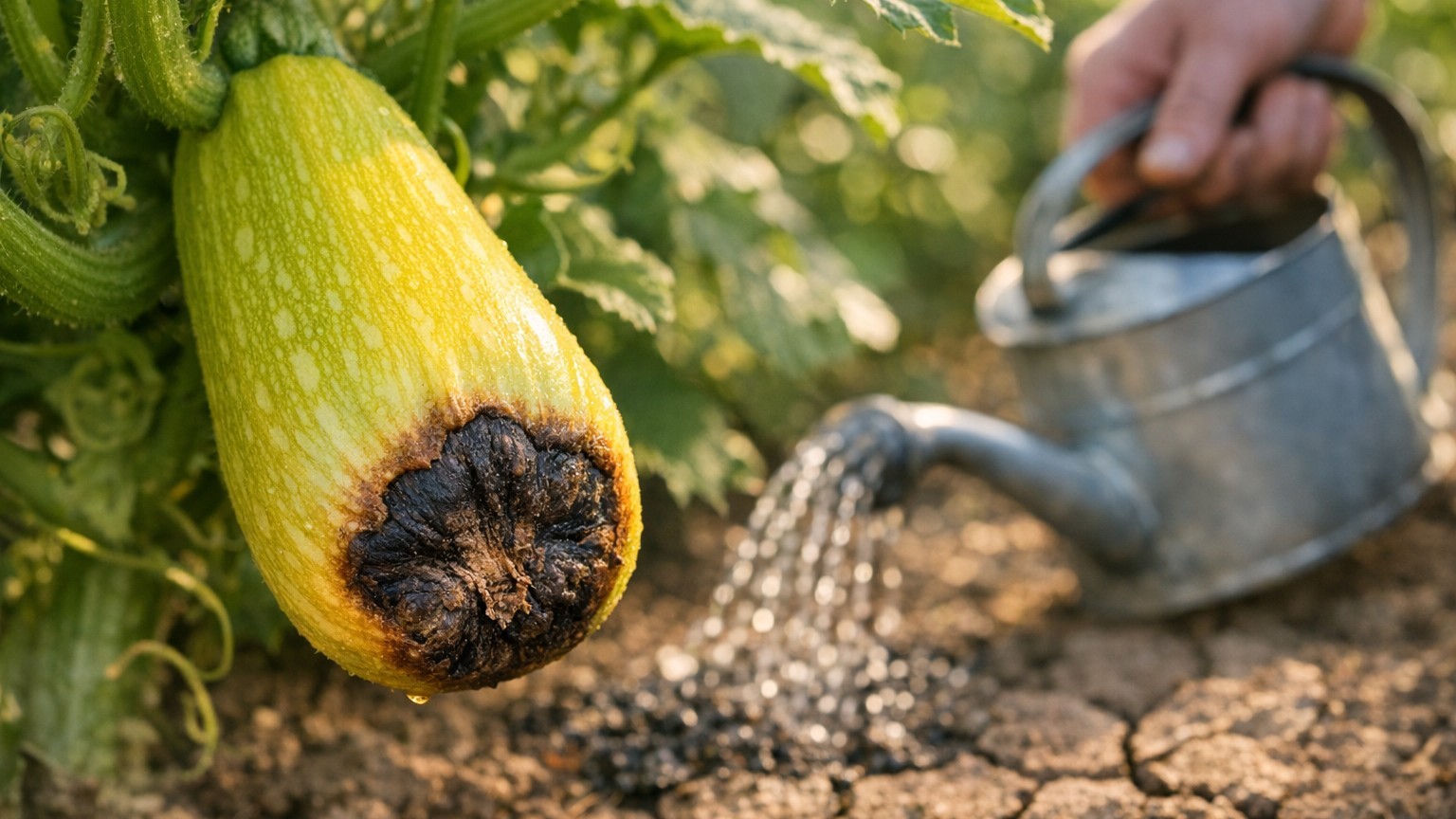

Blossom end rot on summer squash comes from a calcium delivery problem, not a calcium shortage in the soil and not a disease. The fruit’s blossom end stops getting the calcium it needs because water supply to the plant has been uneven, so the fix is watering consistency, not lime, not a calcium spray, and definitely not a fungicide.
What is actually going on

The thing to understand here is calcium transport. Plants don’t move calcium the way they move sugars or nitrogen. Calcium travels almost exclusively through the xylem, the water-carrying tissue, and it moves passively, riding along with the water the plant pulls up from the roots. There’s no active pumping mechanism sending extra calcium toward a developing squash. It goes wherever the water flow takes it, and it goes in proportion to how much water is moving.
That matters because a summer squash plant is putting most of its water toward the leaves. Leaves transpire constantly, pulling a steady current of water (and the calcium riding in it) up through the stem. Developing fruit, by comparison, is a weak sink. It transpires very little, so it only gets calcium when there’s enough water moving through the whole plant to spare some for that low-demand destination. Cut the water supply for even a day or two during a critical growth window, and the leaves keep pulling what little moisture is available while the fruit gets shorted first.
This is why soil tests so often come back with plenty of calcium even on plants showing textbook blossom end rot. The mineral is sitting right there in the root zone. The problem is delivery, not supply, and it’s specifically a problem of inconsistency rather than of drought alone. A squash plant that gets steady moderate water all season rarely shows the symptom even in soil with modest calcium levels. A squash plant that swings between soaked and bone-dry, even with rich soil underneath it, develops sunken, leathery brown patches at the blossom end with predictable regularity.
The timing window is narrow. Calcium has to be delivered while the fruit’s cell walls are actively forming, which is early in fruit development, in the first several days after the flower fades. A dry spell that hits during that window does the damage even if you correct the watering immediately afterward. The fruit already affected won’t heal. What changes is whether the next fruit, forming a few days later, gets a better run at it. This is one reason gardeners often see the problem clear up on its own as the season goes on: watering habits, rainfall, and the plant’s root system all tend to stabilize as summer progresses, even without any deliberate change on the gardener’s part.
In the garden
Because this is a plumbing problem and not a nutrition problem, the fixes that work are the ones that smooth out water delivery, and the fixes that don’t work are the ones aimed at adding more calcium. The table below runs through the common scenarios.
| Situation | What goes wrong | What to do instead |
|---|---|---|
| Watering only when the soil looks dry, in big soaks | Long dry stretches followed by a flood mean calcium delivery starts and stops instead of staying steady, and fruit forming during the dry stretch gets shorted | Water on a schedule tied to soil moisture at root depth, aiming for a consistent, moderate supply rather than a rescue soak |
| Bare soil around the plant | Soil moisture swings hard between a rainstorm and the next hot afternoon, with nothing slowing the loss | A few inches of mulch over the root zone evens out moisture between waterings |
| Growing in a container or raised bed | Smaller soil volume dries out far faster than an in-ground bed, so a missed watering hits harder and faster | Check containers daily in hot weather and expect to water more often than an in-ground planting |
| Heavy fruit set all at once | Several fruits demanding calcium in the same window can outpace what steady watering alone supplies, especially in a plant already stressed | Keep watering steady rather than trying to compensate with extra fertilizer, which does not address the delivery issue |
| Reaching for a calcium spray or soil amendment at the first sign | Foliar calcium barely moves into fruit tissue and soil calcium that’s already adequate doesn’t fix a transport problem | Adjust the watering routine; treat the amendment as unnecessary unless a soil test shows an actual deficiency |
| Heavy nitrogen fertilization early in the season | Fast, lush leaf growth increases the plant’s water demand and competes even harder with fruit for available calcium | Keep nitrogen moderate once fruiting starts and let root and fruit development balance against leaf growth |
Removing already-affected fruit is worth doing too, though it fixes appearance and plant energy allocation more than it fixes the underlying cause. A squash with a small dry patch at the blossom end is still edible once you trim the affected tissue away; the rot itself does not spread through the flesh the way a fungal infection would, since it is dead tissue rather than an active pathogen.
What it depends on where you are
The mechanism behind blossom end rot is the same everywhere squash grows. What changes by region is how often the conditions that trigger it show up, and that comes down to season length, summer heat, and rainfall pattern.
A region with reliable, evenly spaced rainfall through the growing season gives plants a natural buffer against the swings that cause the problem. A region with long dry stretches broken by occasional heavy downpours creates almost the exact watering pattern that produces blossom end rot without any help from the gardener, simply because the sky is doing the watering on an irregular schedule. Heat matters on its own too: higher temperatures push transpiration rates up, meaning the plant pulls water through faster and a shortfall shows up sooner and more severely than the same missed watering would during a cooler stretch.
Soil type shifts the timeline as well. Sandy soils drain fast and dry out within a day or two after watering, which means the margin for error on a missed watering is much smaller. Heavier clay soils hold moisture longer but can also stay saturated after rain in a way that drowns roots and reduces their ability to take up water and calcium efficiently once conditions dry out again. Neither soil type is immune, they just fail on different schedules.
Season length affects how much this problem matters in practical terms rather than how it happens. A gardener with a long, humid growing season may see the symptom mostly in the first flush of fruit before rainfall patterns and root systems settle into a rhythm. A gardener working a shorter, drier season may deal with it for a larger share of the harvest, simply because there’s less time for those swings to smooth out.
None of these regional differences change the underlying fix. They change how vigilant a gardener needs to be about watering consistency, and how much mulch and irrigation planning matter relative to just waiting it out. For guidance tied to actual local rainfall averages, heat patterns, and soil types, a state extension service publishes information specific to that region, and it’s worth checking rather than guessing from national averages.
The mistake that costs the most
The single costliest mistake is treating blossom end rot as a calcium deficiency and responding with a calcium product instead of fixing the watering. It’s an understandable mistake. The name of the problem points straight at calcium, and garden centers sell calcium sprays and soil amendments specifically marketed for this symptom. A gardener sees the sunken patch, looks it up, finds “calcium,” buys the product, applies it, and waits for the next fruit to look better.
It often doesn’t, because the soil rarely lacked calcium in the first place. What it lacked was a steady water supply to carry the calcium that was already there into the fruit during the narrow window when it mattered. Spraying calcium onto leaves does very little for fruit, since almost none of it moves from leaf tissue into developing fruit through the plant’s normal transport pathways. Adding more calcium to soil that already tested adequate just leaves the extra calcium sitting unused, doing nothing for the fruit currently at risk.
The real cost isn’t the money spent on a spray. It’s the time lost while the actual cause, an irregular watering routine, keeps running unchecked through another two or three weeks of fruit development. A gardener who spends that stretch reapplying a calcium product instead of setting up a mulch layer and a consistent watering schedule ends up right back where they started, with a new round of affected fruit and no clearer idea why.
What to do instead is straightforward: check soil moisture at root depth every couple of days during fruiting, water enough to keep it consistently moist rather than alternating wet and dry, and mulch to buy some margin for the days watering gets missed. If a soil test genuinely shows low calcium, that’s a separate and less common situation worth addressing directly. For most home gardens, though, the watering routine is the whole story, and it’s the only lever that actually moves the outcome.