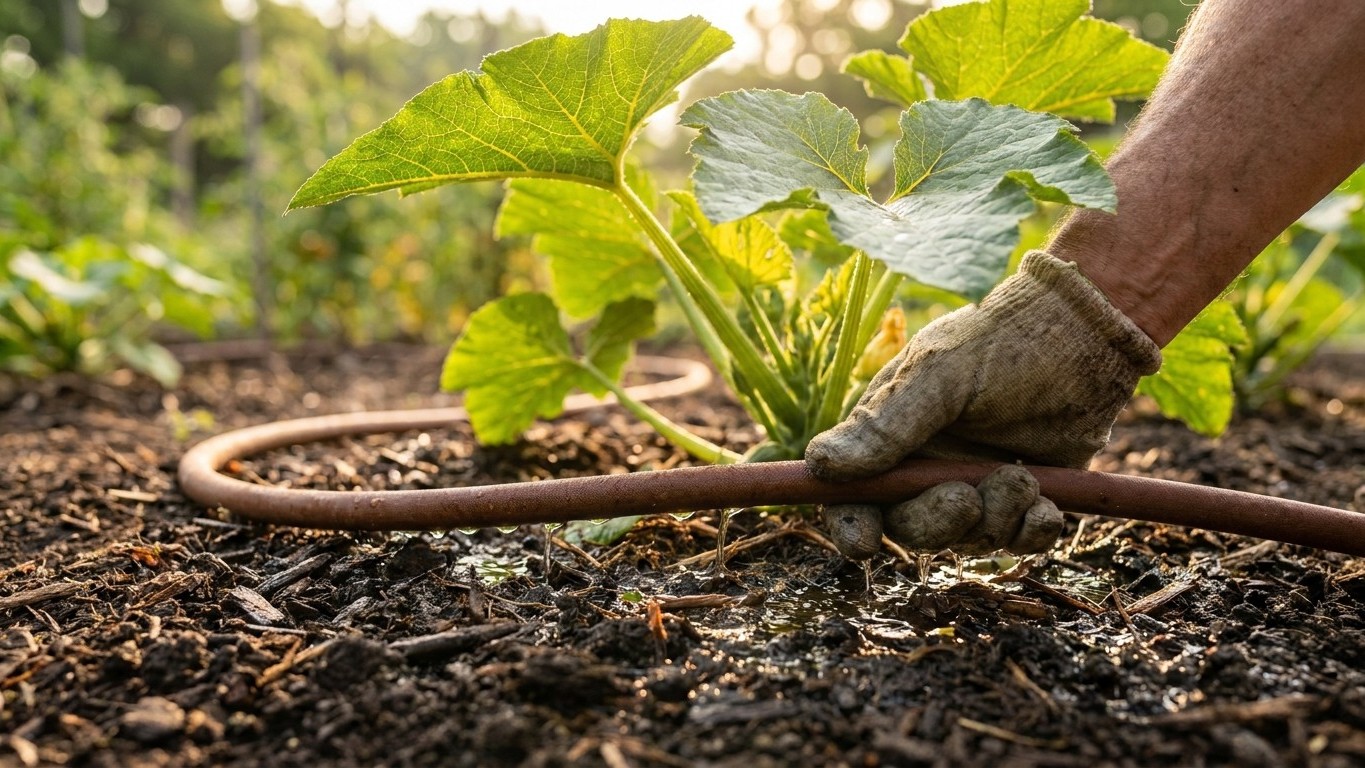

Summer squash needs a deep soak, roughly one to one and a half inches of water a week, delivered slowly at soil level rather than sprinkled from above. The goal isn’t frequency. It’s reaching the roots that actually feed the plant, and keeping the leaves dry enough to avoid fungal trouble.
What is actually going on

The thing to understand here is transpiration. A single summer squash leaf can be the size of a dinner plate, and a healthy plant carries a dozen or more of them. Each one is constantly pulling water up from the soil and releasing it into the air through pores on its underside. On a hot, dry afternoon, that water loss happens fast. A plant that can’t keep up wilts by early evening, even if the soil isn’t technically dry.
That thirst would be manageable if squash had a deep, wide-ranging root system to draw from. It doesn’t. Squash roots form what growers call a root plate: a dense mat concentrated in the top six to twelve inches of soil, spreading out more than it spreads down. That shallow architecture is efficient at grabbing surface moisture after a rain, but it leaves the plant with almost no reserve tank during a dry stretch.
Here’s where watering habits make or break the plant. A light daily sprinkle wets only the top inch or two of soil. The roots respond exactly as you’d expect: they stay shallow, because that’s where the water is. Do this for a few weeks and you’ve built a plant entirely dependent on you showing up every single day. Skip watering during a heat wave or a weekend trip, and that plant has nothing to fall back on.
A deep, less frequent watering does the opposite. Water that soaks down eight to ten inches encourages roots to chase it downward, building a bigger, more resilient root mass that can ride out a dry day or two without drama. This is the same logic that applies to most vegetable garden plants, but it matters more for squash because the leaf-to-root ratio is so lopsided. Big leaves, shallow roots: that combination is exactly why squash punishes bad watering habits faster than, say, a tomato plant with a taproot reaching two feet down.
Soil texture changes the math too. Sandy soil drains fast and needs more frequent deep watering to keep pace. Clay holds moisture longer but drains poorly, so overwatering clay-planted squash is a real risk, one that shows up as yellowing leaves and root rot rather than wilting. Neither soil type changes the underlying principle. Both call for water delivered slowly, at depth, at the root zone.
In the garden
Translating that mechanism into a weekly routine comes down to three variables: how much water, how often, and where it lands. Get any one of them wrong and the plant tells you, usually within days.
| Watering approach | What it looks like | What happens when it goes wrong |
|---|---|---|
| Deep, infrequent soaking | 1 to 1.5 inches of water per week, applied in one or two sessions, soaking 8 to 10 inches down | Done correctly, roots grow deep and the plant tolerates short dry spells without wilting |
| Light, frequent sprinkling | A quick pass with a hose or sprinkler most days, wetting only the top inch or two | Roots stay shallow, the plant wilts fast in heat, and any gap in watering causes stress |
| Overhead watering | Sprinklers or a hose spraying the whole plant, leaves included | Wet foliage that stays damp overnight becomes a breeding ground for powdery and downy mildew |
| Soil-level watering | Water applied directly to the base of the plant, avoiding the leaves entirely | Keeps foliage dry and cuts mildew risk dramatically, at the cost of slightly more setup effort |
| No mulch | Bare soil around the base of the plant | Moisture evaporates quickly, watering has to happen more often, and soil temperature swings stress the shallow root plate |
| Mulched bed | Two to three inches of straw, shredded leaves, or similar organic mulch around the base | Soil stays evenly moist longer, weeds are suppressed, and watering frequency can drop |
Morning watering has a practical edge over evening watering, and it isn’t about the plant’s schedule so much as the humidity window it creates. Water applied in the morning gives any splashed foliage hours to dry out under the sun. Water applied at dusk sits on the leaves overnight, and that prolonged dampness is exactly what fungal spores need to establish. This is why watering the leaves is less a watering question than a disease-prevention one: the volume of water matters for the roots, but the placement of that water matters for what grows on the leaf surface.
Drip irrigation or a soaker hose solves both problems at once, delivering water slowly and directly to the soil while keeping foliage completely dry. For a handful of plants in a home garden, a hand-held hose with the nozzle aimed at the base works nearly as well, provided the habit is deep and slow rather than quick and wide. Checking soil moisture with a finger pushed two inches down, rather than watering on a fixed calendar, catches the variation that weather always introduces.
What it depends on where you are
Everything above (deep watering, dry foliage, roots chasing moisture downward) holds true no matter where the plant is growing. What doesn’t hold constant is how often that deep watering needs to happen, and that’s where local conditions take over from general principle.
Season length sets the outer boundary. A shorter growing season means less margin for a stressed plant to recover from a dry spell, since there’s less time left in the year to make up for a slow patch. Summer heat changes the water budget directly: a plant transpiring in consistent 95-degree afternoons is losing far more water per day than the same plant in a mild 78-degree stretch, even though the weekly watering guideline of an inch or more stays the same starting point. And summer rainfall patterns decide how much of that water the sky delivers for free versus how much falls on the gardener to supply by hose or drip line.
Regions with humid, rain-heavy summers face a different failure mode than dry regions. There, the risk tilts toward too much water and too much leaf moisture, with fungal disease pressure often the bigger threat than drought stress. In arid regions with long dry stretches, the risk flips toward underwatering and a root plate that never gets the chance to establish deeply because the topsoil dries out between waterings faster than the plant can adjust.
None of that is something a national page can resolve with a single number, because the honest answer changes by state, by microclimate, and even by which side of a property gets afternoon shade. This is exactly the gap that state-level growing guides are built to fill, matching watering routines to the actual heat, rainfall, and season length of a specific region. The reader’s own state Cooperative Extension office is the other resource worth using directly. Extension horticulturists track local rainfall data, soil types, and disease pressure year over year, and many publish specific watering and irrigation guidance for vegetable gardens in that state. A quick search for “[state name] cooperative extension vegetable garden watering” usually turns up a program-specific fact sheet built for that exact climate, which a general guide like this one simply can’t replicate.
The mistake that costs the most
Of everything that can go wrong with a squash plant’s water supply, one habit costs gardeners more than all the others combined: watering lightly, every day, because it feels attentive and looks like care.
It isn’t neglect that trains a squash plant into fragility. It’s this exact instinct, the daily few seconds with the hose that wets the surface and stops there. The plant responds by keeping its roots shallow, because that’s where the water shows up. Weeks pass, the plant looks fine, and the gardener assumes the routine is working. Then a heat wave hits, or a work trip means three missed days, and the plant that seemed established collapses into wilted leaves and stalled fruit production almost overnight. Inconsistent soil moisture around the root zone during this stage is also a leading contributor to blossom end rot, showing up as a sunken, leathery patch on the blossom end of developing fruit even when the rest of the plant looks healthy.
The fix isn’t more water overall. It’s the same weekly total delivered differently: fewer sessions, each one soaking the soil deeply enough to reach eight to ten inches down, so roots have a reason to grow toward it rather than sit at the surface waiting for the next light pass. Checking the soil with a finger before watering, rather than watering on a fixed daily habit, catches the plants that don’t need it yet and the ones that are further along than they look.
Type of squash doesn’t change this calculus much. Bush types and vining types both build the same kind of shallow root plate, and both respond to deep watering the same way. Rather than chasing a specific variety’s reputation for drought tolerance, a gardener’s local extension service is the better source for which types have performed well in regional trials, since that answer shifts by climate in ways a general growing guide can’t verify. What stays constant everywhere is the underlying rule: water deep, water less often, and keep the leaves out of it.