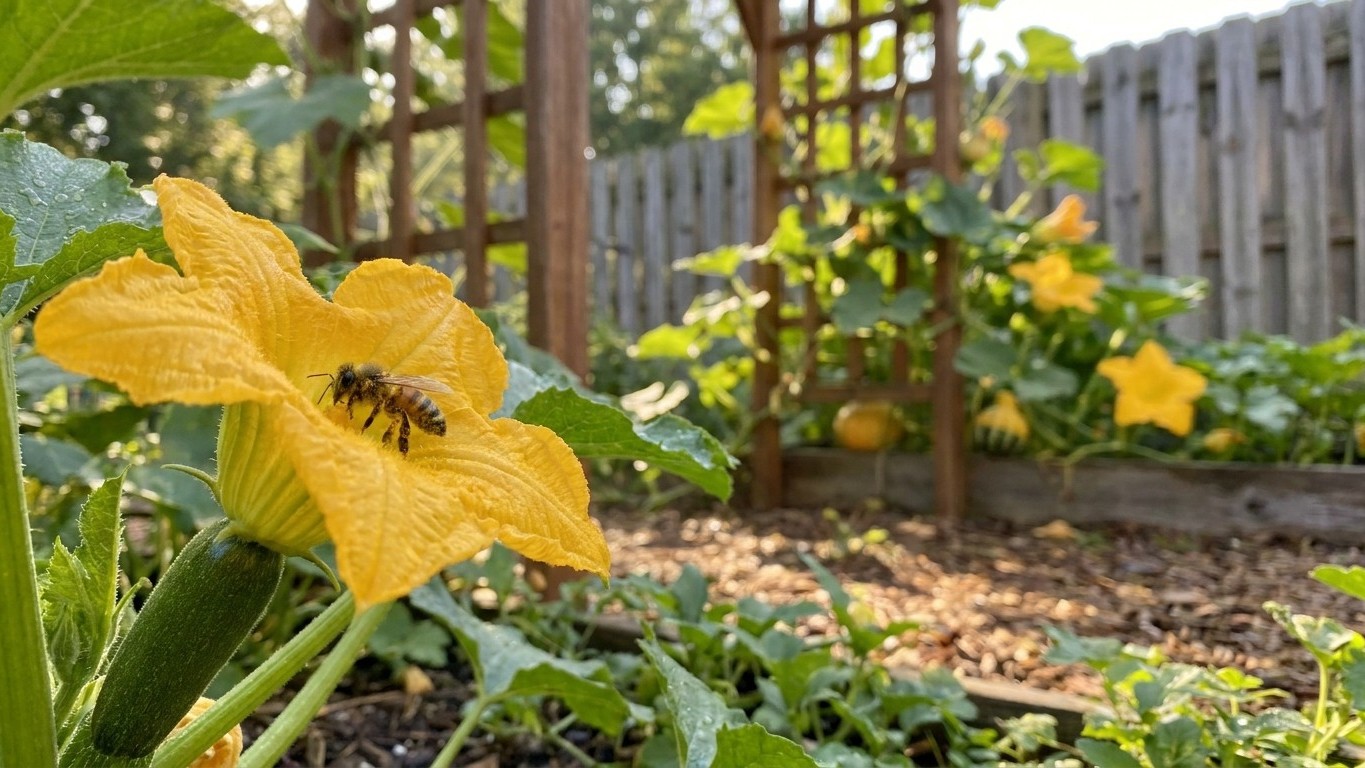

Saved zucchini or crookneck seed rarely grows into the same squash because these plants are insect-pollinated and cross with any other summer squash, ornamental gourd, or pumpkin blooming nearby. The seed itself isn’t unstable; it’s simply carrying pollen from a neighbor’s plant. The fix is isolation or hand-pollination, not better seed-saving technique.
What is actually going on
The thing to understand here is cross-pollination: several distinct squash species share a garden, and some of them interbreed readily while others can’t cross at all. Almost every summer squash grown in home gardens, whether it’s a green zucchini, a yellow crookneck, or a scalloped pattypan, belongs to the same botanical species. That single fact explains most of the mystery seed-savers run into.
Squash flowers are pollinated by bees, and bees don’t respect garden boundaries or plant labels. A bee that visits a female zucchini flower may have picked up pollen from a male flower on an ornamental gourd three yards away, or from a jack-o-lantern pumpkin growing at the edge of the yard, because both of those plants often belong to the same species as garden zucchini. The fruit that forms on the zucchini plant this year will still look and taste like zucchini, because the flesh you eat is the mother plant’s tissue. The cross only shows up in the seeds inside that fruit, and those seeds carry half their genetics from whatever pollen parent the bee delivered.
That’s why the surprise arrives a full season late. A gardener saves seed from a perfectly normal-looking squash in August, stores it over winter, and plants it the following spring expecting the same plant. Instead, the new generation segregates: some fruit might come out warty, some oddly colored, some bitter, some simply misshapen. None of this means the seed was damaged or poorly stored. It means the parent flower was cross-pollinated the previous summer, and the hybrid genetics are only now expressing themselves.
Squash also carries a genetic quirk that makes this riskier than it sounds. A few wild and ornamental relatives in the same species group produce cucurbitacins, bitter compounds that can build up to unsafe levels in fruit when crossbreeding reactivates old traits. It’s uncommon in modern garden varieties, but it’s the reason plant breeders and extension horticulturists take squash isolation seriously rather than treating it as a cosmetic issue. A gardener who wants a bitter fruit shouldn’t be growing squash at all, and a gardener who tastes a mysteriously bitter squash should discard it rather than risk it.
None of this means seed-saving is pointless. It means the plant’s biology, not the gardener’s technique, determines whether saved seed comes true. Understanding which types are actually the same species, and which ones simply look similar, is the piece that changes what happens next.
In the garden
The species groupings matter more than the common names on a seed packet. Zucchini, yellow crookneck, straightneck, pattypan, and most spaghetti-type squash share one species, and so do many pumpkins and ornamental gourds sold at the same garden center. Butternut-type squash belongs to a separate species, and hubbard or buttercup types belong to yet another. Crossing only happens within a species, so knowing which bin a plant falls into is the entire game.
| Planted together | Same species? | What happens if pollen mixes |
|---|---|---|
| Zucchini and yellow crookneck | Yes | Saved seed grows into unpredictable in-between fruit the next year |
| Zucchini and jack-o-lantern pumpkin | Yes | Fruit that year still looks normal, but saved seed produces oddly shaped, sometimes bitter squash |
| Pattypan and ornamental gourds | Often yes | Next generation can revert toward tough, inedible, occasionally bitter gourd traits |
| Zucchini and butternut squash | No | No viable cross forms; seed saved from either type stays true on this point |
| Zucchini and hubbard or buttercup squash | No | Different species; isolation from these types isn’t necessary |
Reading that table the wrong way is the common failure. A gardener who sees butternut squash on the far side of the yard and assumes it’s “the crossing risk” often ignores the ornamental gourds or the neighbor’s pumpkin patch, which are the actual same-species threats. The visual differences between a pumpkin and a zucchini feel enormous to a person, but they mean nothing to a bee or to squash genetics.
What real isolation requires
Extension programs that maintain pure seed lines typically rely on one of two approaches, because bees can carry pollen much farther than most gardeners expect. The first is distance: separating same-species plantings by a large margin, often measured in hundreds of feet rather than garden rows, since a home lot rarely provides enough separation on its own. The second, more realistic for a backyard grower, is hand-pollination: bagging a female flower and a chosen male flower before they open, transferring pollen by hand, then resealing the female flower until the fruit sets. It’s fussy, and it only works if it’s done consistently through the flowering window, but it’s the method that actually guarantees the seed’s parentage regardless of lot size.
Skipping both steps doesn’t ruin this year’s harvest. It just means any saved seed is a gamble, and a gardener who wants predictable results next season should either buy seed again or commit to one of these two isolation methods.
What it depends on where you are
How much any of this matters in practice depends on things this page can’t know about a specific yard. The size of a garden, how many neighbors within bee-flying range grow squash or pumpkins, and how long the local flowering season runs all change the real-world odds of a cross happening. A gardener on an isolated rural lot with no other cucurbits for a half-mile faces a very different risk than one in a dense suburban block where five neighbors all grow zucchini and pumpkins in the same few weeks.
Climate shapes the timeline too, though not in a way that changes the biology itself. Regions with a longer, hotter growing season often see squash plants flower over more weeks, which widens the pollination window and gives bees more opportunities to move pollen between same-species plants. Regions with shorter seasons compress that window, which can, somewhat by accident, reduce crossing simply because there’s less overlap between different plantings’ bloom times. Rainfall and humidity affect flower viability and bee activity on any given day, but they don’t override the basic rule that species compatibility, not weather, decides whether a cross is possible at all.
Local bee populations matter as much as local weather. A neighborhood with strong native bee activity or managed hives nearby will see more thorough cross-pollination than an area with sparse pollinator traffic, where hand-pollination might even be necessary just to get any fruit to set, crossed or not. That’s a detail no national guide can settle, because it depends on local habitat, pesticide use in the area, and whether anyone nearby keeps bees.
This is the point where a state extension service earns its keep. Extension horticulturists track which squash types are widely grown in a given state, what the typical bloom-overlap window looks like locally, and which pollinator conditions are common in that region. The state-level pages on this site cover season length and local growing patterns for summer squash in more detail, and they’re worth checking alongside the extension office for the specific state, since isolation planning only works when it’s built around the actual garden, not a national average.
The mistake that costs the most
The costliest mistake is assuming that because a squash tasted fine this year, its seed is safe to save and replant. That single assumption skips over the fact that this year’s fruit reflects only the mother plant, while next year’s plant reflects both parents, including whatever pollen a bee delivered from a same-species plant somewhere in the neighborhood. A gardener can grow a beautiful, completely normal zucchini all summer and still be saving seed that’s already crossed.
The instinct to trust a good-looking fruit is understandable, but it’s the wrong test. The right test happens before the fruit forms, not after. A gardener serious about saving true seed needs to control pollination at the flower stage, either through real isolation distance or through hand-pollination with bagged flowers, and needs to do it every season, not just in years when something looks off. Skipping that step and relying on taste or appearance as a quality check catches almost nothing, since the bitter-compound risk and the shape and color shifts from crossing don’t usually show up until the seed itself is grown out the following year.
The practical fix is straightforward even if the fussy part is real. Anyone growing more than one type of squash, pumpkin, or ornamental gourd in the same yard, or within range of a neighbor doing the same, should treat any saved seed from open, bee-pollinated flowers as unreliable for producing a true-to-type plant next season. Buying fresh seed for the varieties that matter, and reserving hand-pollination for the one or two plants worth the effort, avoids the entire problem instead of trying to detect it after the fact. That’s less romantic than the idea of a self-sustaining seed supply, but it’s the difference between a garden that behaves predictably and one that turns into a genetics experiment every spring.