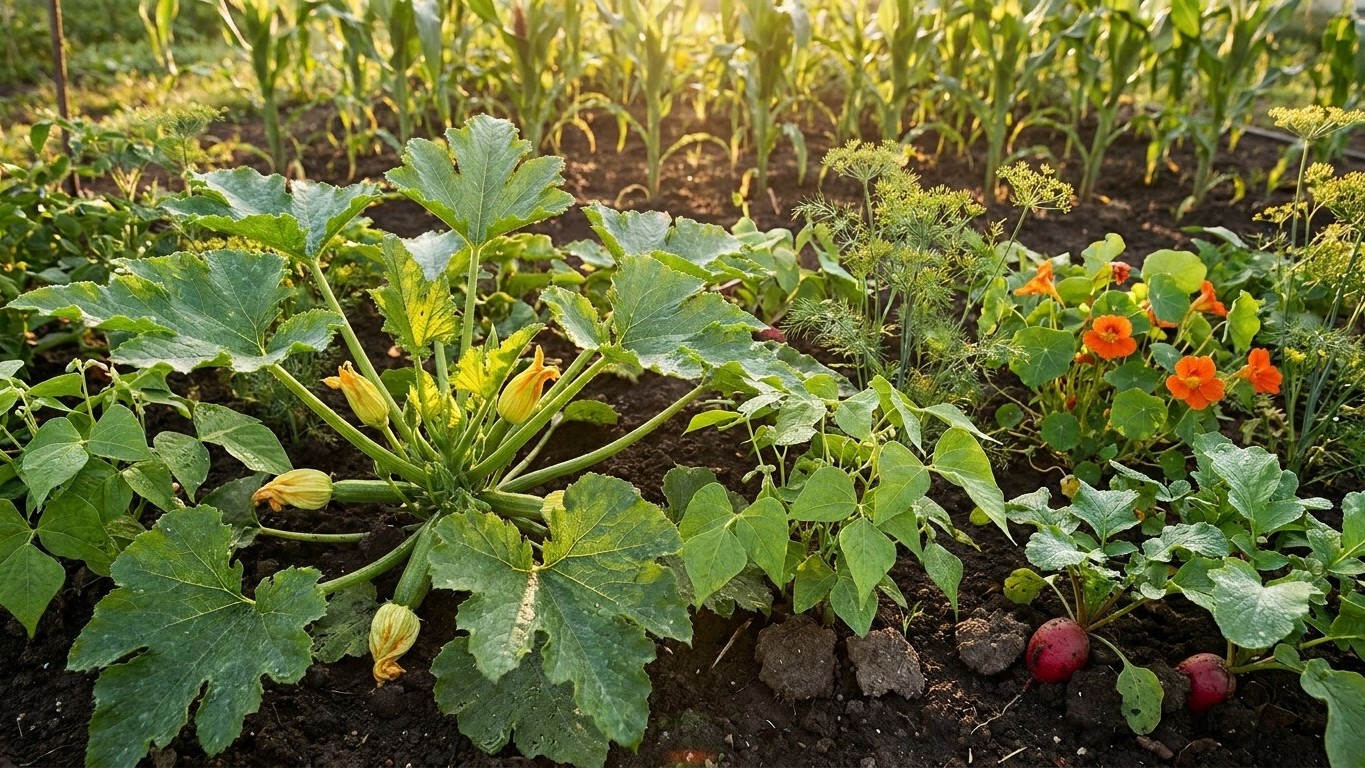

The short answer: grow bush beans, radishes, dill, nasturtiums, or corn near summer squash, and keep potatoes and most vining melons well away from it. What separates a good pairing from a bad one isn’t some mystical plant friendship. It’s four physical mechanisms, and once you know them, you can judge any pairing your grandmother, a seed catalog, or a garden forum throws at you.
What is actually going on
The thing to understand here is that companion planting advice usually gets sorted into “works” or “folklore” based on one question: is there an actual mechanism, or just a story? For summer squash, four mechanisms explain almost everything worth knowing, and everything else is decoration.
Shade is the first. Squash leaves are enormous, and by midsummer a healthy plant can throw shadow over a three-foot radius. That shade suppresses weeds and keeps soil temperature down, which is why lettuce or spinach tucked at the base of a squash plant can survive into weeks that would otherwise bolt them. But the same shade will stunt anything that needs full sun to set fruit, which is why tomatoes and peppers planted too close to squash tend to sulk.
Airflow is the second, and it’s the one most home gardeners underestimate. Squash is prone to powdery mildew, and mildew spreads fastest where air sits still and humid. Crowding squash next to another sprawling, broad-leafed plant doesn’t just compete for light, it creates a dead-air pocket that mildew loves. This is a bigger factor in humid regions than in dry ones, but it applies everywhere squash is grown close together.
Root competition is the third mechanism, and it’s mostly about depth and spread, not chemistry. Squash roots are shallow and wide-ranging, foraging aggressively in the top foot of soil. Plant something with a similarly shallow, wide root system right next to it (potatoes are the classic case) and the two will compete directly for the same moisture and nutrients in the same soil layer. Deep-rooted or narrow-rooted plants avoid this fight entirely.
Shared pests is the fourth, and it’s the one that actually has decent research behind it. Squash bugs, cucumber beetles, and vine borers don’t limit themselves to squash. They’ll happily move onto melons, cucumbers, and other cucurbits planted nearby, which means clustering all your cucurbits together concentrates the pest pressure instead of spreading it out. It also means some traditional pairings (nasturtiums, dill, marigolds) earn their reputation not because they “repel” pests through some mysterious signal, but because they attract the predatory insects, like parasitic wasps and hoverflies, that eat the pests instead.
None of this is about compatibility in a spiritual sense. It’s shade, air, roots, and shared enemies. A reader who keeps those four categories in mind can evaluate a pairing this page never mentions, just by asking which of the four is in play. For variety-specific pest resistance or bloom timing in your area, your state’s cooperative extension service will have trial data that this page can’t responsibly guess at.
In the garden
Here’s where the four mechanisms turn into actual bed layout. Some pairings are famous for good reason. Others are famous despite being a bad idea. The table below covers the common cases, including what tends to go wrong when the pairing is done badly.
| Pairing with squash | Why it works | What goes wrong if mishandled |
|---|---|---|
| Bush beans | Beans fix nitrogen in the soil and have a modest root system that doesn’t compete hard with squash’s shallow roots | Planted too close, beans get shaded out before they can climb or bush properly; give them their own strip |
| Radishes | Fast-growing, shallow but narrow roots, and some gardeners use them as a trap crop for flea beetles and cucumber beetles, pulling pest attention away from young squash | Left in the ground too long they bolt and do nothing useful; they need to be harvested young to earn their spot |
| Dill and other umbellifers | Their small flowers draw in parasitic wasps and other predatory insects that prey on squash bugs and beetle larvae | Letting dill go fully to seed everywhere turns a helper into a weed problem next season |
| Nasturtiums | Sprawling habit competes with weeds for the same ground squash would otherwise leave bare, and they draw in aphids away from more valuable plants as a sacrificial crop | Left unchecked they can smother young squash seedlings, since nasturtiums grow just as aggressively as squash does |
| Corn (three sisters) | Corn provides height and light shade tolerance, beans fix nitrogen for both, and squash’s sprawling leaves shade out weeds at ground level; each plant does a job the others can’t | Done in poor soil or a short season, the three crops compete for water and light instead of dividing labor, and all three underperform |
| Potatoes | No real benefit; both are shallow, wide-rooting, heavy feeders | Direct competition for the same nutrients and moisture in the same soil layer, plus potatoes make squash bug and beetle problems harder to spot and treat |
| Melons and cucumbers | No real benefit; all are cucurbits | Shares every major squash pest and disease, concentrating cucumber beetles, squash bugs, and powdery mildew in one section of the garden instead of spreading exposure |
The three sisters planting deserves a closer look because it gets romanticized without much explanation. It works when it works because each plant is filling a physical role: corn is the trellis, beans are the nitrogen source, squash is the living mulch. When people try it in a small raised bed or shallow, depleted soil, the three plants aren’t complementing each other, they’re competing for the same limited water and nutrients, and the result is three mediocre crops instead of one good one. The traditional version was grown in wide fields with deep, rich soil, not a four-foot suburban bed.
What it depends on where you are
Everything above is mechanism, and mechanism travels. Shade suppresses weeds in Georgia the same way it does in Minnesota. What doesn’t travel is timing, and that’s the part this page genuinely can’t answer for you.
Season length changes which companions make sense. In a region with a short growing season, radishes and lettuce planted as squash companions need to come and go fast, harvested well before squash leaves get big enough to shade them out completely. In a region with a long season, you might get two or even three rounds of a quick companion crop before squash fills in.
Summer heat changes the shade calculation. In cooler regions, the shade squash throws might be a mild bonus for a heat-sensitive companion. In hot, dry regions, that same shade can be the difference between a companion crop surviving August or not, which is part of why lettuce-under-squash is a much bigger deal in the Southeast or Southwest than it is in coastal Maine.
Summer rainfall and humidity change the airflow calculation more than anything else. Powdery mildew pressure in a humid Gulf Coast summer is a different animal from mildew pressure in a dry Rocky Mountain summer, which means spacing that’s generous enough in Colorado might be too tight in Louisiana.
Pest pressure is regional too. Squash vine borer ranges and cucumber beetle populations vary enough by state that a trap-crop strategy proven effective in one region might be irrelevant in another where that particular pest isn’t the dominant problem.
None of this is guesswork you have to do alone. Check the state-specific guides on this site for your region’s squash timing, and cross-reference with your local cooperative extension service, which tracks exactly which pests and diseases are active in your county in a given year. That’s the level of specificity a general companion planting page can’t responsibly fake.
The mistake that costs the most
The single most expensive mistake is planting summer squash next to another cucurbit, whether that’s a cucumber, a melon, or a second squash variety, and assuming proximity is harmless because they’re all “vegetables in the same family, so they’ll be friends.” They’re not friends. They’re the same buffet for the same pests.
Squash bugs and cucumber beetles don’t distinguish between a zucchini-type squash and a cucumber vine three feet away. Once either pest establishes on one plant, it spreads to the other almost immediately, and now instead of managing one outbreak you’re managing two, in the same corner of the garden, at the same time. Powdery mildew behaves the same way: spores don’t respect species lines within the cucurbit family, so a mildew infection on melons can jump straight to squash growing alongside it.
The fix isn’t complicated, it’s spacing and separation. Give your cucurbits distance from each other, not closeness. If garden space is tight, stagger them so squash is in one bed and melons or cucumbers are in another, even if that means putting a row of corn, beans, or flowers between them instead of letting them touch. That physical break does real work: it slows a beetle’s crawl from one host to the next, and it breaks up the still, humid air pocket that two sprawling cucurbit canopies create when grown side by side.
This is also where scouting matters more than any companion pairing. Checking the undersides of leaves for squash bug eggs, and the base of stems for the sawdust-like frass that signals a vine borer, catches a problem while it’s still contained to one plant. Do that regularly, keep your cucurbits at a real distance from each other, and the pairing questions about beans, dill, or corn become the fine-tuning, not the fix for a mistake that’s already spreading.