
Ontario’s frost-free window averages 169 days, and the province never really gets hot: the reference station logs zero days a year above 90°F. That combination favors early and midseason cucumber types over anything bred for a long, blazing summer. Slicing, pickling, burpless, and parthenocarpic types all work here, but disease resistance and trellising matter more than heat tolerance ever will.
The short answer for Ontario
Start with the season length. An average frost-free stretch of 169 days, from an April 30 mean last spring frost to an October 16 mean first fall frost, gives cucumbers plenty of room, since they’re already one of the fastest-maturing vine crops a garden grows. The limiting factor in Ontario isn’t time. It’s moisture and disease pressure, driven by roughly 8.9 inches of rain across June, July, and August, with June alone bringing 2.81 inches. That’s a wet start to summer, and cucumbers planted flat on damp soil in June are exactly what downy and powdery mildew wait for.
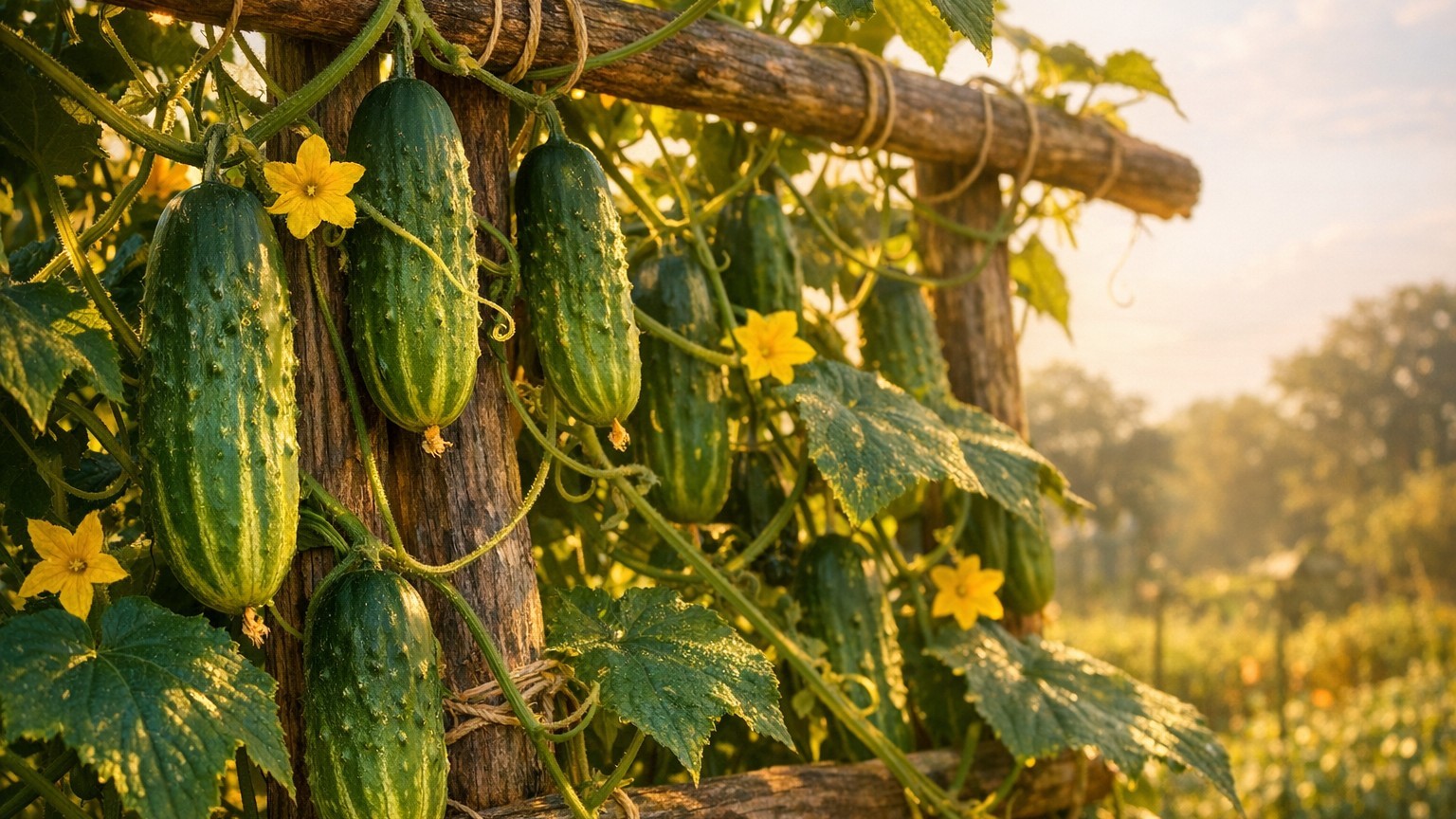
So the decision by type looks like this: pickling cucumbers and compact bush types suit small beds and containers, and their tighter growth habit is easier to keep off wet ground. Vining slicing types produce more over the season but need a trellis or fence in this climate, not a sprawl across the soil. Burpless types (thin-skinned, mild-flavored) do fine here since the cool summer nights that come with zero 90-degree days rarely trigger the bitterness some varieties develop under heat stress. Parthenocarpic varieties, which set fruit without pollination, are worth considering for anyone gardening under row cover or in a partly shaded yard where pollinator visits run light.
| Type | Fits Ontario because | Watch for |
|---|---|---|
| Pickling / bush | Compact, easy to keep off wet soil, suits short raised beds | Lower total yield per plant |
| Vining slicing | Long harvest window fits the 169-day average season | Needs a trellis in humid summers |
| Burpless | Stays mild in cool summer nights, no 90°F stress days | Thin skin bruises easily in transport |
| Parthenocarpic | Sets fruit without reliable pollinator traffic | Best under row cover, less useful in open beds with active bees |
None of this replaces a local cultivar list. This page can tell you which type of cucumber matches Ontario’s season and moisture pattern. It can’t hand you a variety name and guarantee it performs in your soil, because that answer lives with your regional agriculture office, not a general province-wide page.
What will not work here

The first thing that fails is treating April 30 as a safe planting date. It’s a mean, which means in roughly half the years on record, frost arrived after that date at the reference station. Gardeners who set out transplants right on the average and skip a check of the week’s forecast are gambling with a coin that only looks fair. The same applies at the other end: October 16 is also a mean, not a guarantee, and a vining slicing variety that needs the full late-season stretch to finish its late flush can get caught by an early fall frost in the years that run short.
The second failure is spacing that ignores the rainfall pattern. With June alone averaging 2.81 inches and July and August close behind at 2.98 and 3.07, Ontario summers stay damp enough that vining cucumbers left to sprawl on bare soil sit in consistently moist, low-airflow conditions. That’s the exact setup for downy mildew and powdery mildew to spread through a planting in a matter of days. A trellis or vertical support isn’t a nicety here. It’s the difference between a healthy plant and one that collapses by late July.
Third, don’t count on the province’s mild heat to punish a heat-loving variety into better flavor. Some cucumber types bred for scorching, low-humidity growing regions rely on intense daytime heat to develop their characteristic crispness and to avoid excess water uptake. With zero days a year reaching 90°F at the reference station, those varieties tend to grow leggy and watery instead, not because Ontario is unsuitable for cucumbers, but because that specific variety was never selected for this climate.
Last, don’t assume a single planting date works province-wide. A calendar built for Toronto’s frost dates doesn’t automatically apply two hundred miles north, and treating it as if it does is where a lot of disappointing harvests start.
What changes across Ontario
The 7a hardiness zone figure in this page’s facts comes from one reference point: Toronto, using Natural Resources Canada’s plant hardiness system. That system is Canadian, built from seven climate variables rather than the single minimum-temperature measure the USDA uses, so it can’t be converted directly to a USDA zone, and it should never be read as one.
More importantly, that 7a figure describes Toronto’s immediate area, not Ontario as a whole. A province stretching from the Carolinian zone near Lake Erie up through the Canadian Shield and into the far north spans a far wider range of growing conditions than any single station can represent. A gardener near the Niagara Peninsula is working with a longer, milder season than one in the Ottawa Valley or in northern Ontario, where frost can linger later into spring and return earlier in fall.
What that means practically: gardeners north of the Toronto reference point should treat the April 30 and October 16 dates as optimistic, not as their own local averages, and should lean toward the compact bush and pickling types that finish quickly, along with black plastic mulch or row cover to bank extra soil warmth early in the season. Gardeners in the milder southwest, closer to Lake Erie’s moderating effect, often have room to run a full trellised vining variety through its entire season without the same risk of an early fall cutoff.
This page can’t tell an individual reader which zone their own yard falls into. That’s what the hardiness zone map is for, and it’s worth five minutes before choosing between a fast bush type and a longer-season vining one.
Where to check this for your own county
Ontario doesn’t run a county-by-county extension network the way many U.S. states do. The equivalent resource is the provincial agriculture ministry, and that’s the address to bookmark: the Ontario Ministry of Agriculture, Food and Rural Affairs. That’s where regional planting guidance, pest and disease advisories, and updated recommendations for vegetable growers in Ontario get published, and it’s a far more current source than any single blog post or gardening forum thread.
What to actually look for once there: search for vegetable production guidance specific to cucumbers, and check for anything dated for the current growing season rather than an older archived version, since disease pressure and recommended resistant traits shift year to year as new pathogen strains show up. If your area has a local Master Gardener chapter or a regional horticultural society, those groups often translate the provincial guidance into planting dates that reflect their specific corner of Ontario.
A provincial recommendation is a starting point, not a finish line. It was built to apply broadly across Ontario’s growing regions, which means by design it smooths over the differences between a warm Lake Erie shoreline garden and a cooler inland one. Your own local resource, whether that’s the ministry’s regional updates or a nearby extension-style program, will always beat a province-wide page like this one for the specifics of your own soil and microclimate. Treat this article as the “what type, and why” answer, and treat your regional source as the “which exact variety, planted when” answer.
Checking this against your own garden
Dates and averages get a gardener into the right season. What actually tells you the moment to plant, or the moment a plant is thriving, is the garden itself. Three signs matter more than any calendar page.
Soil warmth by feel comes first. Cucumbers germinate slowly and sulk in cold soil, so before setting out transplants or direct-sowing seed, push a finger a couple of inches into the bed. If it still feels cool and damp rather than mild, the soil hasn’t caught up to the calendar yet, regardless of what the average frost date suggests.
The first flush of male flowers is the second signal. Cucumbers typically produce a wave of male blooms before the female flowers (the ones with the tiny swollen base that becomes the fruit) appear. Seeing plenty of male flowers with few or no females yet is normal early on, but if that pattern drags on for weeks, it’s often a sign the plant is stressed, commonly from uneven watering.
The first true leaves round out the check. The initial rounded seed leaves aren’t the plant’s real leaves; the true leaves that follow, with the characteristic cucumber shape and texture, show that the plant has settled in and is actively growing rather than just surviving. A garden that’s slow to reach that stage, compared to a neighbor’s plot a mile away, is telling you something about its own particular microclimate that no province-wide average ever could.