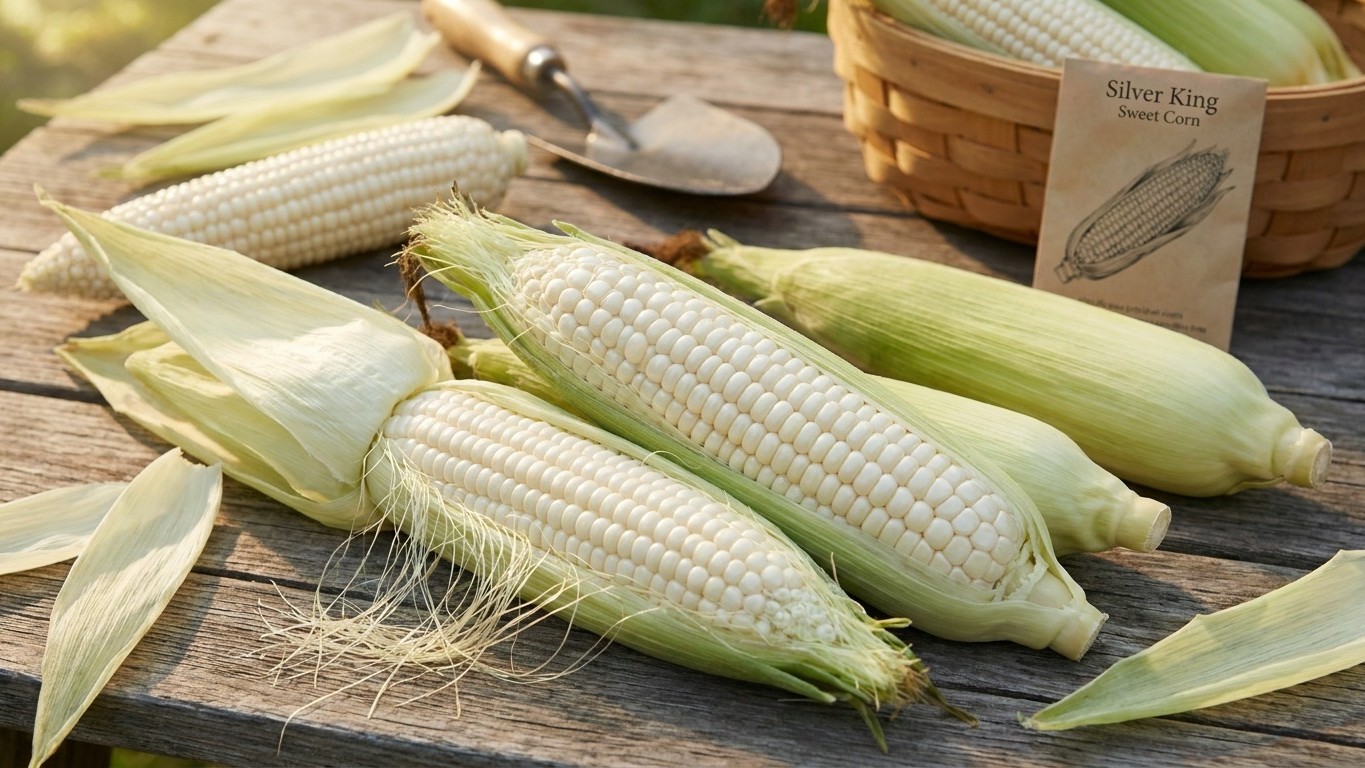

Silver King is a sugary enhanced (se) sweet corn with white kernels, recommended by Clemson Cooperative Extension. That genotype means sweeter, more tender kernels than standard sugary (su) corn, and sugar that holds in the kernel longer after picking. Plant once soil at 4 inches reaches 50 F, skip isolation worries, and eat it soon after harvest for the best flavor.
What the Genotype Tells You Before You Even Plant
Corn breeders sort sweet corn into a handful of genetic families, and the letters matter more than the variety name on the packet. Silver King falls into the sugary enhanced (se) group, according to Clemson Cooperative Extension. That single fact answers most of the practical questions a home gardener has before a seed goes in the ground.
Sugary enhanced corn carries a modifier gene that slows the conversion of sugar to starch inside the kernel. The result is corn that tastes sweeter and more tender at the table than an old-fashioned sugary (su) type, and that keeps more of that sweetness in the days after picking. It’s a middle ground: not as intensely sugary or long-lasting as a supersweet (sh2) hybrid, but far more forgiving in the garden than either extreme.
The kernel color is white, and that’s worth separating from the taste conversation entirely. White versus yellow versus bicolor is a matter of what looks good on a plate, not a marker of sweetness. Clemson’s variety recommendations list Silver King for its se genotype and white kernel, not because white kernels carry more sugar than yellow ones. They don’t. The genotype does that work.
This distinction matters because seed catalogs often lean on color to sell corn, when the genotype label buried in the fine print is the number that predicts flavor and storage behavior. Read that label first.
Soil Temperature: The Only Planting Rule That Actually Applies
Sweet corn seed doesn’t germinate reliably in cold soil, and the threshold changes depending on which genetic family a variety belongs to. For a sugary enhanced type like Silver King, the soil at a 4-inch depth needs to reach 50 F before the seed goes in the ground. That’s meaningfully lower than what supersweet (sh2) varieties require, which is 65 F at the same depth. Confusing the two thresholds is a common mistake among gardeners who’ve grown a supersweet hybrid one year and switch to an se type the next, then wait weeks longer than necessary to plant.
The depth in that measurement is not a minor detail. A soil thermometer pushed just an inch or two below the surface reads warmer than the zone where the seed actually sits, because surface soil heats and cools faster with daily sun and overnight swings. Four inches down is where the seed lives, and it’s a slower, more stable reading. A gardener checking at midday, an inch deep, can easily see a number 8 to 10 degrees warmer than what the seed itself is experiencing, enough to convince someone the soil is ready when it isn’t.
No calendar date substitutes for that measurement, no matter what region a gardener lives in. A date that works in a warm spring in one part of South Carolina can be two or three weeks off in a cooler year, or in a microclimate just a few miles away. Soil temperature is the instruction; the calendar is not.
Days to maturity is a separate question, answered by neither the genotype nor Clemson’s cultivar list. No days-to-maturity figure for Silver King appears in that published guidance, and estimating one from the se classification alone would be guesswork. The seed packet in hand is the figure that applies to that specific seed lot and growing season.
Does Silver King Need Isolation From Other Sweet Corn?
No. Because Silver King is a sugary enhanced (se) variety, it needs no isolation from other sweet corn growing nearby. This is one of the more persistent points of confusion among home gardeners: the isolation rule that shows up in gardening advice again and again applies specifically to supersweet (sh2) varieties, not to se types like this one.
Here’s why the distinction matters so much for anyone growing sh2 corn. If pollen from an ordinary sweet corn variety, whether su or se, drifts onto the silks of a supersweet plant, the resulting kernels lose much of what makes supersweet corn worth growing: that intense, long-holding sweetness. Nothing about the ear looks wrong, it fills out normally, husk and kernels look healthy. The failure only shows up at the table, when an ear that should taste remarkably sweet instead tastes flat or starchy. By then, nothing can be done about that ear.
Silver King’s se genotype sidesteps that problem entirely. It can be planted alongside other sugary or sugary enhanced varieties, or even near a neighbor’s sweet corn, without the harvest’s sweetness being compromised by stray pollen. No isolation distance or timing window is published for Silver King, and none is needed given its genotype.
The one situation where a gardener growing Silver King should think about isolation is if a supersweet variety is planted somewhere on the same property. In that case, the sh2 corn is the one that needs distance and timing protection, not the Silver King.
Why the Genotype Decides How Fast You Need to Eat It
Clemson Cooperative Extension puts the mechanism behind old harvest advice in plain terms: “Sweet corn loses sugar from the kernel rapidly at high temperatures… Sweet corn can be stored under optimal conditions for about five days, but will lose sweetness with each day of storage.” That’s a description of what’s physically happening inside the kernel: sugar converts to starch, and heat speeds that conversion along.
About five days is a maximum, and only under optimal conditions, kept cool, ideally refrigerated, right after picking. It is not a promise that an ear will taste the same on day five as day one. Every day of storage costs some sweetness, and a warm kitchen counter burns through that window far faster than a refrigerator does.
This is where the genotype conversation from earlier pays off. Sugary (su) corn loses its sugar fastest of the three families, which is why older varieties earned an “eat it within the hour” reputation. Sugary enhanced (se) corn, Silver King’s genotype, holds its sweetness longer than su but not as long as a supersweet. Supersweet (sh2) corn holds longest of all, sometimes tasting reasonably sweet even a week after picking under good storage.
That middle position is the practical case for choosing an se variety like Silver King in the first place. It buys a gardener more flexibility than an old-fashioned su type, whether that means a day or two to get the harvest to a farmers market or simply not feeling pressured to cook everything the moment it comes off the stalk, without the isolation headaches that come with growing a supersweet.
Common questions
Is white sweet corn sweeter than yellow sweet corn?
No. Kernel color is a preference, not an indicator of sweetness. Sweetness comes from the genotype, whether su, se, or sh2, not from whether the kernels are white, yellow, or bicolor.
How many days does Silver King sweet corn take to mature?
No days-to-maturity figure for Silver King appears in Clemson’s published cultivar guidance. Check the specific seed packet for the figure that applies to that seed lot.
Do I need to isolate Silver King from other sweet corn varieties?
No. Silver King is a sugary enhanced (se) variety and needs no isolation from other sweet corn. The isolation rule applies specifically to supersweet (sh2) varieties.
How long can I store Silver King sweet corn after picking?
Under optimal conditions, sweet corn can be stored about five days, though it loses sweetness with each day. Silver King’s se genotype holds sugar longer than an old-fashioned su variety, but not as long as a supersweet (sh2).