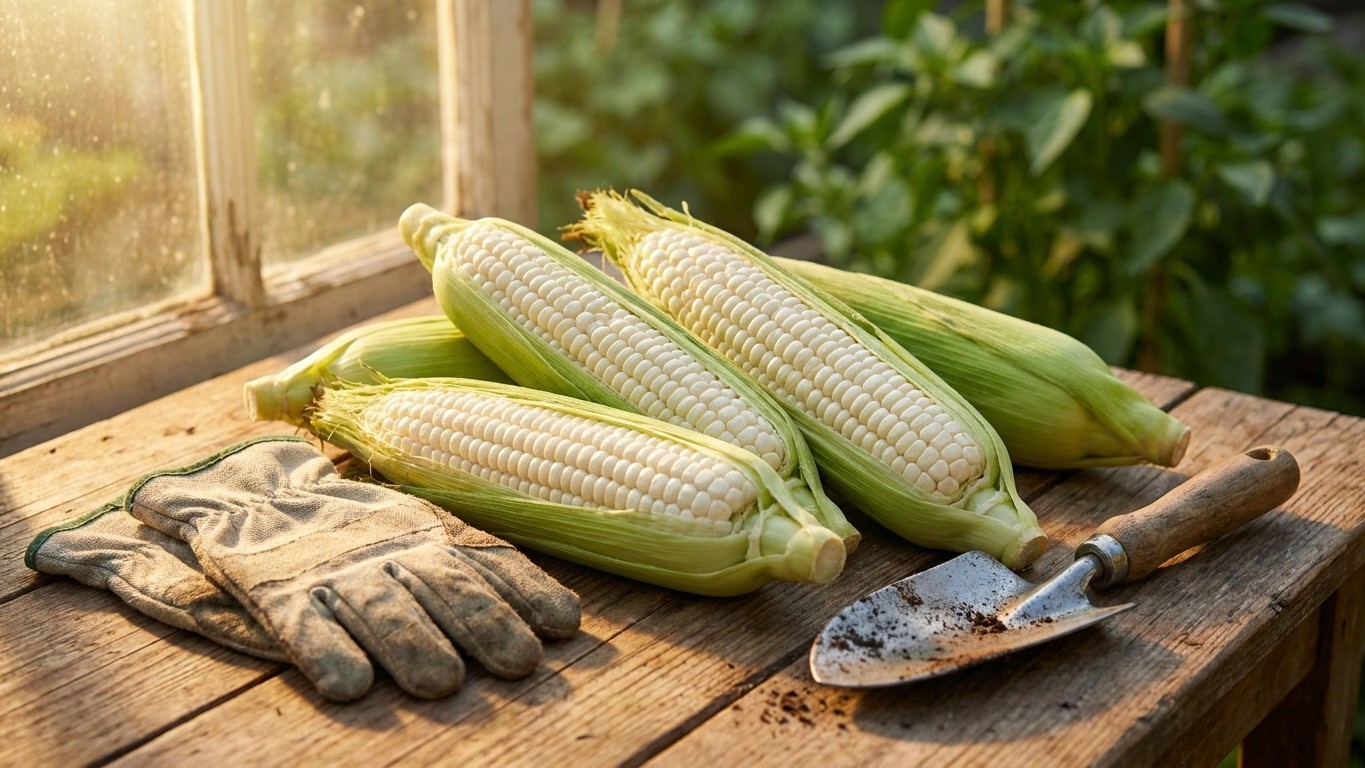

Silver Queen sweet corn is a white-kerneled, normal sugary (su) cultivar recommended by Clemson Cooperative Extension. That genotype means good old-fashioned corn flavor, but sugar converts to starch quickly once an ear is picked, and the plant needs no isolation from other sweet corn nearby.
Genotype and Kernel Color: What Silver Queen Actually Is
Every sweet corn variety carries a genetic label that matters more than its name: su (normal sugary), se (sugary enhanced), or sh2 (supersweet). Silver Queen falls into the su category, according to Clemson Cooperative Extension’s list of recommended sweet corn cultivars. That single letter code tells a grower more about what to expect at harvest than any marketing description could.
Normal sugary corn is the traditional type home gardeners have grown for generations, delivering the classic corn taste people associate with a summer roadside stand. The trade-off is that sugar-to-starch conversion happens fast once the ear leaves the stalk: rich flavor now, a short window to enjoy it.
Then there’s the color. Silver Queen produces white kernels, a trait Clemson lists alongside the genotype in its cultivar description. Neither color is inherently sweeter or more flavorful than the other; sweetness comes from the genotype, not from whether the kernel is white, yellow, or bicolor. Anyone who tells you white corn is sweeter than yellow is repeating garden folklore, not agronomy.
Knowing the genotype before planting changes how a gardener manages the whole season, from soil temperature at sowing to how quickly that ear needs to reach the table after picking.
Soil Temperature: The Real Planting Signal
Forget the calendar. Sweet corn genotype dictates a soil temperature threshold, and for a normal sugary variety like Silver Queen, that threshold is 50°F, measured at a 4-inch depth. Supersweet (sh2) varieties need warmer ground, closer to 65°F, because their seeds are more prone to rot in cool, wet soil. Since Silver Queen is su, not sh2, the lower 50°F mark applies here.
The depth matters as much as the number. A thermometer pushed just an inch or two into the ground, or a reading taken at the surface, will almost always run warmer than what’s happening 4 inches down, where the seed actually sits. Surface soil warms fast on a sunny afternoon and cools just as fast once the sun drops, giving a misleadingly optimistic number. A true 4-inch reading, taken consistently over several mornings, gives a far more honest picture of whether the ground is ready.
Cold, damp soil is where sweet corn seed struggles most. Seeds sown into ground below that 50°F mark tend to sit and rot rather than germinate, especially if a spring cold front rolls through after planting. Waiting for the soil to warm on its own terms, rather than rushing to plant on a date circled on a calendar, is the more reliable approach. Some regions hit that mark in early spring; others, especially at higher elevations or in clay-heavy soils that hold cold longer, need extra weeks.
One number that won’t appear here, because no source publishes it for this cultivar, is days to maturity. That figure varies by seed source, growing region, and even the specific seed lot. The most reliable number is the one printed directly on the seed packet in hand, since that’s the figure tied to the actual seed being sown that season.
Isolation: Why Silver Queen Doesn’t Need It
Isolation distance is one of the most misunderstood rules in sweet corn growing, largely because it only applies to one genotype. Supersweet (sh2) varieties require serious isolation from other corn types, because cross-pollination from ordinary sweet corn or field corn ruins the very trait that makes sh2 corn special: its intense sweetness. Pollen drift from a neighboring su or se planting reduces sugar content in sh2 kernels, and the damage is invisible until the corn is cooked and eaten.
Silver Queen doesn’t carry that risk, because it’s a normal sugary (su) cultivar, not a supersweet. It needs no isolation from other sweet corn varieties growing nearby. A gardener can plant Silver Queen next to a yellow su variety, an se bicolor, or another white su cultivar without worrying about cross-pollination wrecking the eating quality.
The confusion usually comes from gardeners hearing the isolation rule tied to a supersweet variety they grew previously, and assuming it’s universal advice. It isn’t. That rule belongs to sh2 varieties specifically; su and se types, Silver Queen included, are far more forgiving neighbors in a mixed vegetable garden.
No specific distance or timing window is published for any genotype’s isolation needs, sh2 included. The safest approach for anyone growing a supersweet alongside other corn is to separate plantings as much as garden space allows, or stagger planting dates so tasseling and pollen shed windows don’t overlap. But that’s a supersweet problem, not a Silver Queen one.
Taste, Storage, and Why the Genotype Decides the Countdown
Every genotype comes with its own storage clock, and it starts the moment the ear leaves the stalk. As Clemson Extension puts it: “Sweet corn loses sugar from the kernel rapidly at high temperatures… Sweet corn can be stored under optimal conditions for about five days, but will lose sweetness with each day of storage.” That five-day figure is a ceiling under ideal, cool storage conditions, not a guarantee, and sweetness declines faster still if the corn sits somewhere warm.
Genotype determines how steep that decline is. Normal sugary (su) varieties like Silver Queen lose sugar the fastest of the three types, since the conversion from sugar to starch happens quickly once the ear is picked. Sugary enhanced (se) varieties hold their sweetness noticeably longer, and supersweet (sh2) varieties hold it longest, which is part of why sh2 corn has become popular for shipping to grocery stores.
That doesn’t make Silver Queen a lesser choice, it makes it a different kind of choice. Gardeners who grow su corn are usually after that traditional, deeply corn-flavored ear, and they’re typically planning to eat it close to harvest rather than store it for a week. The old advice about running from the garden straight to a pot of boiling water isn’t just folklore, it’s a rough description of what Clemson’s research explains: heat and time both accelerate sugar loss, and su corn has the least buffer of the three genotypes.
Refrigerating unhusked ears immediately after picking, and cooking them within a day or two rather than stretching toward that five-day maximum, keeps a su variety like Silver Queen tasting closer to what it tasted like the moment it left the stalk.
Common questions
Is Silver Queen a supersweet corn variety?
No. Silver Queen is a normal sugary (su) cultivar, not a supersweet (sh2) type. That means it has excellent traditional corn flavor but converts sugar to starch faster after harvest than se or sh2 varieties.
Does Silver Queen need to be isolated from yellow sweet corn?
No isolation is needed. Silver Queen is su, and isolation requirements only apply to supersweet (sh2) varieties, which are vulnerable to cross-pollination from other sweet corn types. Su and se varieties can be grown near each other without affecting eating quality.
What soil temperature does Silver Queen need for planting?
Soil at a 4-inch depth should reach 50°F before sowing, since Silver Queen is a normal sugary variety, not a supersweet. Supersweet varieties require warmer soil, around 65°F, but that threshold doesn’t apply here.
How long does Silver Queen corn stay sweet after picking?
Under optimal storage conditions, sweet corn can last about five days, but it loses sweetness with every day that passes. Because Silver Queen is a su genotype, that sugar loss happens faster than in se or sh2 varieties, so it’s best eaten within a day or two of harvest.