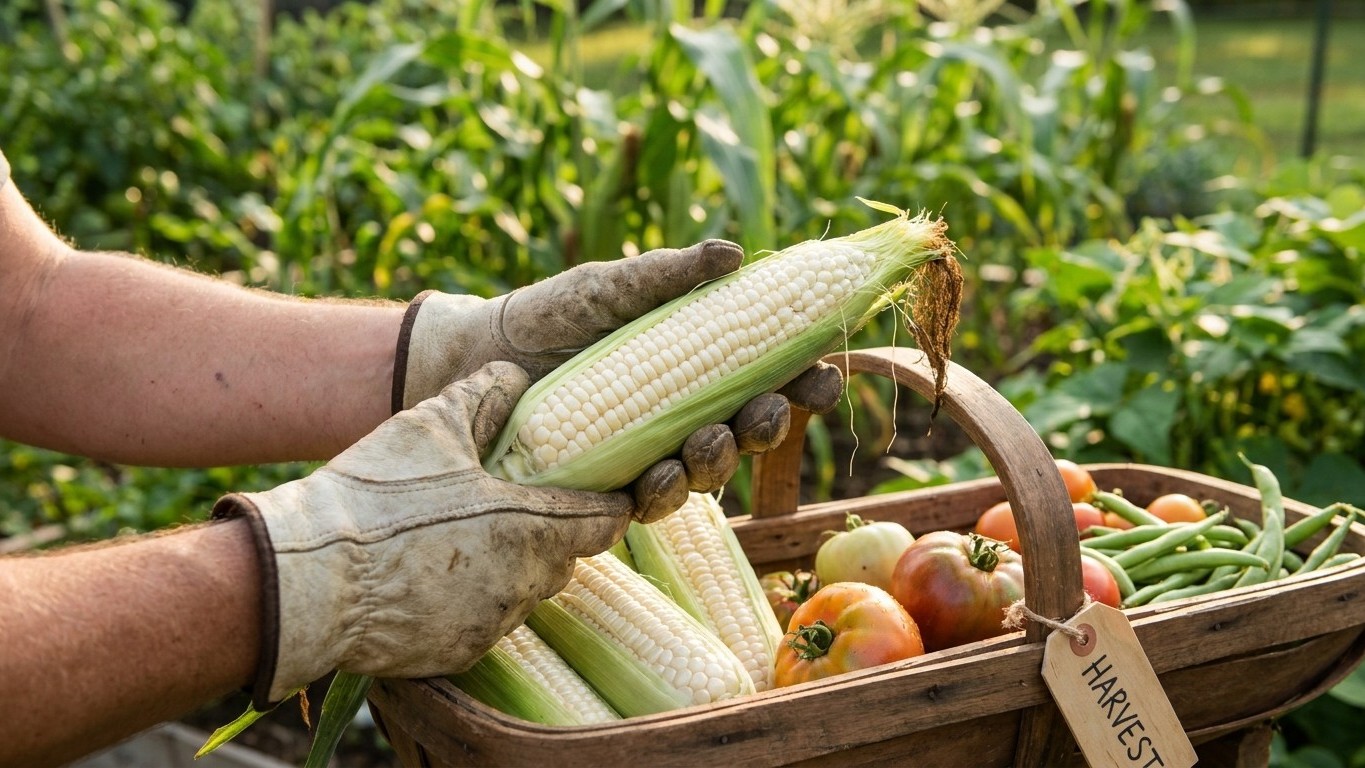

Silver Princess is a white-kerneled sugary enhanced (se) sweet corn recommended by Clemson Cooperative Extension. That genotype means tender, sweet ears that hold their sugar longer than standard su corn after picking. Sow it once soil at 4 inches reaches 50 degrees Fahrenheit, and skip the isolation worries that supersweet growers deal with.
Genotype and Kernel Color: What Makes Silver Princess Sweet
The genotype behind an ear of sweet corn tells you more than the name on the seed packet ever will. Silver Princess is a sugary enhanced (se) variety, a category that sits between old-fashioned sugary (su) corn and the newer supersweet (sh2) hybrids. The se gene produces kernels that are sweeter and more tender than standard su corn straight off the stalk, and critically, they hold that sugar content longer after harvest instead of converting it to starch within hours.
That staying power matters for anyone who can’t get from garden to pot in the same afternoon. With su corn, the clock starts ticking the moment the ear leaves the stalk. Sugary enhanced varieties buy a bit more room to breathe, without the isolation headaches that come with the sh2 supersweets.
Kernel color is a separate story entirely. Silver Princess produces white kernels, a trait that’s purely cosmetic. Clemson Cooperative Extension lists this cultivar alongside yellow and bicolor se varieties, and nothing in that guidance suggests white corn tastes sweeter or blander than its yellow counterparts. Sweetness comes from the genotype, not the color. If a neighbor’s yellow or white corn tastes different, the cause is genotype, growing conditions, or how long the ear sat before cooking, not pigment.
Soil Temperature: When to Plant Silver Princess Sweet Corn
Forget the calendar. Soil temperature, not the date on the wall, decides when Silver Princess goes in the ground. Because this cultivar is sugary enhanced rather than supersweet, the threshold is 50 degrees Fahrenheit at a 4-inch depth, measured before sowing. That’s a meaningfully lower bar than the 65 degrees required for sh2 supersweet corn, which germinates poorly in cool soil and rots before it sprouts if planted too early.
The 4-inch depth isn’t an arbitrary detail. Soil warms unevenly from the surface down, and a reading taken at the surface, or even at 1 or 2 inches, will run warmer than what the seed actually experiences once it’s tucked into the ground. A soil thermometer pushed down to where the seed will sit gives the number that matters. Guessing based on air temperature or how warm the topsoil feels is how gardeners end up with spotty germination and gaps in the row.
This is also where regional variation makes a single planting date useless as advice. Soil at 4 inches can hit 50 degrees in early spring in the coastal Southeast and weeks later at higher elevations or further north. Checking the ground with a thermometer, rather than relying on a date from a seed catalog written for a different climate zone, is the only way to know Silver Princess is ready to go in.
One figure worth flagging by its absence: days to maturity. No days-to-maturity number for Silver Princess is published in the sourcing behind this guide, and estimating one based on genotype alone would be a guess dressed up as fact. The seed packet in hand is the authority here, since maturity length varies from one seed source to the next.
Isolation Requirements for Silver Princess
Isolation distance is the detail that trips up gardeners who’ve heard sweet corn horror stories from a friend or a forum post. Here’s the relief: Silver Princess, as a sugary enhanced (se) variety, needs no isolation from other sweet corn varieties growing nearby. Cross-pollination between se and su corn doesn’t ruin either crop the way it does for supersweets.
The isolation rule that circulates in gardening circles, warning growers to keep varieties hundreds of feet apart or stagger planting by weeks, applies specifically to supersweet (sh2) corn. When sh2 corn receives pollen from ordinary sweet corn, sugary or sugary enhanced, the resulting kernels lose sweetness and turn starchy. Nothing about the ear looks wrong in the garden; the disappointment only shows up at the table, in kernels that taste flat instead of sweet, by which point the growing season’s chance to fix it is gone.
Since Silver Princess doesn’t carry the sh2 gene, that entire failure mode doesn’t apply. It can share a garden bed with other su or se sweet corn without the sugar-robbing cross-pollination that plagues supersweet growers. No specific isolation distance or timing window is published for se corn in the source material, because for this genotype, none is needed in the first place. The takeaway isn’t a number to measure out with a tape measure. It’s simply permission to plant Silver Princess without the isolation planning that supersweet varieties demand.
Storage and Sweetness: What to Do With the Harvest
The old advice about running from the cornfield straight to a pot of boiling water wasn’t folklore. As Clemson Cooperative Extension puts it: “Sweet corn loses sugar from the kernel rapidly at high temperatures… Sweet corn can be stored under optimal conditions for about five days, but will lose sweetness with each day of storage.”
That “about five days” is a ceiling, not a promise, and it only applies under optimal, cool conditions. Heat accelerates the sugar loss, so an ear left in a hot car or on a warm counter loses sweetness faster than one refrigerated promptly. Every day of storage, regardless of conditions, chips away at what made the ear worth growing in the first place.
Genotype decides how steep that decline is. Standard su corn loses its sugar fastest of the three types, converting to starch within a day or two even under decent storage. Sugary enhanced corn, Silver Princess included, holds its sweetness measurably longer than su, which is exactly why se varieties earned a reputation as a practical upgrade for gardeners who can’t harvest and cook in the same hour. Supersweet sh2 corn holds longest of all three, part of the tradeoff for its isolation demands.
For Silver Princess specifically, that middle position is the whole point. It won’t hold flavor indefinitely, and five days under optimal cold storage is the outer edge, not a target to aim for. But compared to older su varieties, there’s real breathing room between harvest and dinner, without needing to isolate the patch from other sweet corn to get it.
Common questions
Is Silver Princess a supersweet variety?
No. Silver Princess is sugary enhanced (se), a genotype distinct from supersweet (sh2) corn. It’s sweeter and more tender than old-fashioned su corn and holds its sugar longer after picking, but it doesn’t carry the sh2 gene or its isolation requirements.
Does white sweet corn taste different from yellow sweet corn?
Kernel color is a cosmetic trait, not a flavor indicator. Sweetness is determined by genotype, su, se, or sh2, not by whether the kernels are white, yellow, or bicolor. Clemson’s variety recommendations list Silver Princess for its se genotype, with white listed simply as its kernel color.
Do I need to isolate Silver Princess from other sweet corn?
No. As a sugary enhanced variety, Silver Princess needs no isolation from other su or se sweet corn. The isolation rule some gardeners have heard about applies to supersweet (sh2) varieties, which lose sweetness when cross-pollinated by ordinary sweet corn.
How long can I store Silver Princess after harvest before it loses its sweetness?
Under optimal storage conditions, sweet corn can last about five days before quality declines meaningfully, though it loses some sweetness with every day of storage. Because Silver Princess is sugary enhanced, it holds its sweetness longer than standard su corn, though not as long as supersweet sh2 varieties. Refrigerating ears promptly after picking slows the sugar loss considerably.