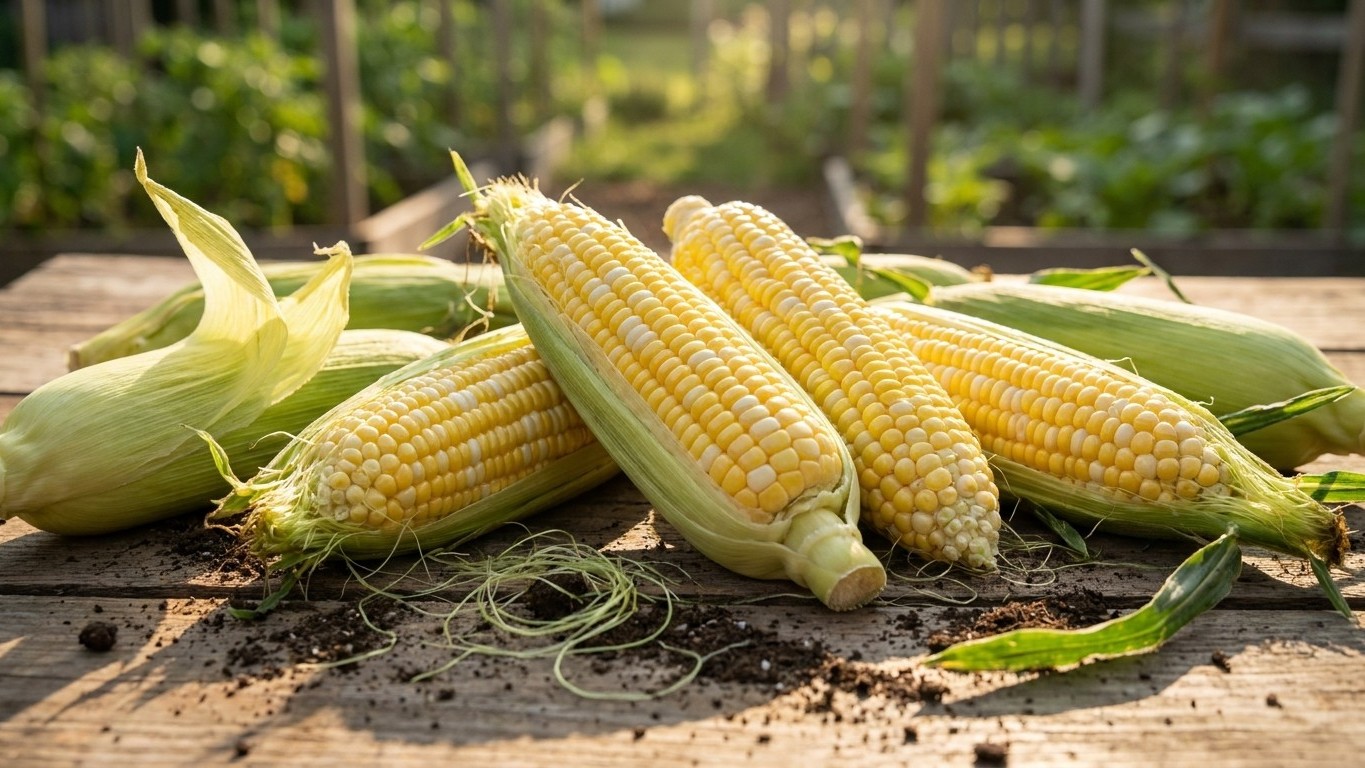

Chubby Checkers is a bicolor sweet corn with a sugary enhanced (se) genotype, recommended by Clemson Cooperative Extension. That genotype means sweeter, more tender kernels than standard sweet corn, sugar that holds longer after picking, and no need to isolate it from other sweet corn varieties in the garden. The bicolor kernels are simply a preference, not a marker of quality.
Genotype and kernel color: what actually determines flavor
The genotype is the number that matters more than the name on the seed packet. Chubby Checkers carries the sugary enhanced (se) gene, which sits between old-fashioned sugary (su) corn and the modern supersweet (sh2) hybrids. Compared to su corn, se varieties convert less of their sugar into starch after picking, which is why the ear stays sweeter and the kernel skin stays more tender through a longer window after harvest.
Clemson Cooperative Extension, which lists Chubby Checkers among its recommended home garden cultivars, describes it plainly: an se type that’s sweeter and more tender than su corn, holds its sugar longer after picking, and needs no isolation from other sweet corn.
Then there’s the color. Chubby Checkers produces bicolor ears, meaning a mix of yellow and white kernels on the same cob. Some gardeners have a strong preference for bicolor over solid yellow or solid white, usually for looks or nostalgia rather than any documented flavor edge. Nothing in Clemson’s variety data suggests that kernel color changes sweetness, tenderness, or storage life. Those traits trace back to the genotype, not the color.
Soil temperature: the planting rule that applies here
Sweet corn seed doesn’t care what the calendar says. It cares about soil temperature, and that’s the number to track before Chubby Checkers goes in the ground. For ordinary sweet corn genotypes, including sugary (su) and sugary enhanced (se) types like this one, the soil needs to reach 50 degrees Fahrenheit at a 4-inch depth before sowing. That’s a meaningfully different threshold than what applies to supersweet (sh2) hybrids, which need the soil to warm to 65 degrees at the same depth before germination rates hold up.
Because Chubby Checkers is se, not sh2, the 50-degree mark is the number to use. Mixing up the two thresholds is a common mistake among gardeners who’ve grown a mix of genotypes over the years. The gap between 50 and 65 degrees isn’t trivial in early spring soil, and it can be the difference between a seed that germinates within a reasonable window and one that just sits in cold, wet ground rotting before it sprouts.
The depth matters as much as the number itself. A soil thermometer pushed down to 4 inches gives a very different reading than one resting at the surface, where morning sun can warm the top half-inch of soil well past 50 degrees while the root zone underneath is still cold. It’s the 4-inch reading that predicts germination. Checking at the same time of day for a few days running gives a more reliable picture than a single reading taken right after a warm afternoon.
One number this article won’t give: days to maturity. Clemson’s cultivar list doesn’t publish a maturity count for Chubby Checkers or the other varieties on it, and there’s no reliable way to estimate one just from knowing the genotype is se. That figure lives on the individual seed packet.
Isolation: does Chubby Checkers need it?
This is where the genotype answers a question a lot of gardeners ask by default, without needing it to. Because Chubby Checkers is sugary enhanced (se), not supersweet (sh2), it needs no isolation from other sweet corn varieties growing nearby. Clemson states this directly in its variety notes: this genotype “needs no isolation,” full stop.
The isolation rule that circulates in gardening conversations, the one about keeping different corn varieties a certain distance apart or timing plantings so they don’t tassel at the same time, is a supersweet (sh2) concern. Sh2 corn has a different starch conversion pathway, and cross-pollination from ordinary sweet corn (su or se types) growing too close can knock the sweetness out of an sh2 crop. The kernels don’t look wrong or show damage. The only sign is on the plate: a supersweet ear that tastes starchy and flat instead of crisp and sweet, because pollen from a different genotype reached those silks weeks before harvest.
None of that applies to Chubby Checkers. As an se variety, it can be planted alongside other sweet corn varieties, including other se and su types, without worrying about cross-pollination robbing the harvest of sweetness. That’s one less logistical puzzle for anyone working with a smaller garden plot where separating varieties by any real distance simply isn’t practical. Neither a specific distance nor a specific timing window is published for isolating sh2 corn; the rule exists, but no universal number attaches to it, so the safest approach for anyone growing supersweet corn is still to keep an eye on tasseling times and separate varieties as much as the garden layout allows.
What the genotype means at the table
Sweetness is a moving target after the ear leaves the stalk, and this is where the genotype decision pays off or doesn’t. Clemson Cooperative Extension puts the mechanism plainly: “Sweet corn loses sugar from the kernel rapidly at high temperatures… Sweet corn can be stored under optimal conditions for about five days, but will lose sweetness with each day of storage.” That’s the science behind the old advice about running straight from the garden to the pot: sugar actively converts to starch inside the kernel, faster in the heat, from the moment the ear is picked.
That five-day figure is a ceiling under ideal, refrigerated storage, not a guarantee, and it shrinks in a hot kitchen or a warm car ride home from a farm stand. Every day of storage costs some sweetness, regardless of variety.
Genotype decides how steep that decline is. Sugary (su) corn, the old-fashioned type, loses its sugar fastest and is genuinely best eaten within a day or so of picking. Sugary enhanced (se) corn, which is what Chubby Checkers is, holds its sugar longer than su, giving a wider window where the ears still taste genuinely sweet rather than merely edible. Supersweet (sh2) hybrids hold sugar longest of the three, which is part of why they’ve become popular for corn that travels to grocery stores rather than straight from a backyard patch to the table.
That’s the practical case for choosing an se variety like Chubby Checkers for a home garden: it doesn’t demand the same-day urgency of su corn, and it doesn’t require the isolation planning that sh2 varieties do. It sits in a middle ground that tolerates a normal harvest schedule and a normal kitchen routine, without needing to be picked and cooked within the hour.
Common questions
Is Chubby Checkers a supersweet corn variety?
No. Chubby Checkers carries the sugary enhanced (se) genotype, not the supersweet (sh2) genotype. It’s sweeter and more tender than old-fashioned sugary (su) corn, but it belongs to a different genetic category than supersweet hybrids.
Do I need to isolate Chubby Checkers from my other sweet corn?
No. Clemson Cooperative Extension states that this se genotype needs no isolation from other sweet corn. The isolation concern applies specifically to supersweet (sh2) varieties, which can lose sweetness from cross-pollination with ordinary sweet corn nearby.
What soil temperature does Chubby Checkers need for planting?
Soil should reach 50 degrees Fahrenheit at a 4-inch depth before sowing, the standard threshold for sugary and sugary enhanced sweet corn. That’s lower than the 65-degree mark required for supersweet (sh2) varieties.
How long does Chubby Checkers stay sweet after picking?
Clemson Extension notes sweet corn can be stored under optimal conditions for about five days, but loses sweetness with each day of storage, and that loss accelerates in heat. As an se variety, Chubby Checkers holds its sugar longer than su corn, though not as long as supersweet (sh2) hybrids.