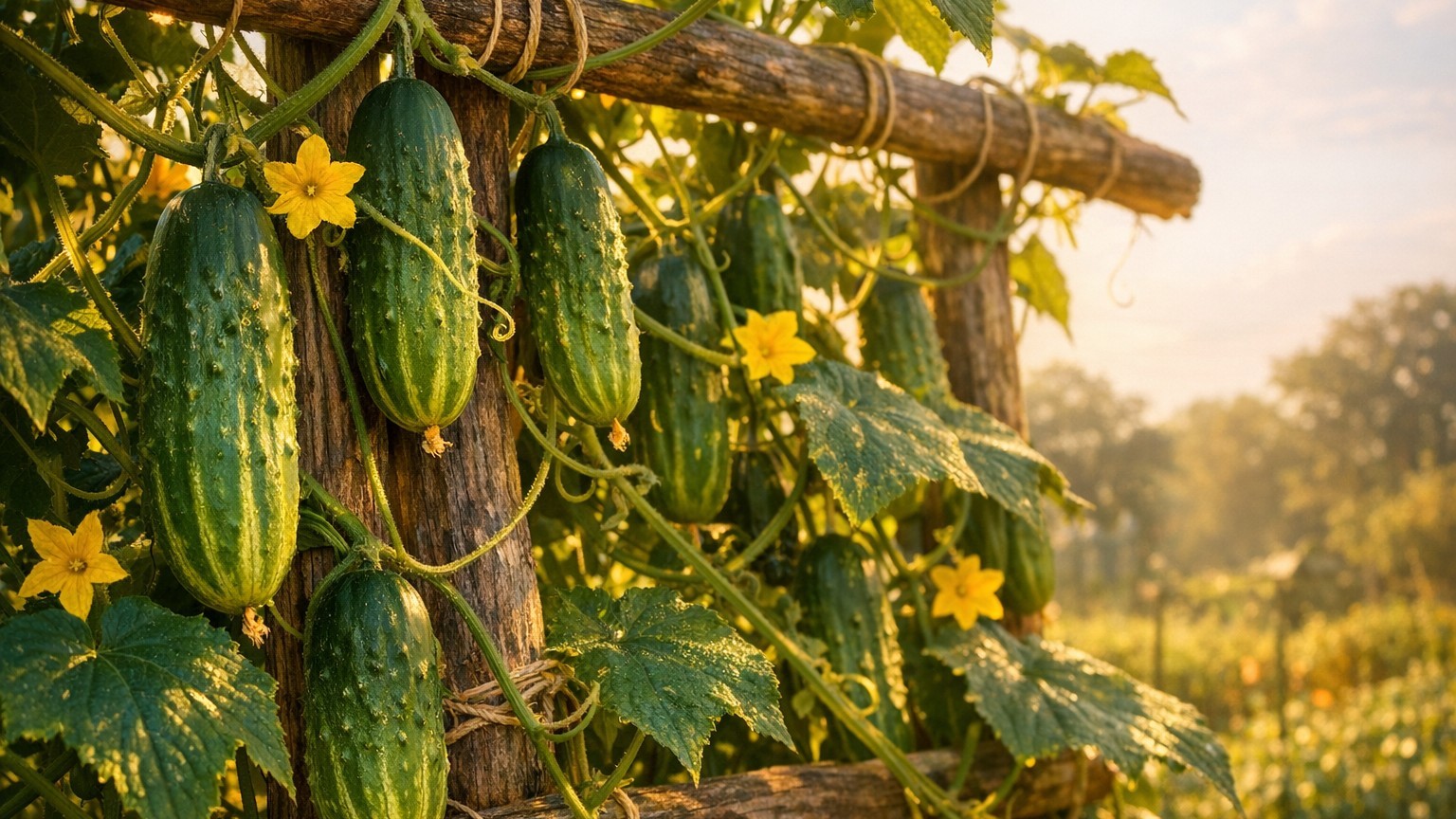

For Texas, the answer depends less on a variety name and more on type: pickling and bush cucumbers for gardeners who want a fast, compact harvest before summer heat shuts things down, and burpless or parthenocarpic slicing types for anyone willing to trellis and irrigate through 100+ days of 90-degree heat. County extension trial lists fill in the exact cultivar.
The short answer for Texas
Houston’s climate normals give a useful anchor, even though they only describe the Gulf end of a state that runs from the Panhandle to the Rio Grande. The last spring freeze there falls between February 4 and March 1, and the first fall freeze arrives December 1 to December 19. That’s a long frost-free stretch on paper, but 102.4 days a year hit 90 degrees or higher, and cucumber vines start dropping blossoms and producing bitter, misshapen fruit once daytime highs sit consistently above the mid-90s. The real growing window for cucumbers on the Gulf Coast isn’t the full frost-free season. It’s the weeks before that heat load kicks in, plus a second window in early fall once the days above 90 start tapering off.
That two-window pattern is what should drive the type you pick, not a brand name on a seed packet.
Bush and pickling types for a short first window
A compact bush habit gets fruit set and picked before the worst of the heat arrives. Pickling types tend to fruit earlier and more uniformly than long slicing vines, which makes them a fit for gardeners working a spring window bounded by a mid-90s heat wall rather than a frost date. They also take up less trellis space, which matters on a small suburban lot where a second fall planting has to fit in the same bed.
Burpless and parthenocarpic types for the long heat stretch
Burpless slicing cucumbers, usually the longer, thinner-skinned kind sold for fresh eating, tolerate a wider temperature swing before quality drops. Parthenocarpic varieties, which set fruit without needing pollination, are worth knowing about specifically because Texas heat can suppress bee activity during the hottest midday hours. A vine that doesn’t depend on pollinators working a 98-degree afternoon has one less failure point.
None of this replaces a variety name. Texas A&M AgriLife Extension runs county-level vegetable trials and publishes which cultivars performed in a given region’s soil and heat, and that’s the list to pull the actual seed packet from. The hardiness zone range for the whole state, 6a to 10a under the USDA system, is wide enough that a variety trialled well in the Rio Grande Valley isn’t automatically the right pick for the Panhandle.
What will not work here

Long-season, slow-maturing slicing cucumbers bred for cooler, longer summers struggle here for a simple reason: they’re still building vine and setting first fruit right as the region crosses into its 90-degree stretch, and cucumber flowers abort at a much higher rate once nighttime lows stop dropping below the mid-70s. A type that needs a slow, mild ramp-up loses that ramp-up in most of Texas. The frost-free window on the Gulf Coast is long, but the usable cucumber window inside it is shorter than the calendar suggests.
Watering on a weekly schedule is the second common failure. Summer rainfall across June, July and August averages about 14.6 inches at the Houston reference station, but that number hides a sharp mid-summer dry spell: July averages just 3.77 inches against June’s 6.0 and August’s 4.84. Cucumbers have shallow roots and need consistent soil moisture, especially once daily highs are routinely clearing 90 degrees and pulling water out of the top few inches of soil fast. A gardener watering once a week on a July schedule built around June’s rainfall is watering to the wrong month. The plants that fail this way don’t usually die outright. They just stop setting fruit, or set fruit that turns bitter and curled from stress.
The third failure is closer spacing on the ground, which is a workable shortcut in a dry climate but not in a humid Gulf one. Vining cucumbers left to sprawl on soil, in a region getting regular summer moisture and running warm, humid nights, are exposed to powdery mildew and downy mildew far more than trellised plants with air moving under the leaves. It isn’t the rainfall total that causes this on its own. It’s the combination of that rainfall with the heat load driving humidity right at leaf level, which is exactly the cross-check the summer rainfall figures call for: read the water number against the heat number, not alone.
None of these three failures are about picking the “wrong” variety in the abstract. They’re about matching a type’s habit and maturity speed to a season shape that’s front-loaded with heat and has a dry patch sitting right in the middle of it.
What changes across Texas
A hardiness zone range of 6a to 10a is not a rounding error. It’s four full zones, which means the average annual extreme minimum temperature across the state’s growing regions differs by roughly 40 degrees Fahrenheit from one end to the other. There is no single Texas cucumber calendar, and any answer that tries to give one is describing a reference city, not the state.
| Region (general) | Approximate zone character | Practical shift from Houston |
|---|---|---|
| Panhandle / far north | Cooler end, zone 6a-7 | Later last frost, earlier fall frost, shorter frost-free season, but less brutal summer heat load |
| North & Central Texas | Mid-range, zone 7-8 | Similar heat pressure to Houston but a shorter frost-free window on both ends |
| Gulf Coast (Houston reference) | Zone 9a | The window described in this article’s frost data |
| Rio Grande Valley / far south | Warmest end, zone 9b-10a | Frost is rare to absent most years; the limiting factor becomes summer heat duration, not cold |
A gardener at the cooler end of that range is working with a shorter frost-free season but a milder heat load, which can actually favor a longer-maturing slicing type that would struggle on the Gulf Coast. A gardener at the warmest end may barely see frost most winters, which shifts the whole conversation toward heat tolerance and away from frost dates entirely.
Where to check this for your own county
Texas A&M AgriLife Extension is the state’s land-grant extension service, and it’s reachable at https://agrilifeextension.tamu.edu/. This is the resource that turns a statewide range into a county-specific answer, and it’s worth using for two things specifically.
The first is the local planting calendar. County extension offices, and the horticulture agents attached to them, publish spring and fall vegetable planting windows tied to local frost data rather than the Houston normals used as the reference point in this article. A county in the Panhandle and a county on the coast are working from different last-frost and first-frost dates, and the county calendar is built on the station closest to that specific soil.
The second is the trial variety list. AgriLife’s horticulture program and county agents track which cucumber cultivars have actually performed well in regional trials, disease pressure and all, which is the only reliable source for a specific variety name. This article talks in types, pickling, slicing, burpless, bush, vining, parthenocarpic, deliberately, because a name that performs well in one county’s clay soil and humidity level can underperform two hundred miles away.
A county recommendation beats a state one every time, for the plain reason that a county recommendation is built on the actual soil, frost dates and disease history of that specific place. The statewide picture is the broader one. It’s useful for narrowing down the type of cucumber worth growing and understanding why certain approaches fail in Texas generally, but the final variety choice and the final planting date belong to the county extension office, not to a statewide article.
Checking this against your own garden
Every fact in this article is a regional average built from decades of data at one weather station. A reader’s own plot, with its own soil, sun exposure and microclimate, is going to be the more accurate signal in the end. Three things are worth watching directly, and each one answers a different question the climate normals can’t.
- Soil warmth by feel: cucumber seed germinates poorly in cold soil, no matter what the calendar says. Pushing a finger a few inches into the bed first thing in the morning, before the sun has warmed the surface, gives a rough read. Soil that still feels cool and damp rather than mild is telling the gardener the ground hasn’t caught up to the air temperature yet, regardless of the frost date on paper.
- The first flush of male flowers: cucumbers typically produce male blossoms before female ones, and a heavy early flush of male flowers with no females forming yet is normal, not a failure. It signals the plant is building toward fruit set, and it’s a useful marker for timing a second planting a few weeks behind the first.
- The first true leaves: the initial seed leaves look different from the rougher, more textured true leaves that follow. Slow true-leaf development in warm weather usually points to a nutrient or watering gap rather than temperature, since by that stage the season shape described in the summer rainfall figures, that dry mid-summer patch, is often already the bigger factor than the calendar date itself.
These three observations, tracked over a single season, tell a gardener more about their own yard than any statewide normal ever will, and they’re the check worth running before trusting a date on a page like this one.