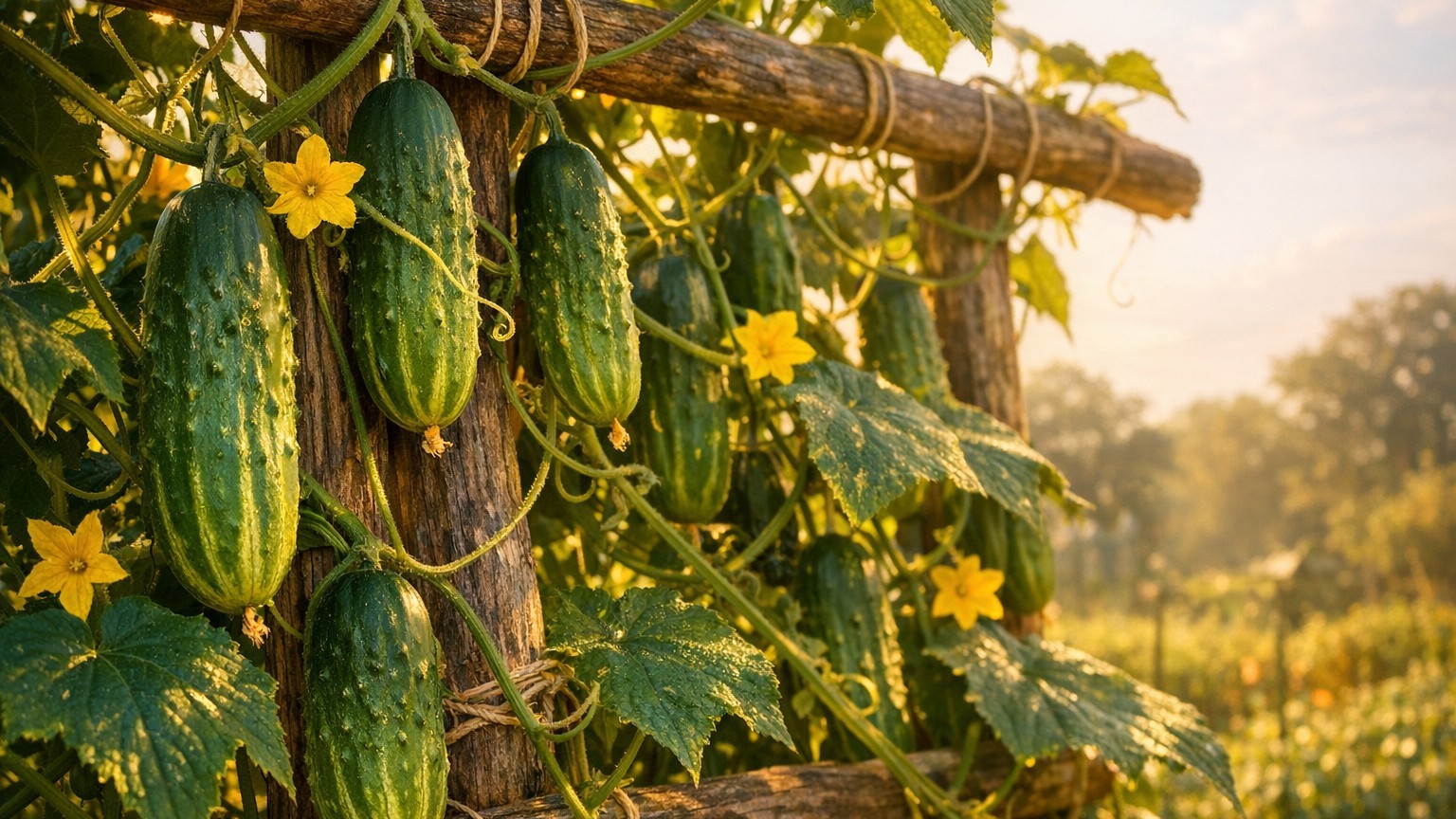

Cucumbers grown in West Virginia do best when the type matches the state’s short, humid summer: bush and compact vining pickling types for cooler mountain gardens, and vigorous slicing or burpless types for warmer river valleys with a full frost-free stretch. The choice comes down to season length and how much moisture your garden holds through July and August.
The short answer for West Virginia
Start with the numbers that actually shape this decision. The reference station in Charleston shows a last spring frost landing anywhere from April 9 to April 23, and a first fall frost between October 18 and November 1. That’s a frost-free window that can run close to six months in the valley, but the state’s elevation swings mean gardens at higher altitude lose weeks off both ends. Heat load is moderate rather than intense: only about 16 days a year reach 90°F or higher at the reference station, so this isn’t a climate that pushes cucumbers into the kind of relentless summer heat you’d find further south or west.
That combination, a decent season length but modest heat, points toward vigorous vining or semi-vining types trained on a trellis. Trellising matters more here than in a drier state because summer rainfall averages about 13.8 inches across June, July and August, with June alone bringing 4.72 inches. Fruit and foliage sitting close to wet soil in that kind of humidity is an invitation to fungal disease, so getting the vine up off the ground earns its keep.
For gardeners at higher elevation, where the frost-free window is shorter than the valley numbers suggest, bush-type pickling cucumbers make more sense. They mature on a more compact plant, tolerate a slightly shorter season, and work well in raised beds or containers where soil warms faster in spring. Parthenocarpic types, which set fruit without needing pollinators, are worth asking about too. They’re often bred for greenhouse or tunnel production, but some field-adapted versions handle the sporadic cool, wet stretches this region can throw at flowering time, when bees fly less and pollination gets unreliable.
Slicing cucumbers with a longer maturity window belong in the valley gardens, where the frost-free season stretches closer to the October 18 to November 1 range rather than the earlier October dates that higher ground sees. Burpless and Asian-style long types, which need consistent heat and a full season to size up properly, are a reasonable bet in those same warmer pockets, but a riskier one anywhere the season runs shorter.
What it can do is point you toward the category that fits your elevation and your garden’s drainage, and then send you to a source that names the cultivars actually trialled in West Virginia conditions, which the next section covers.
What will not work here
The clearest failure mode in this state is planting a long-season slicing or specialty cucumber bred for a hot, dry climate and expecting it to perform the same way here. With only about 16 days a year above 90°F, West Virginia doesn’t deliver the sustained heat that pushes those varieties to their full size and flavor. They’ll often still produce, but slower and smaller than the seed packet’s home region would suggest, and a late cool spell near the April frost dates can set them back further than a quicker-maturing type would tolerate.
Humidity undoes ground-level planting
The bigger issue is moisture. At nearly 14 inches of rain across the three summer months, with June alone delivering 4.72 inches, cucumber foliage left sprawling on bare soil sits in damp, still air for long stretches. That’s the setup for powdery mildew and downy mildew, both of which spread fast in humid Appalachian summers and can defoliate a planting in a couple of weeks once they take hold. Vines planted too close together compound the problem, because tight spacing blocks the airflow that would otherwise dry leaves out between rains.
Direct-seeding too early is the other trap. Because the last spring frost date ranges from April 9 to April 23 depending on where in the valley you are, and higher elevations lag well behind even that, cucumber seed put in the ground before the soil has genuinely warmed will simply sit and rot rather than germinate. Cucumbers are a warm-soil crop; cold, wet ground does more damage than a light frost ever could.
Finally, gardeners who water on a rigid weekly schedule regardless of rainfall tend to either drown their plants in a wet June or starve them in a drier August, when the same station shows summer rainfall dropping to 3.75 inches, the lowest of the three summer months. A fixed schedule ignores exactly the variability this state’s rainfall pattern produces.
What changes across West Virginia
West Virginia’s hardiness zone range runs from 5a to 7a under the USDA Plant Hardiness Zone Map, and that spread is wide enough that no single planting date or variety choice covers the whole state. A garden at the warmer end, generally the lower river valleys, functions closer to a 7a climate with a longer, milder season. A garden at the cooler end, up in the mountains, behaves more like 5a, with a shorter growing window and a real risk of late spring or early fall cold snaps that valley gardeners rarely see.
The Charleston station used for the frost dates and rainfall figures in this article sits in a river valley, which the National Centers for Environmental Information data itself flags as running warmer than the state’s higher ground. That means the April 9 to April 23 last-frost window, and the October 18 to November 1 first-frost window, describe the valley, not the mountains. A gardener at elevation should expect both dates to shift toward a shorter season, frost lingering later in spring and arriving earlier in fall.
Because the difference between 5a and 7a represents a meaningful gap in average extreme minimum winter temperature, and because that gap tracks fairly closely with growing-season length in this state’s topography, the practical shift for anyone gardening at higher altitude is to lean further toward the compact, quicker-maturing pickling and bush types discussed above, and to treat any slicing or burpless variety needing a long, warm run as a gamble rather than a safe bet.
The USDA map, searchable by ZIP code, does that job properly and is worth checking before finalizing a variety choice.
Where to check this for your own county
West Virginia University’s Extension Service is the state’s land-grant authority on this, and it’s reachable at extension.wvu.edu. This article works from statewide climate normals recorded at a single reference station in Charleston, which is useful for understanding the broad pattern but isn’t a substitute for what your own county’s agents have actually observed in local trial plots and reported back over multiple seasons.
Two things are worth hunting for on the WVU Extension site. First, a county-level or regional planting calendar, which will translate the statewide frost-date range into something closer to your actual location, particularly if you garden at elevation where the valley numbers cited here run too optimistic. Second, any variety trial results or recommended-cultivar lists for cucumbers, which will name specific pickling, slicing, or burpless types that have performed well under West Virginia’s humidity and disease pressure, something this state-level page is deliberately not doing.
County extension offices also tend to know which local disease pressures matter most, whether that’s a particular strain of downy mildew moving through a river valley in a wet year or a wilt problem more common in one part of the state than another. That kind of hyperlocal knowledge doesn’t show up in climate normals, and it’s exactly the sort of detail that separates a state-level answer from a county-level one.
A recommendation calibrated to your own county, built on seasons of local observation, will always beat a statewide average, however carefully sourced that average is.
Checking this against your own garden
None of the dates or averages above beat what your own garden tells you directly, and cucumbers give three fairly reliable signals worth learning to read.
Soil warmth by feel is the first and most useful. Push a bare hand a couple of inches into the bed in spring; if the soil still feels cold and damp rather than merely cool, cucumber seed will sit there rather than germinate, regardless of what the calendar says about the last frost date having passed. This matters more in West Virginia’s mountain gardens, where cold air pools and soil can lag well behind the valley’s timeline.
The first flush of male flowers is the second signal. Cucumbers typically produce a run of male blooms before the female flowers, the ones with a tiny swelling behind the petals that will become fruit, show up. Seeing plenty of male flowers with no females yet isn’t a problem, it’s normal sequencing, but it’s a useful marker of where the plant is in its cycle relative to your local heat and day length.
The first true leaves, the second set that emerges after the rounder seed leaves, tell you whether the plant has settled into real growth. Slow, pale true leaves usually point to soil that’s still too cool or nitrogen that hasn’t become available yet, both common in a wet Appalachian spring. Fast, deep-green true leaves are a decent sign that your particular spot is running warmer or drier than the valley average, and that you can likely push planting dates a little earlier than the statewide window suggests.