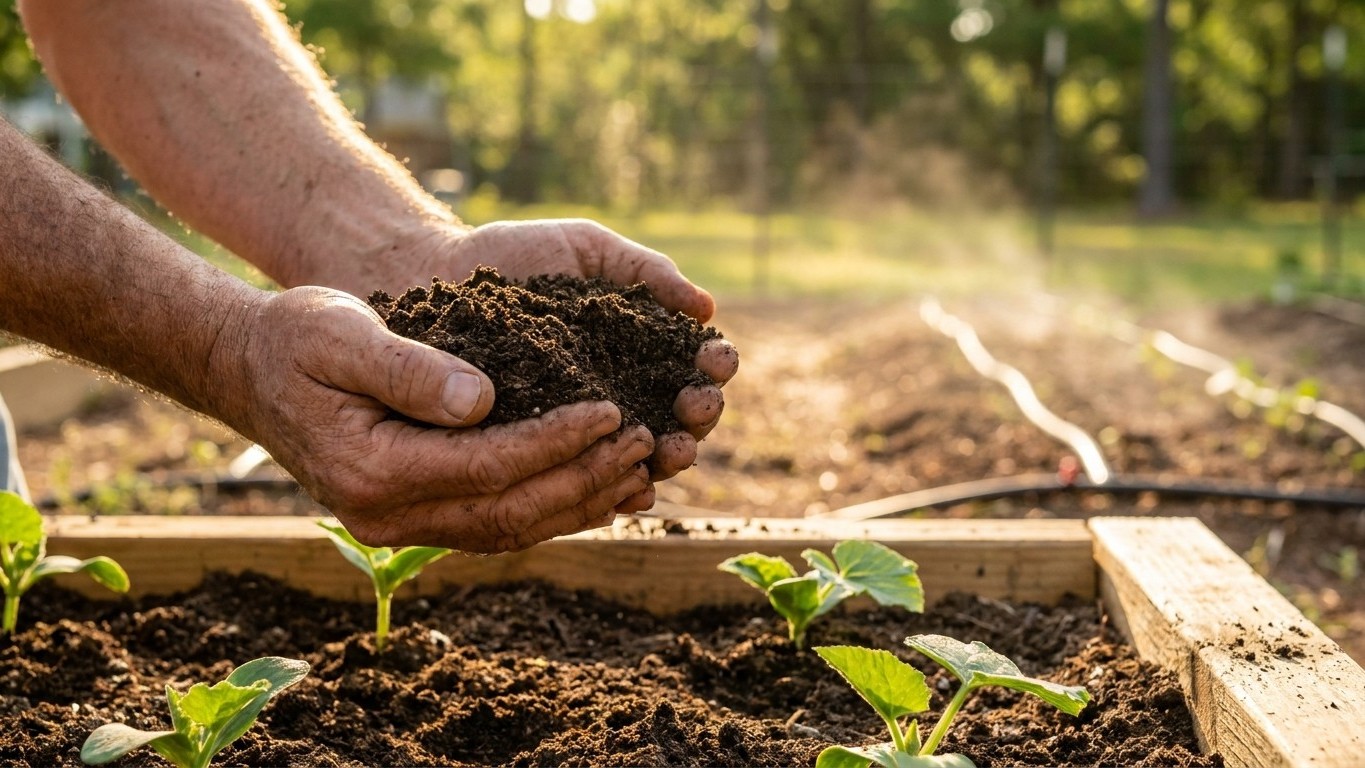

Summer squash goes into Indiana ground once the last spring frost has passed and the soil itself has caught up with the air, usually somewhere between mid-April and late May depending on where you garden in the state. The bigger question isn’t the calendar date so much as what that date actually guarantees, and how the state’s heat and rainfall pattern shapes the rest of the season.
When the soil is warm enough in Indiana
At the Indianapolis reference station (USW00093819), NOAA’s 1991-2020 Climate Normals put the last spring frost somewhere between April 9 and April 21. That’s a 30-70% probability band, not a single day circled on the calendar, which means it’s a window where the odds of a 32F freeze shift from possible to unlikely, never a promise that frost is finished.
Frost is only a proxy for what summer squash actually needs, which is warm soil. Air temperature can climb into the 60s on a sunny April afternoon while six inches down the ground is still cold and slow. Squash seed sitting in that cold soil doesn’t die outright, it just sulks: germination drags, roots stall, and a plant that should be racing by early June instead limps along a week or two behind a neighbor who waited. That’s the real reason gardeners are told to hold off past the frost date rather than sow the moment it clears.
Purdue’s extension service adds a caution worth repeating here: even after the published spring frost date, there’s still roughly a 10% chance of a 32F event. That’s not a large risk, but it’s not zero either, and anyone setting transplants out on the early edge of that April 9 to April 21 range should have row cover or an old sheet within reach for a cold night.
Location inside Indiana matters more than the statewide date suggests. The Indianapolis normals are a useful reference point, but southern Indiana, down along the Ohio River, typically clears frost a week or two earlier in spring and holds it off a week or two later in fall than the northern part of the state. A gardener in Evansville working from the Indianapolis date alone is giving up real growing time on both ends of the season.
Indiana’s hardiness zones run from 5b up to 7a across the state, per the USDA Plant Hardiness Zone Map. That range is built on one number, the average annual extreme minimum winter temperature, and it says nothing directly about spring soil warmth or summer heat. It’s useful for perennials and fruit trees, less so for deciding the week to plant squash. For that decision, the frost probability window and your own soil, not the zone number, are what count.
How long the season lasts here
Run the subtraction on the two frost windows and Indiana’s frost-free season lands somewhere between about 183 and 204 days, depending on which edge of each band your particular year falls on. Take the more conservative combination, a later spring frost (April 21) paired with an earlier fall frost (October 21), and you get roughly 183 frost-free days. Take the more generous combination, April 9 through October 30, and it stretches to about 204 days. Either way, that’s somewhere around six to six and a half months of growing room, which by national standards is a genuinely long season.
What that length allows is more interesting than the number itself. A window over six months wide gives summer squash room for more than one sowing. The first planting, going in once soil has warmed in mid-to-late spring, can carry a household through early and midsummer. A second sowing, timed to mature before the first fall frost arrives sometime between October 21 and October 30, can replace plants that have slowed down, been hit by squash bugs, or simply gotten leggy and unproductive by August. Squash plants don’t age gracefully; a fresh planting often outproduces a tired one even late in the season.
A season this length also changes the calculation on transplanting versus direct seeding. Summer squash resents root disturbance, and direct-sown seed usually catches up to and passes a transplant within a few weeks anyway. In a short-season territory, gardeners sometimes accept the root check of transplanting just to buy a few extra weeks before frost. Indiana’s window is generous enough that direct seeding, done once soil has genuinely warmed rather than by the calendar alone, is the lower-risk choice for most of the state, with transplants reserved mainly for gardeners who want an extra-early first harvest.
The math also opens the door to succession sowing as a real strategy rather than an afterthought. For a fuller breakdown of timing a second and even third planting to keep squash coming without a midsummer gap, see the succession sowing guide elsewhere on this site.
Heat and water in Indiana
The Indianapolis reference station averages 14.6 days a year at or above 90F, per NOAA’s 1991-2020 Climate Normals. That’s a moderate number, not the kind of relentless heat load seen in the Deep South or the desert Southwest, but not a cool-summer figure either. It matters because squash pollen is short-lived once temperatures push into the high 90s, and a run of days that hot during flowering can mean blossoms opening, getting pollinated poorly or not at all, and dropping without setting fruit. At 14.6 days a year, Indiana sits in a middle ground: heat stress is a real possibility during a hot stretch in July, but it’s not the defining condition of the whole summer the way it is farther south.
Rainfall tells a more layered story. Summer rain across June, July and August totals about 12.6 inches at the same reference station, out of 43.6 inches for the full year. Broken down by month, June averages 4.95 inches, July 4.42, and August drops to 3.2, the driest of the three. That August dip lines up awkwardly with the stretch when summer squash plants, now carrying their full leaf canopy and setting fruit heavily, are drinking the most water they’ll need all season.
Squash leaves are large and lose water fast through transpiration, while the plant’s root system stays relatively shallow. That combination means a squash plant can run short on water within a couple of dry days even when the season total looks generous on paper. A single summer thunderstorm, common in Indiana’s pattern, tends to run off a dry or crusted surface rather than soaking in evenly, so the 3.2 inches of August rain rarely arrives as the steady, gentle soaking a shallow-rooted plant actually wants.
Soil type changes this equation further. The same inch of rain drains through sandy ground within a day and leaves a squash plant asking for water again almost immediately, while clay soil holds that same inch for a week or more. A gardener on sandy soil in a dry August, even in a state with respectable summer rainfall totals, may need to water every other day. There’s no substitute here for a rain gauge on the actual plot; the normals describe what the region can typically expect, not what falls on any one garden in any one summer.
Where summers run cooler and wetter than these Indianapolis normals, closer to the northern edge of the state or during an unusually damp year, the concern flips. Excess moisture on squash leaves, especially overnight, is the classic setup for powdery mildew, and fruit can ripen more slowly under overcast, humid conditions than the sunnier, hotter stretches farther south in the state.
Which summer squash suit Indiana
None of this points to a single named variety, and that’s deliberate. The seed catalogs list dozens of summer squash cultivars, and which ones actually perform well shift from one growing season to the next based on disease pressure, rainfall, and which strains a state’s extension trial gardens happened to test that year. A name printed on this page today could be a poor performer in Indiana two seasons from now. What the state’s own numbers do point to is a set of types worth favoring.
The season length, roughly 183 to 204 frost-free days, is generous enough that early types aren’t strictly necessary the way they would be in a short-window northern territory; there’s room for both an early planting and a later succession sowing, so maturity speed matters less here than it would elsewhere. The moderate heat load, 14.6 days above 90F on average, means most types will set fruit reasonably well most summers, though a spell of extreme heat during flowering can still knock pollination back for a week or two regardless of variety. The rainfall pattern, decent totals but a distinctly dry August and rain that often arrives as runoff-prone downpours, makes disease resistance and good airflow around the base of the plant a sensible first filter, since humid, still air around dense foliage is exactly what invites powdery mildew.
Bush-type growth habits, which keep foliage more open than sprawling vine types, tend to handle Indiana’s mix of summer humidity and occasional dry spells better simply because air moves through the plant more freely and the root zone is easier to keep evenly watered. Beyond that general shape, the honest answer is to check with Purdue Extension, whose trial gardens test specific cultivars against Indiana’s actual disease pressure and weather each year. That’s not a dodge; it’s the only recommendation that means anything, because a variety proven in a Purdue trial plot has already been tested against the same frost windows, heat days and August dry spell laid out here, in a way no general article can replicate.