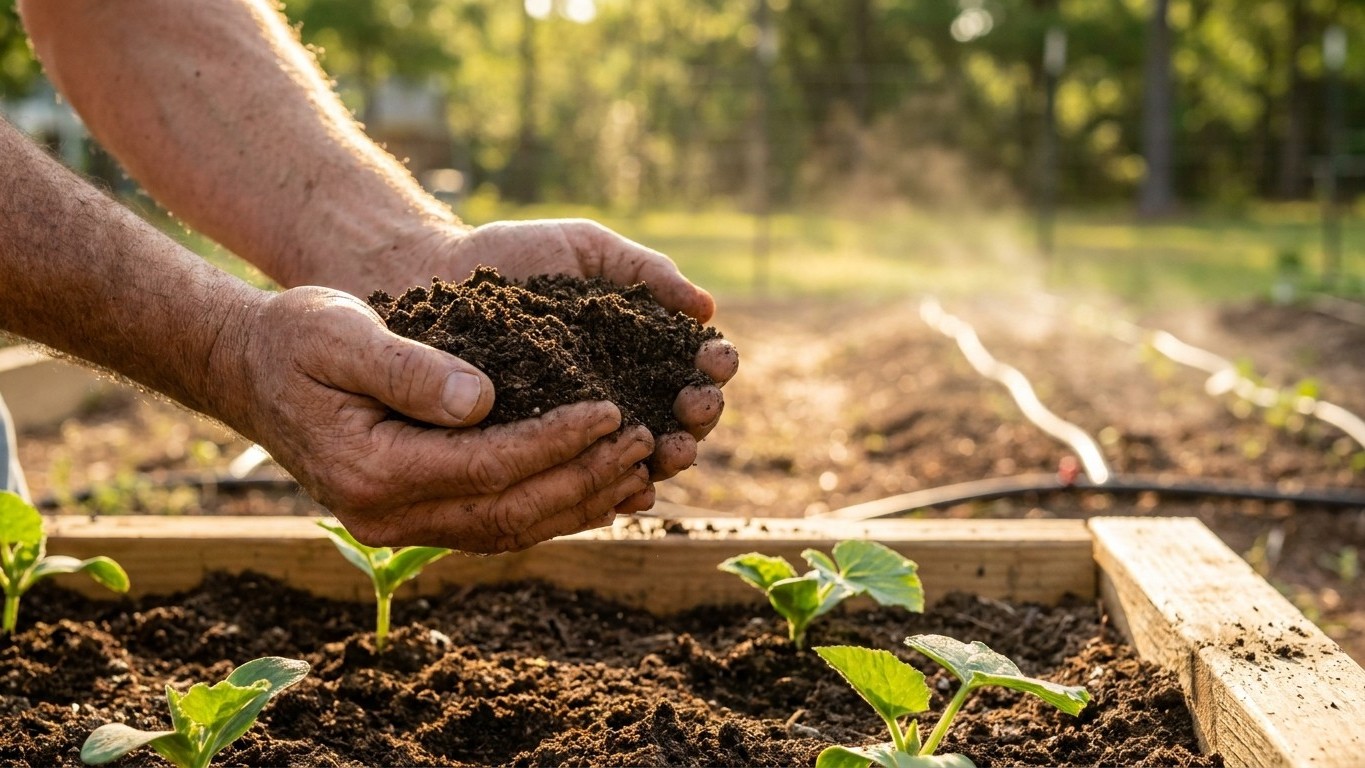

Soil temperature, not the calendar, decides when summer squash go in the ground in Kansas. Aim for late April through mid-May in most counties, once nighttime soil readings hold above 60°F. The frost-free window then runs roughly six and a half months, long enough for a second sowing in many parts of the state. Heat and uneven summer rain are the bigger challenges once the plants are up.
When the soil is warm enough in Kansas
At the reference station used by NOAA (Wichita’s long-term climate site, USW00003928), the last spring frost falls somewhere between April 4 and April 18, based on 1991-2020 climate normals measuring the 30-70% probability band for a 32°F freeze. That’s a wide window, and it’s worth sitting with for a second: it means in three years out of ten, frost risk lingers past April 18, and in three years out of ten it’s already gone by April 4. A frost date is a probability, not a promise.
But frost isn’t really what summer squash care about. These plants germinate and grow from warm soil, and soil doesn’t warm on the same schedule as the air. A morning with no frost risk can still have soil sitting in the low 50s if a cold snap passed through the week before, and squash seed planted into that soil will sit and sulk, or rot, rather than sprout. The practical fix: wait until soil temperature at a two-inch depth holds consistently above 60°F for several days running, which in most Kansas counties lands somewhat after that April 4-18 frost window, not right on top of it.
Suburban and rural gardens away from the airport station typically see their own last frost land later than the April 4-18 range, sometimes by one to two weeks, and more at elevation or in low-lying frost pockets. Treat the NOAA figure as a starting reference for Wichita, not a guarantee for your specific yard. County-level records, if you can find them for a nearby cooperative weather station, will get you closer.
Direct-seed or transplant
Summer squash resent root disturbance, so many gardeners direct-seed once soil is reliably warm. Transplants started indoors buy a couple of weeks but need hardening off and careful handling at planting, since a check to the root system can stall the plant for a week or more. In a state with a season as long as Kansas offers (more on that below), the time saved by transplanting matters less than in a shorter-season territory.
Whichever method you choose, hold off mulching heavily until the soil has actually warmed. A thick mulch laid too early acts as insulation against warming, not just moisture retention, and can undo the waiting you just did.
How long the season lasts here
Kansas’s frost-free window can be worked out directly from the two NOAA date ranges. Pairing the earliest last-spring-frost date with the earliest first-fall-frost date (April 4 to October 23) gives a window of about 202 days. Pairing the latest dates in each range (April 18 to November 2) gives about 198 days. Either way, that’s roughly six and a half months of frost-free growing, one of the longer windows among the states in this territory-by-territory series.
| Frost pairing used | Start | End | Approximate window |
|---|---|---|---|
| Earliest dates | April 4 | October 23 | ~202 days |
| Latest dates | April 18 | November 2 | ~198 days |
A window of that length changes what’s worth planning for. Summer squash typically finish their first flush of production within eight to ten weeks of a warm-soil planting, well inside even the shorter 198-day estimate. That leaves a real second sowing on the table for gardeners who want continuous harvest rather than one big early wave followed by decline, especially once squash bugs or vine borers start working on the first planting later in summer. A fresh sowing in early-to-mid July, timed against your own county’s likely fall frost, can still mature well before the season closes.
This is also where the transplant-versus-direct-seed question resolves itself for most Kansas gardeners. With nearly seven months of frost-free growing to work with, the week or two a transplant might save rarely changes the outcome, while the root check it risks can cost more than it gains. Direct-seeding twice, spaced weeks apart, tends to outperform a single early transplanting in a season this generous. For a fuller walk-through of timing a second sowing against your local fall frost, the succession sowing guide on this site covers the spacing and timing in more detail.
Heat and water in Kansas
Wichita’s reference station logs an average of 57.6 days a year at or above 90°F, a substantial heat load by the standards of this territory series. That number matters more than the average summer temperature, because it’s the count of days when two specific things go wrong for squash. First, pollen loses viability fast once temperatures push into the high 90s, and a plant that flowers heavily but sets fruit poorly is often simply too hot to pollinate well, not sick or under-fed. Second, squash carry enormous leaves on a comparatively shallow, spreading root plate, and on a 90-plus-degree afternoon those leaves can lose water faster than the roots can pull it back in, showing up as midday wilting even in soil that isn’t actually dry.
Rainfall doesn’t offset that heat load as much as it might look on paper. Summer rain across June, July and August averages about 13.2 inches, respectable against the 34.3 inches that falls over a full year. But it isn’t evenly spread: June brings 4.93 inches, August 4.3, and July, the hottest stretch, drops to just 3.98 inches, the driest of the three summer months. A dry July landing on top of the year’s heaviest run of 90-degree days is exactly the combination that stresses squash hardest, right when fruit is setting.
None of this reads the same on every soil. The same inch of rain soaks in within a day on sandy ground and can sit near the surface for a week on heavy clay, so two Kansas gardens receiving identical rainfall can need entirely different watering schedules. And rain that arrives as a single summer thunderstorm, common in this part of the country, tends to run off a dry, crusted surface rather than soak down to the root zone, so a big storm total doesn’t always translate into water the plant can actually use. A rain gauge and a finger pushed into the soil next to the plants will tell you more than the July average ever will. Afternoon shade cloth over the row during the worst heat spells, and deep, infrequent watering rather than a light daily sprinkle, are the two practical responses to this combination of numbers.
Which summer squash suit Kansas
The facts here point toward a specific set of priorities rather than a specific variety. A season running close to 200 days removes the pressure to chase the earliest-maturing types just to beat the frost, since even a second sowing has time to finish. That frees a Kansas gardener to choose based on the two factors that actually bite here: heat tolerance around fruit set, and airflow around the crown of the plant.
Compact bush types, planted with real spacing between plants rather than crowded rows, let air move through the foliage and dry morning dew faster, which matters given how much of Kansas’s summer rain arrives as sudden thunderstorm bursts rather than gentle steady moisture. That same airflow also helps during the hottest stretches, since a plant sitting in still, humid air under its own leaf canopy struggles more to cool itself than one with a breeze reaching the base of the stems. Disease resistance, particularly to powdery mildew, is worth weighing heavily given how the summer rainfall pattern combines heat and intermittent wet leaves.
What this page won’t do is name a specific cultivar. Every seed catalog claim about a variety’s heat tolerance or disease resistance was tested somewhere, and “somewhere” matters: a squash bred and trialled in a humid coastal climate doesn’t necessarily perform the same way against 57.6 days above 90°F and a dry Kansas July. The Kansas State University Research and Extension service runs its own variety trials across the state’s growing conditions, and its recommendations reflect actual local performance rather than a seed packet written for a national audience. That’s the list worth checking before buying seed, not a name picked at random for this article.
Kansas’s hardiness zone stretches from 5b to 7a across the state (USDA Plant Hardiness Zone Map, based on 1991-2020 average extreme minimum winter temperatures), a reminder that a variety doing well in the milder southeast corner may not perform identically near the Nebraska line. Extension offices tend to break recommendations down by region for exactly this reason, and that regional detail is worth seeking out before the seed order goes in.