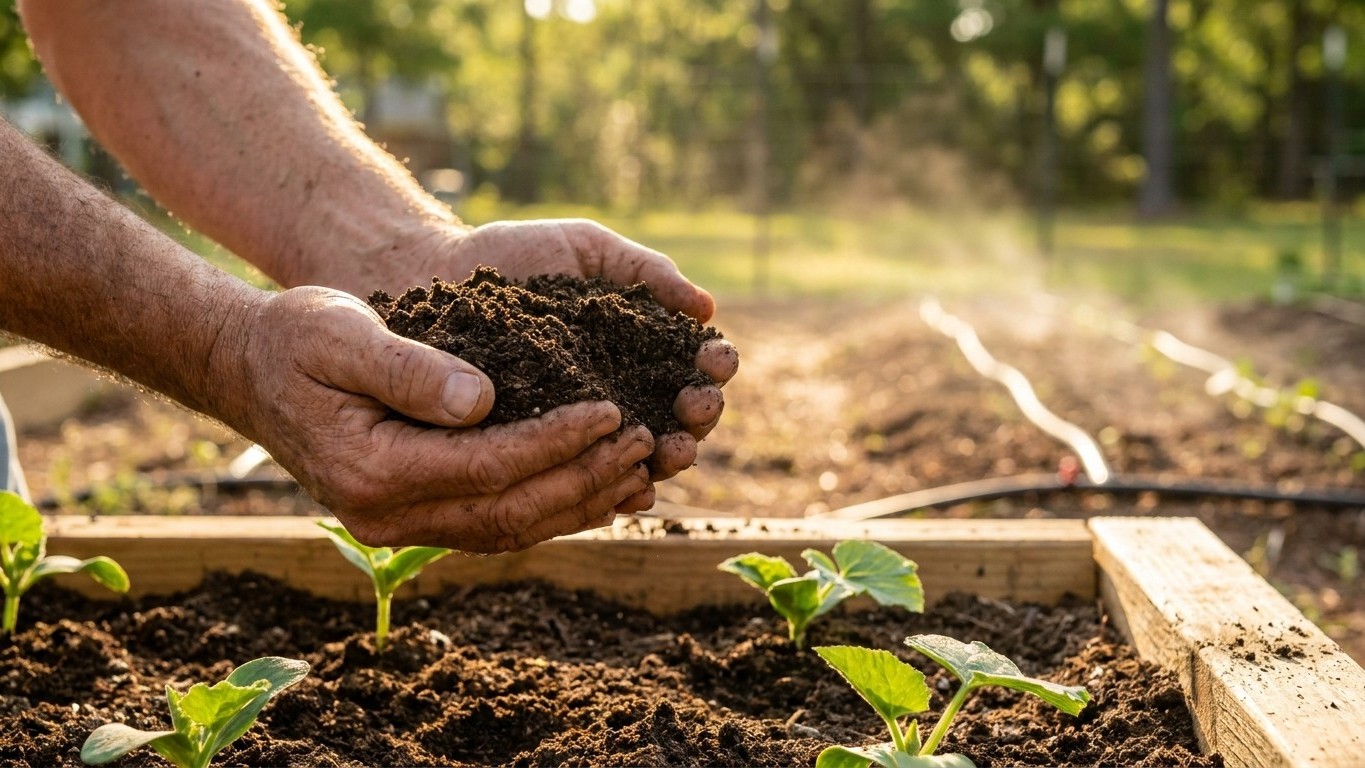

Summer squash goes into Massachusetts gardens once the soil itself has warmed, not simply once the calendar clears the last frost date. In most of the state that means transplanting or direct-seeding in mid-to-late May, with the season running into early or mid-November depending on where you garden, and the heat and rainfall pattern here favoring steady watering and disease-resistant types over anything bred for scorching summers.
When the soil is warm enough in Massachusetts
The reflex is to circle the last spring frost on a calendar and plant the next morning. Summer squash punishes that reflex. Its seed germinates poorly in cold soil and its seedlings sulk or rot if the ground is still tight and chilly, so the frost date matters mainly as a marker for when the soil, a few inches down, finally crosses into workable warmth. At the NOAA reference station used for these normals, Boston’s Logan Airport (USW00014739), the last spring frost falls between April 1 and April 8, based on the 1991-2020 Climate Normals and their 30-70% freeze-probability band.
That date is a probability, not a promise. Half the years in the record, a freeze happens later than the window suggests, and Logan is the mildest reporting point in Massachusetts. It sits on open water, in the state’s warmest corner. Inland towns, the Connecticut River Valley, and especially the Berkshires run noticeably colder in spring and frost earlier in fall, sometimes by two to three weeks. A gardener in Pittsfield or the Worcester hills should treat the Logan window as a floor, not a target date.
Soil temperature is the more honest signal, and it lags air temperature by days to weeks. Summer squash wants soil that has warmed well past the frost risk, typically once nighttime lows are reliably staying above the mid-50s. That’s usually two to three weeks after the last frost date at any given station, which for most of Massachusetts lands somewhere in mid-to-late May. Gardeners who push earlier by covering soil with black plastic or using row cover to trap heat aren’t cheating the calendar so much as compensating for it.
The state’s USDA Hardiness Zone range, 5a to 7b under the USDA Plant Hardiness Zone Map (2023 edition, based on 1991-2020 normals), reflects how much that variation matters. That range is built on one number, the average annual extreme minimum winter temperature, and it says nothing directly about spring soil warming, but it does confirm the spread between the coast and the interior highlands is real and worth planning around. Boston itself sits toward the warmer end of that range; the Berkshires sit toward the colder one.
None of this changes with a fancier seed packet. The safest local move is checking with the UMass Extension for soil temperature guidance and planting windows calibrated to your county, rather than trusting a single statewide date.
How long the season lasts here
Subtracting the two frost windows gives a real answer, not a guess, because both dates come from the same NOAA station record. The last spring frost falls between April 1 and April 8; the first fall frost falls between November 3 and November 14. Depending on which end of each window a given year lands on, the frost-free growing season in the Boston area runs somewhere between about 209 and 227 days, call it roughly seven months at the shorter end and closer to seven and a half at the longer.
That’s a long window by New England standards, and it changes the math on how you plant. A frost-free season stretching past 200 days doesn’t just accommodate one crop of summer squash sown in late May and harvested through August. It leaves room for a second sowing in early-to-mid July, timed to mature before the shorter end of that fall frost window arrives, extending the harvest into October in favorable years and giving you a fresh flush of plants right when the first ones start slowing down from squash vine borer damage or simple age.
Whether that second sowing is worth the effort depends on what happened to the first planting. Direct-seeded squash that’s cropping heavily by late July often isn’t worth pulling for a restart. Transplants that got hit by a cutworm or a cold snap in May, or that are visibly declining from borer damage by midsummer, are a different story, and a mid-season reseeding can outproduce a struggling holdover by September. The math changes again in the colder interior counties, where the fall frost window shifts earlier than the Logan station data shows, compressing that second-sowing option into a narrower gap.
The mechanics of timing a second planting, how far back to count from your expected frost date and how to stagger sowings so you’re not overwhelmed or under-supplied, are covered in more detail in this site’s guide to succession sowing for summer squash. Massachusetts’s season length makes that a genuinely useful exercise here, not a marginal one.
Heat and water in Massachusetts
Summer squash has two real enemies in a New England summer, and neither of them is a hard freeze. The first is extreme heat, which shortens pollen viability and can cause blossoms to drop without setting fruit once daytime highs push into the high 90s for days at a stretch. The second is water stress, because the plant’s broad leaves lose moisture fast and its root system is comparatively shallow, so it depends on regular topsoil moisture rather than deep reserves.
On the first count, Massachusetts is mild. At the Boston reference station, the 1991-2020 normals put the average at just 10.2 days a year at or above 90°F. That’s a modest heat load, not the kind of repeated extreme-heat stretch that causes widespread pollination failure in squash further south or in the interior West. Gardeners here are far more likely to lose a crop to squash vine borer, powdery mildew, or a wet, cool June that slows everything down than to lose blossoms to heat stress.
On the water side, the numbers demand more attention. Summer rainfall across June, July and August averages about 10.4 inches, broken down as 3.89 inches in June, 3.27 in July, and 3.23 in August, the driest of the three summer months. That sounds like a reasonable amount of rain on paper, and over a full season it often is, but it rarely falls in the small, steady doses a shallow-rooted crop like squash actually wants. Summer rain in this region tends to arrive as thunderstorms, dumping an inch in an hour and running off a compacted or sloped garden bed rather than soaking in evenly.
That’s where soil type does the real work the rainfall figure alone can’t. Sandy soil common in parts of Cape Cod and the Connecticut Valley terraces drains that rain within a day, leaving the root zone dry again by the next afternoon. Heavier clay soil common in parts of central Massachusetts holds it far longer, sometimes to the point of waterlogging a poorly drained bed after a wet week. Neither extreme is solved by the rainfall average. A rain gauge at your own garden, checked weekly through July and August, tells you more than the seasonal number ever will, and it’s the cheapest tool in this whole guide.
Practically, that means mulching to slow evaporation and even out soil moisture between storms, and watering deeply at the base of the plant rather than overhead, which also helps keep foliage dry and cuts down on the powdery mildew that thrives in this state’s humid August air.
Which summer squash suit Massachusetts
Nothing here points toward a specific variety name, and that’s a deliberate choice, not a gap. Squash varieties are trialled and rated by state extension programs precisely because performance shifts by region, soil, and even the particular summer, and a name recommended for the Midwest or the Deep South carries no guarantee it will perform the same way in a Worcester County garden. The honest answer to “which variety” is to check UMass Extension’s current vegetable variety trials, which are updated with results specific to Massachusetts growing conditions.
What this page can responsibly do is point to the type of plant that fits the state’s conditions, based on the facts already laid out.
- Early-to-midseason types make sense given the state’s roughly seven-month frost-free window; there’s enough season length to also support a second sowing of an early type in July, rather than betting everything on one long-season planting.
- Bush-habit types with open growth suit the humid summer air here, since better airflow around the leaves and fruit reduces the window powdery mildew has to take hold.
- Types bred or selected for disease tolerance, particularly to powdery mildew and the viruses spread by cucumber beetles, matter more in Massachusetts’s damp summers than heat tolerance ever will, given the modest 10.2-day average above 90°F.
Growers on the sandier soils of the Cape or the Connecticut Valley terraces should weigh varieties known to tolerate quicker drying between waterings, while those on heavier clay soils inland benefit more from raised beds or ridged rows that shed excess water after the thunderstorm-driven rain pattern typical of a Massachusetts July. Either way, the extension service’s regional trial data, drawn from actual Massachusetts test plots rather than a national seed catalog description, remains the one source built to answer the variety question for your specific county.