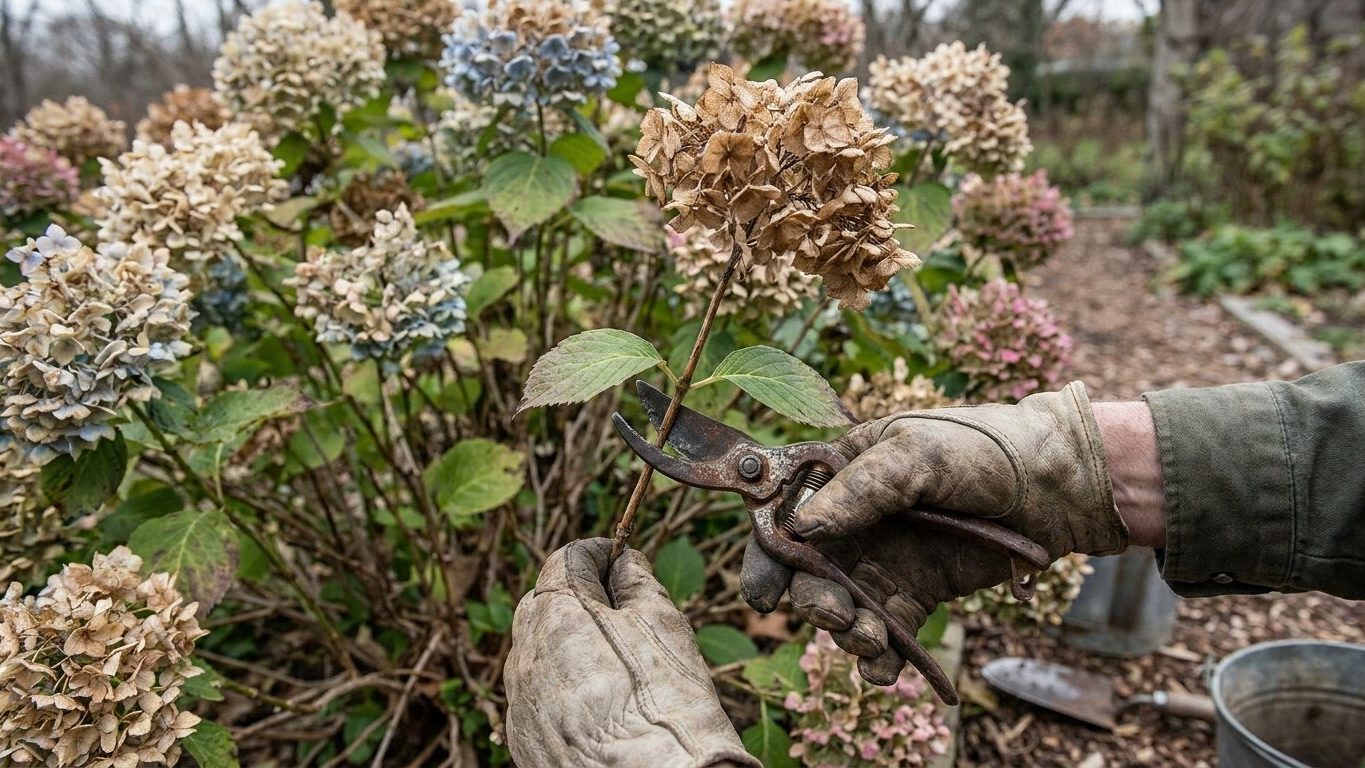

Deadheading means cutting the spent flower head, not the whole stem — snip just above the first full pair of healthy leaves below the faded bloom. But how far down you can safely go, and whether it matters at all for next year’s flowers, depends entirely on whether your hydrangea blooms on old wood or new wood. Get the type wrong and you cut off next spring’s show.
Why this matters
Deadheading is mostly cosmetic. A hydrangea head that’s gone brown and papery isn’t hurting the plant by staying put, but it does pull a small amount of energy toward seed production instead of root and stem growth. Removing it redirects that energy and tidies the shrub for the rest of the season. That’s the whole mechanical benefit, it’s a low-stakes task on a genus the NC State Extension Gardener Plant Toolbox already rates as low-maintenance overall.
The real consequence isn’t skipping deadheading, it’s doing it carelessly on the wrong type. Bigleaf hydrangea, oakleaf hydrangea, mountain hydrangea and climbing hydrangea all set their flower buds on old wood, meaning the wood grown the previous season. Cut too far down one of those stems, and you’re not removing a spent flower, you’re removing the exact tissue that would have carried next year’s buds. Panicle hydrangea and smooth hydrangea (Annabelle types) bloom on new wood instead, so deadheading them has almost no bearing on next year’s flowering at all. Skipping it entirely on those two types costs you nothing but appearance.
When to do it
Watch the flower head itself rather than the calendar. A spent bloom loses its saturated color first, the petals (technically sepals) turn papery and dry, and the whole head takes on a tan or rusty tone depending on the variety. That’s your signal, not a date on a chart, bloom timing shifts by zone and by type, and this page can’t hand you a date that would be wrong for half its readers anyway.
For the old-wood bloomers, bigleaf, oakleaf, mountain and climbing, deadhead as soon as the flower fades and before the plant pushes much new growth below it. New buds for next year start forming on this season’s wood not long after bloom, so working promptly means you’re less likely to accidentally cut through a spot that’s already differentiating into a bud. For the new-wood bloomers, panicle and smooth, timing is far more forgiving. Because next year’s flowers will come from stems that haven’t even grown yet, you can deadhead any time after the bloom fades, or skip it and leave the dried heads standing through winter for structure and for the hollow stems native bees use to nest in.
How to do it
Start with clean bypass pruners rather than anvil-style shears. Bypass blades slide past each other like scissors and leave a clean cut; anvil pruners crush the stem, which invites disease into a plant already listed by NC State as susceptible to leaf spot and powdery mildew. Wipe the blades with rubbing alcohol between plants if you’re working on more than one hydrangea, especially if any show signs of bacterial wilt.
For old-wood types: bigleaf, oakleaf, mountain, climbing
Follow the flower stem down from the dried head. You’re looking for the first full, healthy pair of leaves, usually just a few inches below the bloom. Make your cut at a slight angle right above that leaf pair, leaving the node intact. Stop there. Do not follow the stem further down “to neaten it up”, everything below that point is the older wood carrying buds that already formed for next spring, and on bigleaf hydrangea specifically, those buds were set the previous summer. The NC State source is explicit that pruning this type removes the flowers, and that’s true whether the cut is a hard prune or an overly enthusiastic deadhead. Done correctly, the plant should look like it kept most of its foliage and lost only the brown, crispy tops.
For new-wood types: panicle, smooth
You have more room to work with. Cut the spent head back to the first strong leaf pair for a tidy look, or go further down the stem if you want to shape the plant, since the buds that matter for next year haven’t grown yet. Panicle hydrangea in particular can take a much harder cut in late winter without any bloom penalty, because it flowers entirely on the current season’s new growth.
What a good cut looks like
A properly deadheaded hydrangea shows short, clean stubs where flower heads were, each one ending just above a leaf node, with the surrounding foliage untouched. There’s no ragged tearing, no stripped bark, and no long bare stem sticking up above the leaf canopy. If you’re removing more than the top six inches or so of a stem on an old-wood type, you’ve likely gone past deadheading into pruning territory, which is a different task with different timing rules.
What goes wrong
The most common failure is simple: cutting too low on an old-wood bloomer and removing the very buds you wanted to see next year. It shows up the following spring as a bigleaf or oakleaf hydrangea that leafs out fine but produces few or no flowers, even though the plant looks otherwise healthy. There’s no fixing it retroactively, the wood that would have flowered is gone, and the shrub has to grow a fresh season of stems before it can set buds again.
The mistake that looks like extra care but isn’t: cutting every stem back hard in fall to “clean up” the bed for winter. On an old-wood type this strips off next year’s flowers just as surely as a badly placed deadhead, and it also removes the dead hollow stems that native bees use for nesting over winter. Leaving stems standing at 12 to 24 inches until they naturally break down does more for the garden than a tidy fall cutback ever does.
A second, quieter problem shows up as a color complaint rather than a pruning one. Gardeners deadhead, then feed the plant a high-phosphorus fertilizer to “help it along,” and wonder why a blue bigleaf hydrangea starts drifting toward pink. Phosphorus locks up the aluminum in soil that blue flowers depend on, that’s a feeding decision, not a pruning one, but it gets blamed on the wrong step because both happened around the same time.
Doing it differently
Container-grown hydrangeas can be deadheaded a bit more aggressively than the same variety in the ground, simply because their overall size is already restrained by the pot, and a slightly deeper cut is less likely to remove a meaningful share of the plant’s flowering wood. Both bigleaf and panicle hydrangea are shallow-rooted, so containers and raised beds suit them well as long as mulch keeps the root zone from drying out between waterings.
Climbing hydrangea barely needs deadheading as routine maintenance at all. It’s notoriously slow to start flowering in the first place, clinging by aerial rootlets and often taking several years to bloom, so most of the early work is training growth rather than managing spent flowers.
Panicle hydrangea offers the most legitimate variation: because it flowers on new wood, you can treat “deadheading” as optional and instead do a hard structural cut in late winter, which the NC State source notes this species tolerates well. That single hard prune does the job of a whole season of deadheading at once, and it’s the only hydrangea type built to take full sun, which changes how it’s sited compared to the shade-preferring bigleaf.
| Type | Blooms on | Deadhead effect on next year |
|---|---|---|
| Bigleaf / mop-head / lacecap | Old wood | Cutting past first leaf pair removes next year’s buds |
| Panicle / peegee | New wood | No effect; can even cut hard in late winter |
| Smooth (Annabelle) | New wood | No effect |
| Oakleaf | Old wood | Cutting past first leaf pair removes next year’s buds |
| Mountain | Old wood | Same risk as bigleaf, though buds tolerate late frost better |
| Climbing | Old wood | Rarely needs deadheading; slow to flower regardless |
Common questions
Does deadheading make a hydrangea bloom more?
Not directly. It redirects energy away from seed production and tidies the plant, but it doesn’t force additional flower buds. For new-wood bloomers like panicle and smooth hydrangea, the number of blooms next year depends more on how much new growth the plant puts on than on deadheading the previous season’s flowers.
Can I deadhead a bigleaf hydrangea any time after it blooms?
It’s safer to do it soon after the flower fades rather than waiting late into the season, since bigleaf hydrangea sets its buds for next year on the current season’s wood not long after bloom. Waiting too long raises the odds you’ll cut into wood that’s already forming a bud.
Will coffee grounds turn my hydrangea blue if I use them after deadheading?
Only on bigleaf and mountain hydrangea, and only weakly. The color shift depends on available aluminum in acidic soil (below about pH 5.5), and the pH change from kitchen coffee grounds is too small to reliably move it. Panicle, smooth, oakleaf and climbing hydrangeas don’t change color with soil pH at all, regardless of what’s added.
Is it safe to compost the deadheaded flower heads?
For most types, yes. The one caution is bigleaf hydrangea, which the NC State Extension Gardener Plant Toolbox documents as toxic if eaten in large quantities, affecting bark, flowers, leaves and stems and posing a risk to cats, dogs and horses as well as people. It’s not a plant to worry over in passing contact, but keep grazing pets away from a compost pile holding a large volume of bigleaf trimmings.