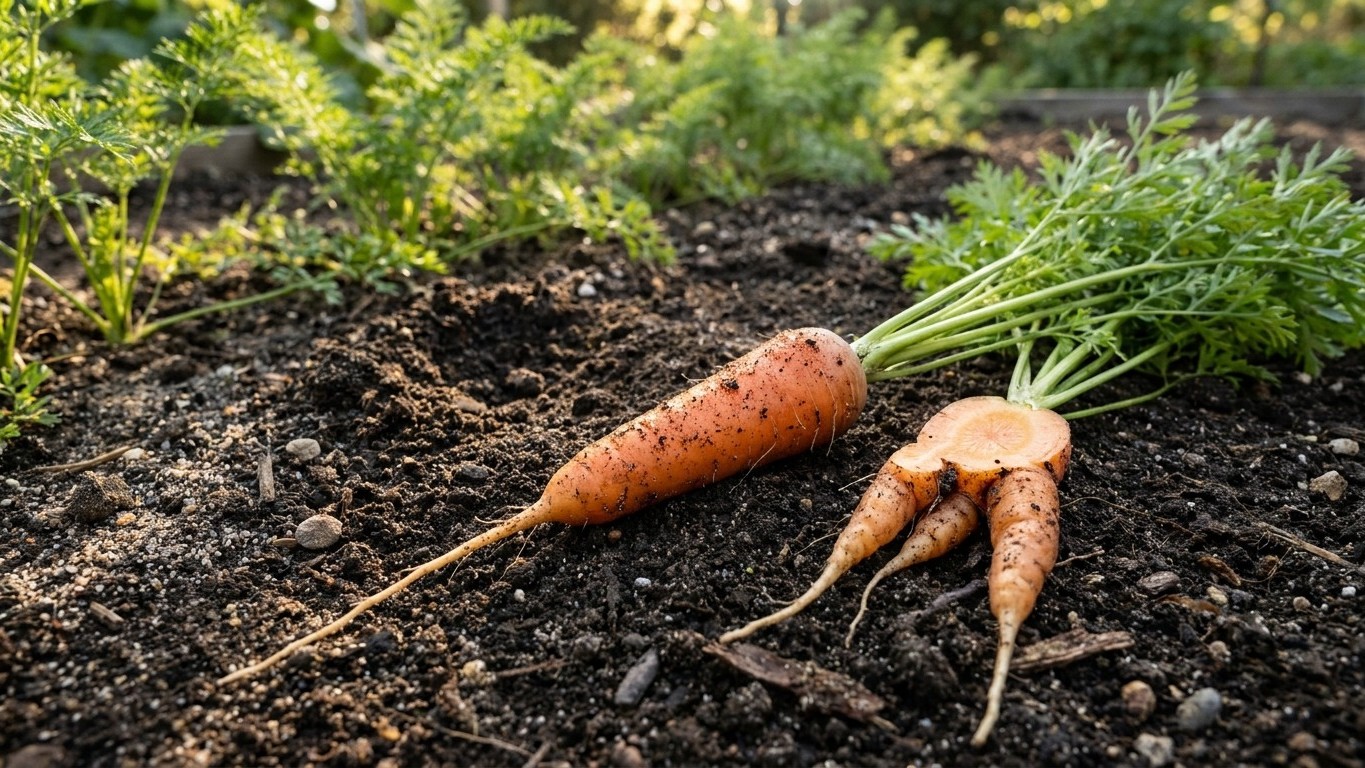

UF/IFAS Extension documents eleven garden pests for this territory, but only five of them ever put a mark on a carrot: aphids, eastern lubber grasshoppers, fall armyworm, root-knot nematodes, and whiteflies. The rest target tomatoes, cucurbits, palms or nothing edible at all. Carrot itself runs 70 to 100 days from seeding, and where each pest lands on that clock depends on whether it feeds above ground or below it.
Which pests attack carrot in Florida
UF/IFAS Extension documents eleven pests for this territory: Aphids, Chilli thrips (Scirtothrips dorsalis), Cycad aulacaspis scale, Eastern lubber grasshopper (Romalea microptera), Fall armyworm, Fire ants, Hornworm caterpillars, Melonworm, Pickleworm, Root-knot nematodes, and Whiteflies. That’s the complete list this office publishes for the state. It isn’t a carrot-specific list, and most of the names on it have nothing to do with a root crop growing a few inches under sandy soil.
Start with what doesn’t belong here. Cycad aulacaspis scale feeds on cycad palms, sago foliage and stems, and never touches a vegetable bed. Chilli thrips target tender new growth on fruiting and ornamental plants like pepper, strawberry and rose; a carrot’s mature, fern-like top isn’t the tissue they go after. Melonworm and pickleworm are cucurbit specialists built to bore into squash, melon and cucumber fruit, and a carrot produces no fruit for either to enter. Hornworm caterpillars work the nightshade family, mainly tomato and pepper foliage, not the carrot family. Fire ants nest in garden soil and will sting a hand that gets too close, but they don’t chew carrot tissue; mostly they tend aphid colonies for the honeydew, which is a reason to notice them nearby, not a reason to blame them for the damage.
That leaves five pests that actually feed on carrot. Aphids and whiteflies are sap suckers working the undersides of the ferny top growth. Fall armyworm caterpillars chew that same foliage from the outside, leaving torn edges instead of curled ones. Eastern lubber grasshoppers are generalist defoliators, slow and unmistakably large, capable of stripping a row of carrot tops in a single pass once their preferred food dries up elsewhere. Root-knot nematodes work underground, and they’re the only pest on this list that damages the part of the plant a gardener is actually growing this crop to eat.
Five confirmed threats out of eleven documented names is a normal ratio for this kind of list. UF/IFAS tracks pests across the whole home vegetable garden, not crop by crop, so any page built around a single root vegetable will always set aside most of a statewide list.
When each one shows up, and what it does first
Carrot goes into the ground as seed, not as a transplant, and it runs 70 to 100 days from seeding to harvest. That window, not a named month, is what this calendar has to run on, since the published facts for this page don’t carry a frost date to hang the timing on instead.
In the first weeks after seeding, while the carrot is still a thread-thin seedling pushing out its first true leaves, aphids are the earliest visitor to watch for. They cluster on the undersides of new growth, and the first sign is rarely the insect itself: it’s curled, yellowing leaf tips and a faint stickiness on the foliage from the honeydew they leave behind. Whiteflies follow a similar early pattern. Brush the leaves and a small cloud of white insects lifts off, which is usually how a gardener notices them before spotting any actual damage.
As the top growth fills in through the middle of the season, fall armyworm caterpillars become the likelier source of chewed foliage. Their damage looks different from sap-sucker damage: ragged holes and stripped leaf margins, because they’re removing tissue rather than draining it.
Eastern lubber grasshoppers tend to arrive later in the run, once nearby vegetation has toughened or dried, and their damage is the most visually dramatic of the group: large sections of foliage stripped to bare stem, sometimes in a single day, from an insect too big to miss once it’s there.
Root-knot nematodes don’t follow this pattern at all. They’re active in the soil from the day the seed goes in, feeding on roots the entire time the crop grows, with no aboveground sign to catch early. Sandy ground doesn’t create root-knot nematodes, but it does little to slow them down once they’re present, and Florida’s representative garden soil, the Myakka series, runs 97 percent sand. The only point a nematode problem announces itself is at harvest, when the root pulls up forked, stubby or knotted instead of straight.
Telling the damage apart from everything else
A forked or stubby carrot root isn’t automatically a nematode problem. Utah State University Extension notes that heavy or rocky soil makes a carrot root fork on its own, with no insect involved, and Florida’s own representative soil profile carries poor drainage as one of its listed traits. The detail that settles it is on the root’s surface: plain forking from compacted or rocky ground produces smooth splits, while root-knot nematode damage adds bumpy, swollen galls attached to the root itself.
Yellowing, curling foliage raises a similar question. It can mean aphids or whiteflies feeding on the undersides of leaves, but it can also mean a nutrient shortfall or drought stress that has nothing to do with insects at all. Checking the underside of the leaf for clustered insects or a sticky residue is the fastest way to rule feeding in or out; deficiency-driven yellowing tends to spread evenly across the whole plant, while insect feeding usually shows up patchy, starting at the margins or undersides first.
| What it looks like | Could be an insect, but could also be | What settles it |
|---|---|---|
| Root splits into several prongs | Heavy or rocky soil, no insect involved | Smooth splits with no bumps or knots on the surface |
| Small bumps or knots on the root | Root-knot nematode feeding | Swollen galls attached to the root, often with stunted top growth |
| Yellow, curling leaves | Aphid or whitefly feeding, or a nutrient shortfall | Sticky residue or clustered insects under the leaf |
| Ragged holes, stripped edges | Fall armyworm or lubber grasshopper feeding, or wind/foot-traffic damage | Chewed edges with nearby droppings versus torn or bruised edges with none |
None of this replaces a look from someone trained to make the call. If a symptom doesn’t match cleanly to one column, that’s the point to send a photo or a sample to a local office rather than guess.
What actually works here, and what is a waste of time
A physical barrier put up at the right moment beats almost anything applied later. Because carrot doesn’t need insect pollination to produce the part you eat, a floating row cover can go over the bed at seeding and stay there for the full 70 to 100 days without costing the crop anything. That single step blocks aphids, whiteflies and egg-laying armyworm moths during the entire window when the foliage is tender enough to matter.
Eastern lubber grasshoppers are large, slow and easy to see, which makes handpicking a genuinely effective option rather than a token gesture. Waiting until they’re fully grown adults makes the job harder, since a mature lubber covers ground faster and shrugs off the kind of light disturbance that moves a nymph along.
Root-knot nematodes are a different problem entirely, because by the time forked or galled roots show up at harvest, the damage happened weeks earlier underground. There is no in-season fix for a crop already affected; the only real lever is not planting carrot, or any related root crop, in a bed that produced galled roots before. Where the soil runs heavy or compacted, working in compost or building a raised bed ahead of seeding does more for straight roots than anything applied after the fact, since it addresses the texture problem behind ordinary forking.
What wastes time: treating soil mid-season for nematodes already established, and spraying before confirming which of the five pests is actually present. Aphid damage and armyworm damage call for different responses, and guessing wrong burns days out of a season that only has 70 to 100 of them to begin with. This site doesn’t recommend specific products; what’s registered for use on a food crop in Florida is a question for the local Extension office, not a garden blog.
Where to check this for your own county
UF/IFAS Extension is the office that documents these pests for the state, and it maintains a Cooperative Extension office in every Florida county. That local office is the right stop for anything specific to a garden, because a statewide list doesn’t say what’s actually present on one property.
The Myakka series data on this page describes a representative state soil, not the soil in any particular yard. A single state can span hundreds of mapped soil series, and a garden near a river bottom, in hill country, or on ground a builder graded and filled can differ completely from that profile. Treat the sand, clay and drainage figures here as a hint about what the region’s ground tends to do, not as a stand-in for a home soil test.
Pest pressure works the same way. A county with heavy lubber grasshopper activity one season may see almost none the next, and a neighborhood a few miles away can have a completely different mix. The next useful step is a call or a visit to the county Extension office, ideally with a photo of the damage or a sample of the affected root in hand, before deciding on any course of action.
Common questions
Is a carrot with root-knot nematode galls safe to eat?
The galls are a cosmetic and yield problem caused by feeding damage, not a food-safety issue by themselves, but a badly affected root is often not worth cleaning up. A county Extension office can advise on the specific case.
Does Florida’s sandy soil cause carrot forking on its own?
Sandy, well-drained soil is actually what carrots want, according to Utah State University Extension. Forking comes from heavy, rocky or compacted ground, or from root-knot nematode feeding, not from sand itself.
When should a row cover go on for these pests?
At seeding, before any of the five pests establish on tender seedling growth, and left in place through the full 70 to 100 day season since carrot doesn’t need insect pollination to develop its root.
Will all eleven UF/IFAS-documented pests show up in one carrot bed?
No. UF/IFAS Extension documents that list across the whole home garden, not for carrot specifically, and six of the eleven target other crops entirely. A given bed may see some, none, or all five of the ones that actually feed on carrot, depending on the county and the season.