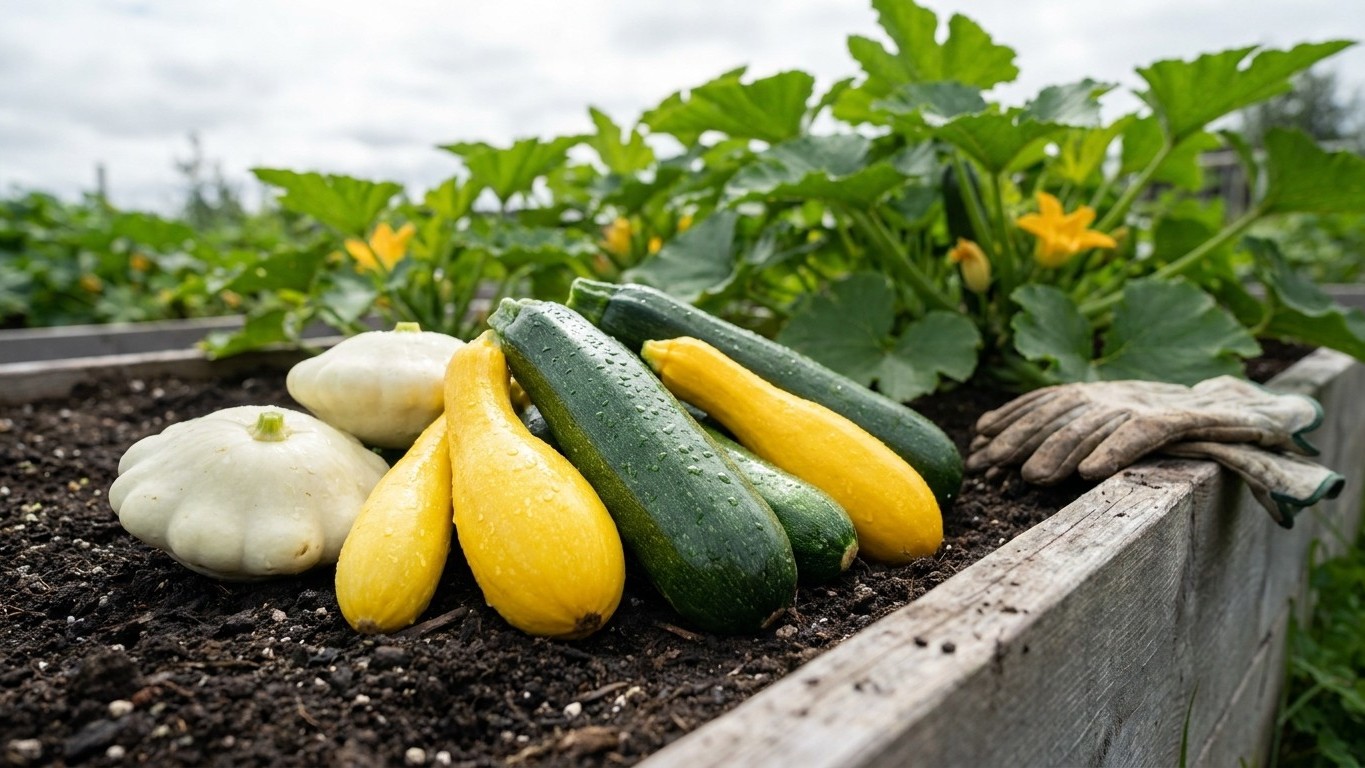

For Delaware gardens, disease-resistant bush-type zucchini and yellow squash beat vining or heirloom types almost every season. The state’s frost-free window is long enough for any Summer Squash to mature comfortably, so the real filter here is humidity, pest pressure, and a summer heat load that’s moderate rather than brutal.
The short answer for Delaware
Start with the math. Using the reference station’s frost dates (last spring frost April 3 to April 14, first fall frost October 26 to November 7, station USW00013781), Delaware’s frost-free stretch runs somewhere between 195 and 218 days depending on where in that window your particular spring and fall land. Even the slowest standard summer squash needs 50 to 65 days from seed to first harvest. That leaves a wide cushion, which means maturity speed is not what should drive a variety decision in this state.
What should drive it: 17.6 days a year averaging 90F or hotter at the Wilmington reference station, paired with roughly 13.1 inches of rain across June, July, and August. That’s not desert-dry, and it’s not the kind of relentless heat that pushes gardeners in Texas or Georgia toward specialized heat-tolerant cultivars. Delaware’s problem is different. Moderate heat plus regular summer rain, often arriving as thunderstorms rather than steady soaking, keeps foliage damp longer than it should be. That’s the exact recipe for powdery mildew and downy mildew, two fungal diseases that summer squash growers up and down the Mid-Atlantic fight every July and August.
What to choose, by type
Given that combination, bush-type zucchini and yellow squash (both crookneck and straightneck) bred for disease tolerance make more sense than open-pollinated vining types. Bush habit matters because it keeps leaves more open and airflow better, which slows fungal spread. Look for hybrid varieties specifically marketed for powdery mildew resistance or tolerance; seed catalogs and extension trial reports typically flag this trait directly.
Pattypan and scallop types work fine here too, on the same bush-habit logic. Vining or trailing summer squash types aren’t disqualified by climate, but they ask for more space, more air circulation management, and more vigilance, so they’re a better fit for a gardener who’s already dealing with squash bugs and vine borers than for someone growing their first squash bed.
What will not work here
Season length won’t kill your Squash in Delaware. Neglecting airflow and pest timing will.
The first failure mode is spacing. A humid summer with 13.1 inches of rain concentrated in June through August means wet leaves linger. Planting summer squash at the tight spacing recommended for drier Western states invites powdery mildew to take hold by mid-July, well before the plant has finished producing. Give bush varieties the wider end of their recommended spacing, and resist the urge to squeeze in one more hill along the row.
The second failure mode is watering on a fixed weekly schedule regardless of weather. Delaware’s summer rainfall sounds generous on paper, but it’s uneven: August, the driest of the three summer months, averages only 3.98 inches against June’s 4.67 and July’s 4.41. Add in 17.6 days a year at 90F or above, when evaporation spikes, and a garden that gets watered “every Sunday” can still run dry for stretches in a hot, dry August pocket. Squash plants stressed by inconsistent soil moisture drop blossoms and produce misshapen fruit, and stressed plants are also more vulnerable to squash vine borer and squash bug damage.
The pest that catches people off guard
Squash vine borer is common across the Mid-Atlantic, and it targets the base of the stem, not the leaves, so a gardener watching for mildew on foliage can miss it entirely until a healthy-looking plant suddenly wilts and collapses. Varieties with a more open, bush-type crown make it easier to spot the telltale frass (sawdust-like debris) at the stem base early, when there’s still a chance to intervene. A dense, sprawling vine hides that early warning sign.
None of this means summer squash is a poor choice for Delaware gardens. It means the varieties and habits that fail here are the ones optimized for a drier, less humid climate, or the ones planted too close together on the assumption that a long season forgives crowding. It doesn’t, not when the air stays damp.
What changes across Delaware
Delaware is a small state, but it isn’t a single climate. The USDA Plant Hardiness Zone Map places the state across zones 7a to 8a, a spread built entirely from average annual extreme minimum winter temperature, not summer conditions. Still, that range is a useful flag: a state spanning a full zone and then some doesn’t behave identically from its northern border to its southern tip.
The frost dates and heat figures cited throughout this page come from a single reference station, and northern Delaware, closer to the Pennsylvania line, tends to run cooler and see frost arrive earlier in fall than the coastal south. Southern Delaware, especially the parts of Sussex County closest to the Atlantic and the bay, typically enjoys a milder, longer growing season, with fall frost holding off later and spring frost breaking earlier. That’s a meaningful difference for anyone deciding how early to set out squash transplants or whether a second late-summer sowing is worth the risk.
There’s no single planting date or single “best zone” answer for a state that spans zones 7a to 8a. A gardener near the Delaware Bay is working with a different frost calendar than one further inland or north, even though both are technically in the same state and reading the same statewide averages. Rather than guess which end of that spread applies to a given yard, check the USDA Plant Hardiness Zone Map directly for the specific address; it’s a five-minute lookup that replaces a guess with an actual zone designation.
The same caution applies to the frost dates cited earlier in this page. They come from an airport weather station, and airport stations tend to run warmer than the surrounding suburban and rural land nearby. Gardens outside the immediate reference-station area often see their last spring frost land later and their first fall frost arrive earlier, sometimes by one to two weeks, more at higher elevation. Treat the dates on this page as the reference point, not the final word for a specific yard.
Where to check this for your own county
This page describes Delaware. It does not describe any single county, and that distinction matters more for squash than for most crops, since disease pressure and frost timing both vary locally in ways a statewide page can’t capture.
The University of Delaware Cooperative Extension is the source built to close that gap. Its site publishes county-level planting guidance that accounts for the local variation this page can only describe in general terms. Two things are worth hunting down there specifically. First, the local planting calendar for the county in question, which will reflect the actual frost pattern for that area rather than the airport-station figures cited here. Second, any variety trial results or recommended-cultivar lists for summer squash, since extension offices in humid Mid-Atlantic states routinely test disease-resistant hybrids under local conditions and publish which ones held up against powdery mildew and vine borer pressure in real gardens, not just in a seed catalog description.
A county-level recommendation beats a state-level one every time, for a simple reason: it’s built from data collected closer to the actual soil a gardener is planting in. This page is the state-level starting point, useful for understanding the broad pattern of Delaware’s season length, heat load, and rainfall. It is not a substitute for what a local extension office knows about a specific county’s frost record and disease history. Treat this article as the “why,” and the extension office’s county calendar as the “when” and “which variety.”
Checking this against your own garden
Every date and average on this page describes a reference station and a statewide range. A gardener’s own plot will tell a more precise story, and it’s worth reading before trusting any calendar, including this one.
Soil warmth is the first and most reliable check. Summer squash seed wants genuinely warm soil to germinate well, and a cold, wet spring can push that warmth back well past the calendar date this page cites for last frost. Push a finger a couple of inches into the planting bed on a sunny afternoon; if it still feels cool and damp rather than warm through, the soil hasn’t caught up yet, regardless of what the thermometer says the air is doing.
The second signal is the first flush of male flowers. Summer squash plants reliably produce male blossoms before female ones, often by a week or more, and that’s normal, not a sign of trouble. What’s worth watching is how quickly female flowers (the ones with a small swollen bulge behind the petals) follow. A long gap can point to stress, often from uneven watering during a hot, dry stretch, more than from anything wrong with the variety itself.
The third is the speed and color of the first true leaves after the seedling’s initial rounded leaves appear. Fast, deep-green true leaves signal a plant settling comfortably into warm soil and good light. Slow, pale growth is worth a second look at the planting spot, whether it’s shadier, cooler, or wetter than the rest of the yard. These three observations, taken together, outrank any date on this page, because they come from the actual conditions the plant is growing in.