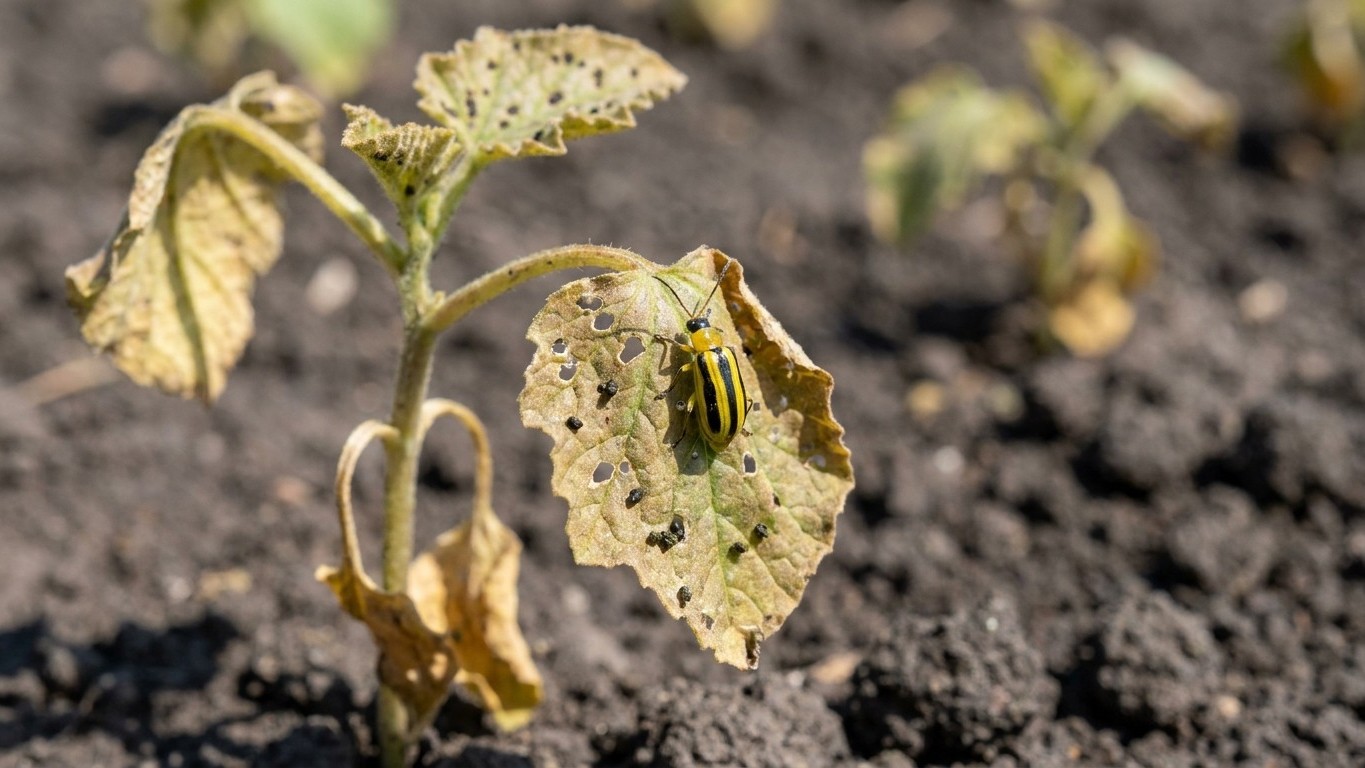

The real damage from cucumber beetles on melons isn’t the chewed leaves. It’s bacterial wilt, a disease the beetle carries in its gut and injects every time it feeds. A handful of beetles on a three-leaf seedling can kill that plant within weeks, long before any fruit sets. Established, sprawling vines shrug off the same beetle count without much trouble. Timing decides whether this pest matters this season, not beetle count.
What is actually going on

Two beetles do this work in most of the country: the striped cucumber beetle and the spotted cucumber beetle. Both overwinter as adults in leaf litter and field edges, then emerge in spring right as melon seedlings are pushing their first true leaves through the soil. That timing is not a coincidence. The beetles are hungry after winter, and tender cotyledons are the easiest meal around. What they leave behind on the leaf surface matters far less than what they leave behind in the wound.
The bacterium responsible for wilt, Erwinia tracheiphila, lives in the beetle’s digestive tract and passes into the plant through feeding scars and through frass dropped onto damaged tissue. Once inside, it multiplies in the water-conducting tissue of the stem and clogs it, the same tissue that would otherwise carry water and sugar to developing fruit. A seedling infected in its first two weeks has almost no reserves to fight that off. A vine infected after it has rooted deeply and spread six feet in every direction often tolerates the infection long enough to still produce a crop, sometimes with one wilted runner while the rest of the plant carries on.
Susceptibility also varies by melon type, and this is where a lot of garden advice gets muddled. Muskmelons (the netted, orange-fleshed type most home gardeners grow) are quite susceptible to bacterial wilt. Watermelon is largely resistant to this particular bacterium, which is why a watermelon patch can host a fair number of beetles without the collapse you’d see in a cantaloupe planting. That difference is about species, not about a particular variety, so it’s worth checking with your state extension service about which melon types perform best against local pest pressure before you assume all melons behave the same way.
One more thing worth saying plainly, since it trips up a lot of people managing a stressed patch: a melon does not ripen after it’s picked. It softens, and it can go from firm to mushy sitting on a counter, but the sugar content it has at the moment the stem separates from the vine is the sugar content it will ever have. If beetle pressure or wilt forces an early harvest, that fruit will not taste the way it would have with two more weeks on a healthy vine, no matter how it’s stored afterward.
In the garden
The first two weeks after seedlings emerge (or after transplants go in the ground) are the window that decides most of the season. Beetle feeding on a plant that size does two kinds of damage at once: it removes leaf tissue the seedling needs for early growth, and it opens the door for wilt transmission at the exact moment the plant has the least ability to recover. Past that window, as vines sprawl and put on leaf area faster than beetles can eat it, the math shifts in the plant’s favor.
Stage by stage, and what goes wrong
| Growth stage | What to watch for | What happens when it’s missed |
|---|---|---|
| Cotyledon / first true leaf | Any beetle presence at all, even one or two per plant | Feeding wounds open the door to wilt; a small plant can collapse within two to three weeks of infection |
| Second to fourth true leaf | Chewed leaf margins, ragged holes, beetles clustered at the growing point | Growth stalls while the plant tries to replace tissue, delaying vine establishment and pushing flowering later |
| Vining out | Feeding on new runners rather than the crown | Cosmetic damage mostly; the plant now has enough leaf area to outgrow the loss unless beetle numbers are very high |
| Flowering | Beetles feeding directly on blossoms | Reduced pollination and fewer fruit set, since damaged flowers may drop before bees ever visit them |
Physical exclusion is the most reliable tool during that first stage. A floating row cover or fine mesh laid over the bed at planting keeps beetles off the seedlings entirely during the window when infection risk is highest. The trade-off is that melons need insect pollination to set fruit, so the cover has to come off before flowering starts, which is exactly when beetle pressure often peaks. That timing gap is where a lot of home gardens lose the crop either to wilt (cover came off too early) or to poor fruit set (cover stayed on too long).
Scouting daily during establishment costs almost nothing and catches problems before they compound. Beetles are most active and easiest to spot in the cooler part of the morning, sitting on cotyledons or clustered at the plant’s growing tip. Hand removal into a jar of soapy water works fine at low numbers on a handful of plants; it stops working as a strategy once a planting gets larger than a small backyard bed. For anyone weighing chemical control against exclusion and hygiene, a state extension service can point to timing and materials suited to local beetle pressure, since recommendations vary by region and by how resistant local beetle populations have become. For general seedling care leading up to this stage, see our guide to starting melons from seed.
What it depends on where you are
Beetle pressure and wilt risk are not the same from Georgia to Minnesota. Season length changes the calculation first. In regions with a long, warm growing season, gardeners can afford to lose a seedling or two to early beetle damage and still replant with time for the melon to finish. In short-season regions, a seedling lost in week two might mean no melon crop at all, which raises the value of exclusion and early scouting considerably.
Summer heat and humidity shift the picture too, mostly because they affect how fast bacterial wilt develops inside an infected plant once transmission has occurred. Warmer conditions generally speed up bacterial multiplication in the stem, so the gap between “beetle feeds on plant” and “plant shows wilt symptoms” tends to be shorter in hot climates than in cooler ones. Rainfall patterns matter for a different reason: beetle populations often build up faster in years following a mild winter, since fewer overwintering adults die off before spring. A wet spring can also delay planting, which can push tender seedlings into the ground right as the first generation of beetles is most active and hungriest.
Local beetle species mix varies as well. Some regions deal almost entirely with striped cucumber beetle, others see spotted cucumber beetle in larger numbers, and the two differ somewhat in how many generations they produce per year and how aggressively they feed. None of that is something a general page can specify accurately for every reader. Your state’s cooperative extension service tracks beetle emergence timing, regional wilt incidence, and locally trialled melon types, and that local data will always beat a national average for deciding when to cover seedlings and when it’s safe to pull the cover off. Our state-by-state melon guides collect some of that regional detail in one place if you’re trying to match timing to your own climate.
The mistake that costs the most
The single most common mistake isn’t ignoring cucumber beetles. It’s leaving the row cover on too long “to be safe,” well past the point where female flowers open. Beetle protection succeeds and the harvest fails anyway, because nothing pollinated the flowers while the plant sat sealed off from bees. A gardener who did everything right during the vulnerable seedling stage ends up with a vigorous, beetle-free vine that sets almost no fruit, and the frustrating part is that it looks like success right up until harvest time never comes.
The fix is a specific signal, not a calendar date. Female melon flowers are easy to tell apart from male ones: they carry a small swollen embryo at the base of the blossom, roughly the size of a pea, that will become the fruit if pollination succeeds. Once those start appearing, the cover needs to come off, even if it means accepting some beetle exposure at that stage. By flowering time, the plant has enough established leaf area and root reserves to tolerate beetle feeding far better than it could as a seedling, so the trade favors removing the cover over keeping the crop sealed off from pollinators.
From that point on, the job shifts from exclusion to monitoring. Check flowers and new growth every few days, hand-remove beetles where numbers are manageable, and resist the urge to judge the plant’s health by leaf damage alone, since a vine can look chewed and ragged while still finishing a full crop. What actually decides the outcome now is whether pollination is happening and whether the vine shows any sign of wilting runners, not how many beetle bites mark the leaves. And when fruit does start sizing up, remember it only gets one shot at sweetness: whatever sugar level it reaches on the vine is the sugar level it will have on the counter, so let it finish there rather than harvesting early out of worry over a few beetles.