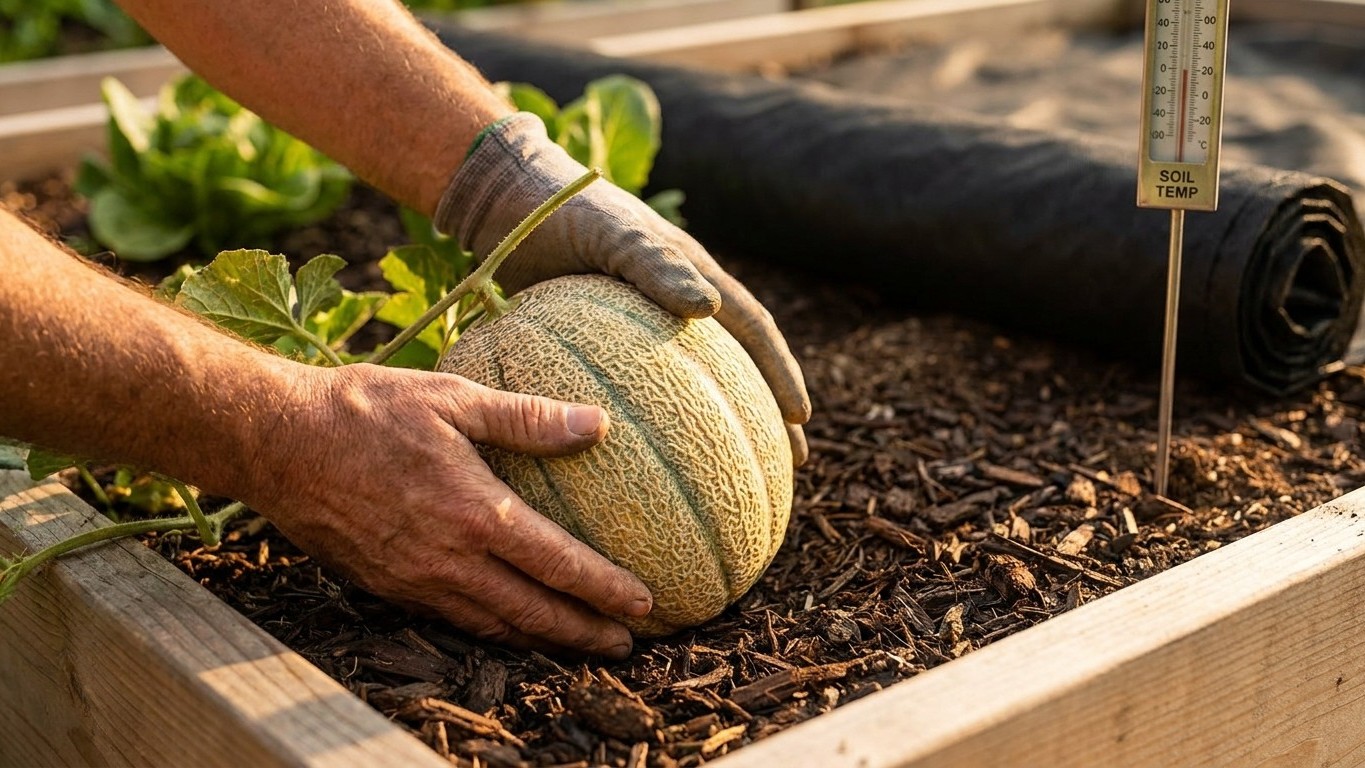

Short summers don’t rule out melons, but they do rule out the casual approach. In cool-summer regions, success comes down to matching the right type of melon to a compressed heat window, warming the soil before the crop goes in, and reading the fruit itself rather than a calendar to decide when it’s ready.
What is actually going on

The thing to understand here is heat accumulation. A melon doesn’t ripen on a fixed number of calendar days; it ripens once it has absorbed a total quantity of warmth, measured over the whole season rather than counted day by day. Agronomists track this as growing degree days, a running total of how far daily temperatures rise above a baseline the plant needs before it grows at all. Two gardens with the same number of frost-free days can produce very different melon harvests if one has warm nights and the other doesn’t, because the plant is banking heat units, not days on a page.
This is why a short-summer garden isn’t really fighting a short calendar. It’s fighting a shortage of warmth. Every technique associated with growing melons in a cool climate, warmed soil, transplants instead of direct seeding, row covers, a sheltered south-facing bed, exists to close that heat gap by some small amount. None of them changes the length of summer. They all change how much of that summer’s warmth actually reaches the plant.
Type selection matters here more than almost anything else, and it’s worth separating from variety shopping. Within cantaloupe types, muskmelon types, and watermelon types, there’s a wide range in how much cumulative heat a given type needs to finish fruit, and breeders have worked for decades on strains suited to shorter, cooler seasons. Rather than naming a specific variety here, which changes constantly and performs differently by region, the more reliable path is checking which types and strains have been trialed successfully by a state land-grant university’s extension service in a climate similar to the reader’s own. That local trial data is worth more than any general list.
Ripeness is the part gardeners in short seasons get wrong most often, usually out of impatience. A melon builds sugar through photosynthesis while it’s still attached to the vine, drawing on the plant’s leaves and root system. The moment the stem parts, that supply line is cut. The fruit can soften afterward, and its texture can change, but it will not get any sweeter sitting on a windowsill or a counter. Whatever sugar content it had at harvest is the sugar content it will have when eaten. That single fact should shape every decision about when to pick, especially when the growing window feels like it’s closing fast.
In the garden
Growing melons on a short timeline works as a stack of small advantages, not one big trick. Skip any single layer and the whole system tends to underperform, even if every other step was done well. The table below breaks down the main pieces and what tends to go wrong when one is missing.
| Element | What it does | What happens if it’s missing |
|---|---|---|
| Short-season type | Needs fewer total heat units to finish fruit, so it can complete its cycle within a compressed warm window | The plant flowers and sets fruit, but the melons stall partway through ripening as cool weather returns before enough heat has accumulated |
| Transplants rather than direct seed | Gives the plant a head start of several weeks of growth before it ever faces outdoor soil temperatures | Direct-seeded melons in cool soil germinate slowly or unevenly, and the season’s heat clock is already running before the plant has true leaves |
| Warmed soil | Dark mulch or a plastic soil covering raises root-zone temperature, which melons are unusually sensitive to | Roots stay sluggish in cold soil even when the air feels warm enough, and the plant simply sits without meaningful growth |
| Row cover or low tunnel | Traps daytime heat and buffers cool nights during the vulnerable early weeks after transplanting | A late cold snap or a run of chilly nights can set a young plant back by weeks, a setback it often never fully recovers from |
| Sheltered, sun-facing site | Blocks wind, which strips heat from leaves and soil alike, and maximizes hours of direct sun | An exposed bed loses accumulated warmth overnight and the plant works twice as hard for the same growth |
Reading ripeness instead of the calendar
Because sugar stops arriving at harvest, the signs that matter are physical, not chronological. Depending on the type, that includes the stem beginning to separate cleanly from the fruit with slight pressure (often called “full slip” in muskmelon types), a change in background skin color from green to more yellow or cream, a sweet smell at the blossom end, or in watermelon types, a dulling of the skin’s sheen along with a browning tendril nearest the fruit. None of these signs are about how many days have passed since transplanting. They’re about what the fruit itself is showing, which matters even more in a short season where the plant has had less margin to work with.
What it depends on where you are
Season length sets the outer boundary, but it’s the least useful number on its own. A region with a long frost-free window but cool, overcast summers can still struggle to accumulate enough heat units for melons, while a shorter but intensely sunny and hot summer elsewhere can outperform it. Summer heat, meaning both daytime highs and, just as importantly, how warm the nights stay, is usually the better predictor of whether a given type of melon will finish reliably.
Rainfall changes the picture in a different way. Regions with humid, wet summers face heavier pressure from fungal diseases on melon foliage and fruit, which can shorten the effective growing window even further by weakening the plant before it finishes ripening fruit. Drier regions trade that risk for a heavier dependence on irrigation timed carefully, since melons are sensitive to both drought stress and to too much water right as fruit approaches ripeness.
Because these three factors interact differently in every state, and sometimes within the same state, the more useful next step than any national guideline is checking the state-specific pages on this site for melons, alongside the local state land-grant university’s extension service. Extension offices run their own regional trials of melon types and strains and publish results specific to local soils, humidity, and heat patterns, which is the closest thing available to a tested answer for a particular garden.
The mistake that costs the most
The single costliest mistake in a short-season melon garden is rushing transplants outdoors into soil that hasn’t warmed up yet, out of fear that the season is already too short to wait. It feels logical: less time to lose, more time to grow. In practice it works backward.
Melon roots are unusually sensitive to cold soil, and a transplant set into ground that’s still chilly doesn’t just pause. It stalls in a way that often shows up weeks later as stunted growth, pale foliage, and delayed flowering, even after the weather warms up and conditions look fine on the surface. That early setback typically costs more total time than waiting an extra week or two for the soil itself, not just the air, to reach a suitable temperature before transplanting.
The fix isn’t complicated, but it does require patience at exactly the moment patience feels hardest to find. Warm the soil first, using a dark mulch or plastic covering laid down ahead of transplanting, and check soil temperature at root depth rather than judging by how warm the air feels on a sunny afternoon. Pair that with a short-season type suited to the local extension service’s trial data, and hold the transplant date until the soil, not just the calendar, is ready. A slightly later start into warm soil consistently outperforms an early start into cold soil, because the plant that isn’t fighting its own root zone from day one is the plant that actually has a chance to bank enough heat units before summer runs out.