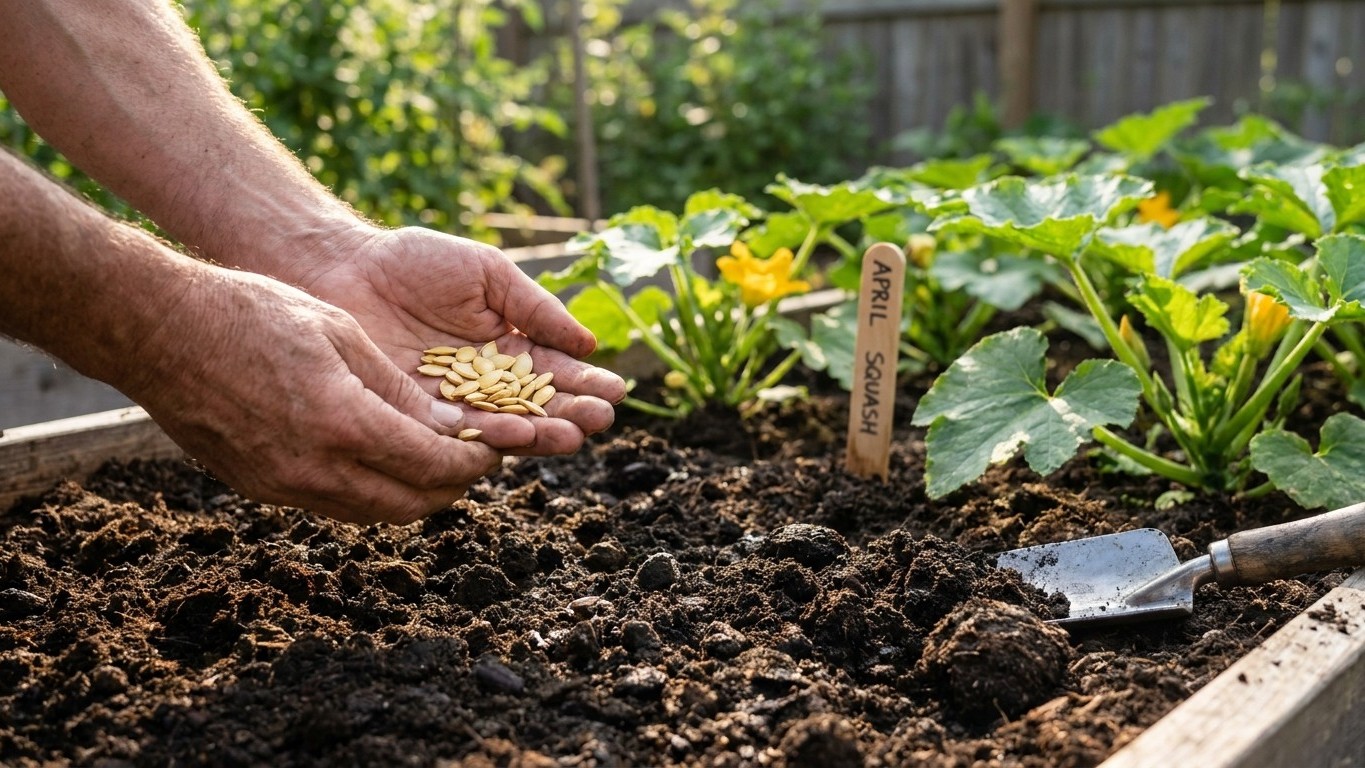

Plant Summer Squash in Maryland after your local last spring frost date, which falls somewhere between April 3 and April 16 depending on where you garden. That window is a 30-70% probability of a 32F freeze, not a promise, so most gardeners wait a few extra days past it. Keep sowing through early July, then count backward from the first fall frost (October 26 to November 5) to set your final planting date.
The short answer for Maryland
Summer squash is a warm-season crop with zero frost tolerance, so the calendar starts with that spring frost window: April 3 to April 16. That range comes from NOAA’s 1991-2020 climate normals and represents the band where a 32F freeze has between a 30% and 70% chance of happening. Read it as a risk gradient, not a switch that flips from “frozen” to “safe” overnight. A gardener who sows right on April 3 is betting on the early end of that probability curve; someone who waits until April 20 or later is buying a much thinner margin of risk.
Because summer squash germinates poorly in cold ground, the practical sowing date usually lands a week to ten days after the last frost date, once soil has had time to warm past the mid-60s. That pushes direct seeding into the back half of April through mid-May for most of the state. Squash also grows fast: many varieties reach harvest in 50 to 65 days from seed, which means Maryland’s frost-free stretch, roughly April into late October, comfortably supports two or even three staggered sowings.
Succession planting is where this crop earns its keep in a Maryland garden. A second sowing in late May or June, and sometimes a third in early July, keeps fresh squash coming after the first flush slows down or gets hit by pests. The cutoff for that last sowing is set by the fall frost window, October 26 to November 5. Count back 50 to 65 days from the earlier end of that range, late October, and a July planting date is the realistic limit for a full harvest before frost ends the season.
None of this replaces watching your own soil and weather. The frost dates above are averages built from three decades of station data, useful for planning but not a forecast for this particular spring. A cold snap in late April or an unusually warm March can shift the safe date by a week or more in either direction.
What will not work here
The failure mode gardeners hit most often in Maryland isn’t a short season, it’s heat and moisture timing working against each other. The reference station near Baltimore averages 24.6 days a year at or above 90F, and most of those land in July and August, right when squash plants are setting fruit. That heat load drives evaporation fast enough that a once-a-week watering schedule, which might get by in a cooler climate, leaves plants stressed during exactly the stretch when they need steady moisture to keep setting fruit instead of dropping blossoms.
Rainfall alone won’t bail you out, either. Summer rain across June, July and August averages about 12.6 inches, broken down as 3.98 inches in June, 4.48 in July, and 4.09 in August. That sounds like plenty, but it rarely arrives evenly. A good chunk falls as thunderstorms that dump an inch in twenty minutes and run off rather than soaking in, especially on compacted or sloped ground. Relying on that rainfall total as a substitute for a watering plan is a common way squash plants end up drought-stressed even in a summer with “normal” precipitation.
The flip side is fungal trouble. Four inches of rain a month, combined with Maryland’s humidity, creates conditions where powdery mildew and downy mildew spread fast on squash leaves, particularly when plants are spaced too tightly and air can’t move through the canopy. Crowding plants to squeeze more into a small bed is a mistake that shows up by mid-July as gray-white film on the leaves, well before harvest winds down.
Planting too early is the other common misstep. Because the spring frost window stretches to April 16 at the late end, and because squash seed simply sits and rots in cold, wet soil rather than germinating, jumping the gun in late March or very early April in anticipation of an early spring usually costs more time than it saves. A seed that rots means starting over two or three weeks later anyway, after buying nothing but a lost head start.
What changes across Maryland
Maryland’s hardiness zone range runs from 5b to 8a under the USDA system, which is built on average extreme minimum winter temperature. That’s a wide spread for a state this size, and it maps roughly onto geography: the mountainous west, Garrett and Allegany counties, sits at the cold end, while the Eastern Shore and the DC suburbs run milder. A 5b-to-8a spread means there is no single planting date that fits the whole state well, only a statewide range with real weeks of difference tucked inside it.
The frost data backs this up directly. The NOAA caution attached to both frost windows notes that western Maryland runs weeks later than the rest of the state for both the last spring freeze and the first fall freeze, while the Eastern Shore trends milder and earlier in spring, later in fall. A gardener in Garrett County working from the April 3 end of the spring window, or worse, from a statewide average, risks planting into ground that’s still weeks away from being frost-safe.
Elevation plays into this too. Higher ground in the western counties holds cold air longer into spring and collects it again sooner in fall, shrinking the frost-free window from both ends compared to the lower-lying Piedmont and coastal areas. That shrinks the room for succession planting: a gardener at higher elevation might only get two sowings in comfortably where someone on the Eastern Shore fits three.
This page can’t tell an individual reader which zone applies to their yard, because zone boundaries shift over short distances, sometimes within the same county, depending on elevation and proximity to water. The USDA Plant Hardiness Zone Map is the tool built for that lookup, and checking it against a home address is the only reliable way to know which end of the 5b-8a range actually applies to a given garden.
Where to check this for your own county
The University of Maryland Extension, at extension.umd.edu, is the source that turns this statewide picture into something specific to a single county. Everything above, the frost windows, the heat load, the rainfall averages, comes from regional climate stations and represents Maryland as a whole. A county office works from local trial data and local weather station records, which is a finer-grained picture than any state-level page can offer.
Two things are worth looking for specifically once there. First, a county-level or regional planting calendar, which will translate the statewide frost window into a narrower date range for that particular area, often accounting for elevation or proximity to the Chesapeake Bay in ways a state average can’t. Second, variety recommendations based on trials actually run in Maryland conditions, since not every summer squash variety handles this state’s combination of summer heat and humidity equally well, and a county extension office will usually have field notes on what performed and what didn’t in recent seasons.
A county recommendation beats a state one for a simple reason: it’s built from data closer to the actual garden in question. This page works from statewide averages, NOAA climate normals for a reference station, a hardiness zone range spanning the entire state, rainfall figures averaged across three summer months. Useful for framing the season, but blunter than what a local office can offer once the questions get specific: which week to sow in a particular zip code, which variety held up against squash bugs in that county last year, whether a late-season planting is worth the risk given local frost timing.
Extension offices also take walk-in and phone questions, and many post updated planting calendars each season that reflect any shifts in local conditions rather than relying solely on 30-year normals.
Checking this against your own garden
Every date on this page is an average built from decades of regional weather data. The soil in a specific backyard, with its own drainage, sun exposure, and microclimate, will tell a more accurate story than any calendar once the season actually starts. Three things are worth watching directly.
Soil warmth by feel is the first check. Squash seed wants soil that feels warm to the touch, not just frost-free air temperature. Pushing a finger a couple inches into the planting bed on a sunny afternoon gives a rough read: cool and damp still means waiting, while soil that feels warm through most of the day is closer to ready regardless of what the calendar says.
The first flush of male flowers is the second signal. Squash plants typically produce several male blooms before the female flowers, the ones with a small bulge at the base that will become fruit, show up. A heavy early run of male-only flowers with no females following within a week or two often points to heat stress or uneven watering rather than a problem with the plant itself, and it’s a cue to check soil moisture before assuming something’s wrong.
First true leaves, the second set that appears after the initial round of seed leaves, tell you how the plant is handling its actual growing conditions rather than just germinating. Slow, pale, or stunted true leaves usually trace back to cold soil, poor drainage, or a rough transplant, and they show up well before fruit does, giving an early read on whether that particular bed is running warmer or cooler than the general date on this page assumes.