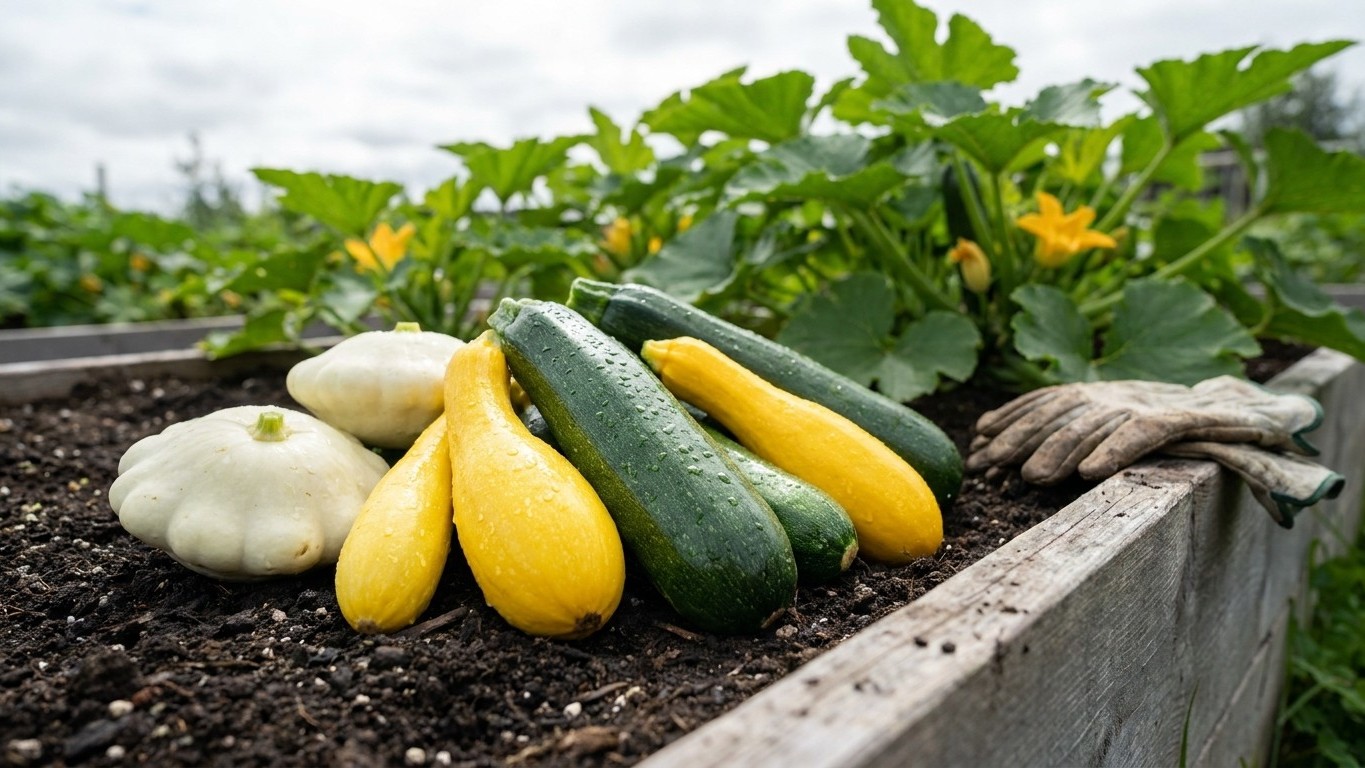

Bush-type summer squash, meaning zucchini, straightneck, crookneck and pattypan varieties that mature in under 60 days, are the best fit for Maryland gardens. The state’s frost-free window runs long enough to support two plantings, and fast maturity is what lets a gardener dodge the pest and disease pressure that builds across a hot, humid Mid-Atlantic summer.
The short answer for Maryland
Maryland’s last spring frost falls between April 3 and April 16, and the first fall frost arrives between October 26 and November 5. That gives a frost-free window of roughly six and a half to seven months, depending on where in the state you garden. Summer squash needs 45 to 60 days from seed to first harvest for the quickest bush types, which means this window has room to spare. That surplus is the whole argument for choosing fast varieties over slow ones: it lets you plant a second round in early-to-mid summer rather than nursing a single planting through the entire season.
The heat load matters just as much as the calendar. Baltimore averages 24.6 days a year at 90°F or hotter, and summer rainfall runs about 12.6 inches across June, July and August, with June the driest month at 3.98 inches. That combination, real heat plus real but uneven rain, is exactly the setup that favors squash bug and squash vine borer populations, and it’s the setup that lets powdery mildew take hold on foliage once nights stay warm and humid. A variety that finishes fast gets picked and pulled before those pressures peak. A variety that lingers on the vine for ten or twelve weeks gives every pest and pathogen in the area time to find it.
By type, that means bush zucchini and straightneck or crookneck yellow squash are the safest starting point anywhere in Maryland. Pattypan and scallop types perform about the same, since most modern releases in that category are also bush habit and quick to bear. Vining summer squash, including some of the longer heirloom Middle Eastern and Lebanese cousa-type squash that take 65 to 70 days or more, are riskier here, not because they can’t mature in the season available, but because the extra weeks on the vine coincide with the worst stretch of Maryland’s summer heat and humidity. If you want to grow one of those slower types, treat it as a second planting rather than your only one, so it isn’t exposed to the full run of the season.
What will not work here
Anything bred for a short, cool growing season, and marketed on catalog copy about tight spacing, tends to underperform in Maryland. Spacing recommendations written for drier, cooler climates assume airflow does most of the disease control on its own. In a state where summer humidity keeps leaf surfaces wet longer after rain or dew, tight spacing traps moisture around the crown and lower leaves, and that is where powdery mildew and downy mildew get their foothold. Squash planted at the minimum spacing listed on a seed packet, rather than a few inches wider, is squash that mildews out weeks earlier than it should.
Watering on a weekly schedule also fails here, and the numbers explain why. June, the peak planting and early-fruiting month for most Maryland gardeners, is also the driest summer month on average, at 3.98 inches. Add in 24.6 days a year above 90°F, mostly clustered in July and August, and a once-a-week watering routine leaves long stretches where evaporation is outpacing what the plant is getting. This hits gardens on sandy soil, common on the Eastern Shore, hardest, since sandy ground lets a single rain event pass through within a day rather than holding it. A garden on heavier clay soil inland can sometimes coast longer between waterings, but even there, an inch of rain from a single summer thunderstorm mostly runs off rather than soaking in, so the rainfall total on paper is not the same as water actually reaching the root zone.
Slow, sprawling summer squash varieties that take 70 to 80 days and cover several feet of ground are also a poor match for a small home garden here, not because Maryland’s season is too short for them, but because that much foliage sitting in warm, humid air for that long is an open invitation to squash vine borer, which lays eggs at the base of the stem once soil has warmed in early summer. A borer that gets a head start on a slow-maturing vine has months to do damage. On a fast bush variety pulled at 50 days, it barely gets a chance.
What changes across Maryland
Maryland spans USDA Plant Hardiness Zones 5b to 8a, a wide range for a state its size, and that spread is built on one variable, the average annual extreme minimum winter temperature. It doesn’t map directly onto summer growing conditions, but it’s a useful shorthand for how differently the state behaves from one end to the other. There is no single answer for “when does the growing season start” or “how much heat will my squash face” that applies evenly from Garrett County to the Eastern Shore.
Western Maryland, meaning the mountainous counties like Garrett and Allegany, runs weeks later on both frost dates than the rest of the state and sits at the cooler end of that zone range. A gardener there should lean even harder toward the fastest-maturing bush varieties, plan on a single planting rather than a succession, and expect fewer days over 90°F, which eases disease pressure somewhat but also shortens the effective window for a second sowing.
The Eastern Shore and other low-lying, coastal parts of the state sit at the milder end, with earlier springs and later falls, which is exactly the setup that makes a second planting realistic. It’s also the area where sandy soils and summer humidity combine to make watering consistency and disease-resistant varieties matter more, not less. Central Maryland, including the Baltimore-Washington corridor where the reference climate station sits, falls in between those two extremes on both frost timing and heat load.
None of this tells an individual reader which zone applies to their own yard, since microclimates, elevation and even a nearby body of water shift things at a scale this map can’t capture.
Where to check this for your own county
The University of Maryland Extension service, at extension.umd.edu, is the source to check before finalizing a variety list or a planting date for your own property. This state-level page covers Maryland as a whole, which is useful for understanding the general pattern, but a county-level recommendation from Extension will always beat what’s written here, because it accounts for local soil types, local pest reporting and local frost records that a statewide summary has to average out.
Once there, look for two things specifically. First, the local planting calendar for your county or region, which will narrow that April 3 to April 16 spring frost window down to something closer to a real date for your specific location, and do the same for the fall side. Second, look for any variety trial results or recommended cultivar lists published for vegetable growers in your area. County agents often track which squash varieties held up against squash vine borer or powdery mildew in local trial gardens that season, information a national seed catalog simply doesn’t have.
If your county’s page doesn’t have a squash-specific writeup, a call or email to the local Extension office is worth the five minutes. Master Gardener volunteers staffed through these county offices are usually the ones fielding “what’s going wrong with my squash” questions all summer, and they tend to know which varieties are underperforming locally well before it shows up in any published bulletin.
Checking this against your own garden
Every date and average on this page describes a region, not your yard, and three simple observations will tell you more about your own microclimate than any calendar. Feel the soil before you plant. Summer squash seed wants soil that feels warm to bare skin, not merely thawed, and if your ground still feels cool and damp in mid-April, your particular spot is running behind the regional average, whatever the frost date says.
Watch for the first flush of male flowers once plants are established. Male flowers, on thin stems without a swollen base, typically appear before the females and signal that the plant has moved into reproductive growth. A long gap before females show up, or female flowers that appear but drop without setting fruit, often points to a pollination gap in your specific yard rather than a variety problem.
Check the first true leaves, the ones that appear after the initial rounded seed leaves, and note how quickly they show up relative to when you planted. A fast emergence of true leaves in a spot that gets full sun most of the day tells you that location is running warm for your property; a sluggish start in a shadier or low-lying corner tells you that spot lags the rest of your garden, information worth remembering for next year’s layout regardless of what the state averages say.