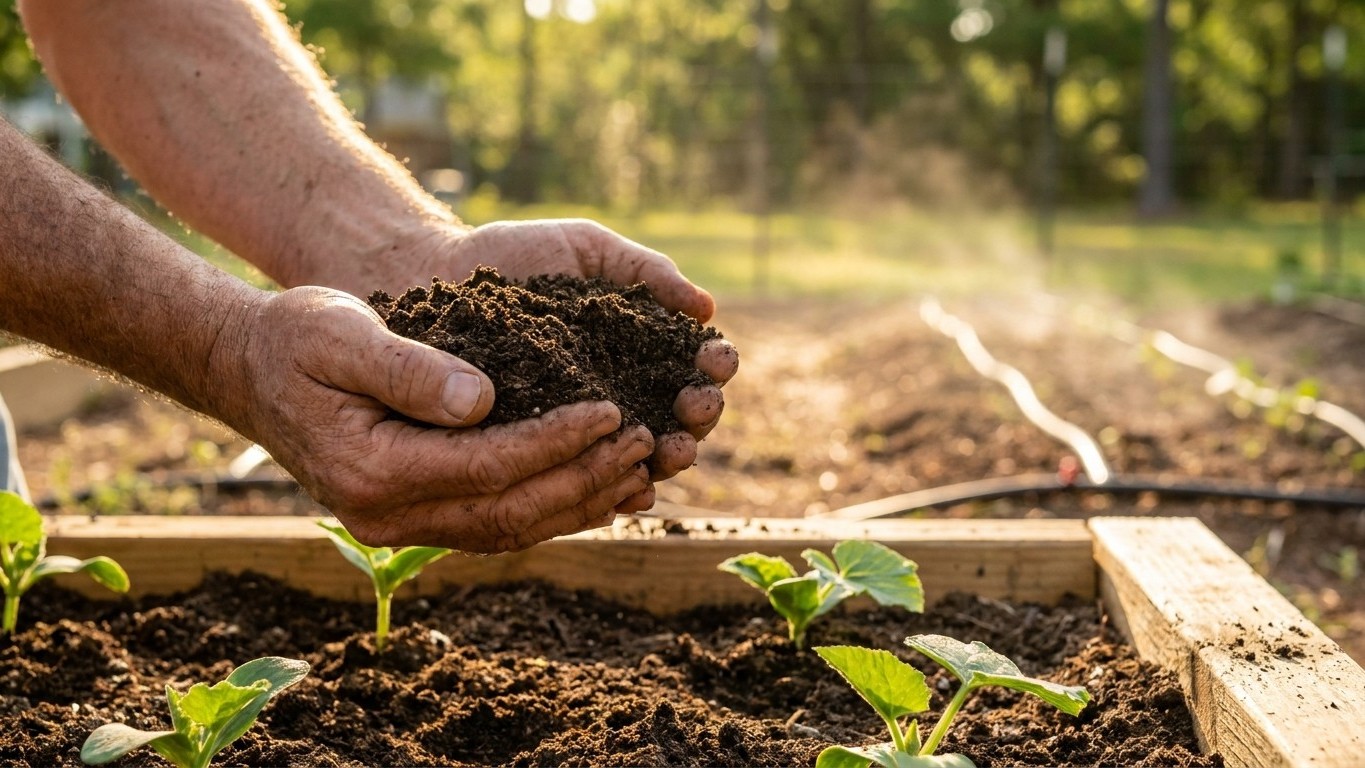

Summer Squash in Maryland goes in the ground once the last spring frost risk has passed and soil temperatures stay reliably warm, typically from mid to late April along the I-95 corridor, later in the western mountains. The state’s long, hot summer (nearly 25 days a year above 90°F at the Baltimore reference station) makes water management, not frost, the real challenge for most gardeners here.
When the soil is warm enough in Maryland
The question every Maryland gardener asks in spring is simple: when is it safe to plant? The honest answer starts with a date that isn’t really about planting at all. NOAA’s 1991-2020 Climate Normals, drawn from the reference station in the state’s official dataset, put the last spring frost (the 32°F freeze risk, in the 30-70% probability band) somewhere between April 3 and April 16. That’s a real, sourced window, not a rounded guess, and it’s worth repeating exactly as recorded.
But that date is a proxy, and treating it as the planting signal is where a lot of squash gets lost to a cold, sulking start. Summer squash doesn’t care what the calendar says about frost; it cares about soil temperature, and soil takes time to catch up once the air stops freezing. A patch of ground can sit at 50°F for a week or two after the frost risk has technically ended, and squash seed sown into cold, wet soil rots more often than it germinates. The safer signal is soil that has held steadily warm for several consecutive days, which in most of Maryland lands a couple of weeks after that April frost window closes.
Regional variation matters here
Maryland is not one climate. The NOAA data flags this directly: Western Maryland, meaning Garrett and Allegany counties, sits at higher elevation and runs weeks later than the frost dates above suggest, both in spring and fall. The Eastern Shore, by contrast, moderates faster thanks to the Chesapeake Bay and tends to warm a bit earlier and hold heat a bit longer into fall. A planting date that works in Salisbury can leave a Garrett County garden sitting in cold soil for another two or three weeks.
Frost probability is exactly that, a probability, not a promise; even inside the 30-70% band, a late cold snap can still happen. Rather than betting everything on one sowing date, many gardeners hedge by direct-sowing a portion of the bed on schedule and holding a few seeds or a tray of young transplants in reserve, ready to replace anything a surprise frost takes out. On variety selection for this stage, this page won’t name a specific cultivar, because what performs well in a Baltimore backyard and what performs well on the Eastern Shore’s sandy soils aren’t always the same plant. The University of Maryland Extension maintains locally trialed variety recommendations, and that’s the list worth checking before buying seed.
How long the season lasts here
Subtract the last spring frost window from the first fall frost window and Maryland’s frost-free growing season takes shape. NOAA’s normals put the first fall frost at October 26 to November 5, again from the 1991-2020 data at the same reference station. Paired against the April 3 to April 16 spring window, the frost-free stretch runs somewhere between roughly 193 and 216 days, depending on where each date falls in a given year. That’s close to six and a half to seven months, one of the longer growing windows on the East Coast outside the Deep South.
That length changes the math for summer squash growers in a real way. A season this long doesn’t just permit one planting, it makes a second one worth planning for. Summer squash plants tend to slow down and get vulnerable to pests and disease after six to eight weeks of heavy production, so a fresh sowing partway through the season often outproduces babying an aging plant. With close to seven months of frost-free time in most of the state, there’s room for an early spring sowing and a second one in mid-summer that carries the harvest into fall, well past when the first planting has given up.
What a shorter western season changes
That calculation shifts in Garrett and Allegany counties, where the later spring frost and earlier fall frost trim real weeks off both ends. A shorter window there makes the first sowing the one that matters most, and it raises the value of starting seed indoors and transplanting rather than waiting on direct-sown seed to catch up. Squash transplants dislike root disturbance, so anyone transplanting needs to start with cell trays or biodegradable pots that let the root ball go into the ground intact rather than bare-rooted.
Anyone working out exact timing for a second sowing, including how many weeks before the first fall frost to make that last planting, should check this site’s succession sowing guide, which walks through the count-back method in detail rather than repeating it here.
Heat and water in Maryland
Heat, not cold, is the bigger obstacle to a good squash harvest in most of Maryland. The Baltimore reference station averages 24.6 days a year at or above 90°F, a meaningful heat load that stacks up over a summer, not a single bad week. Summer squash flowers and sets fruit through pollination, and pollen loses viability fast once temperatures climb into the high 90s; a plant can look healthy and covered in blossoms and still drop fruit if a heat wave hits right during bloom. Add in the plant’s huge, thin leaves, which lose water through transpiration quickly, and a hot stretch without irrigation stresses the plant twice over, at the flower and at the root.
Rainfall doesn’t fully offset that heat load. Summer rain across June, July and August averages about 12.6 inches, with June the driest month at 3.98 inches, July the wettest at 4.48 inches, and August at 4.09 inches. That’s not a drought-level number, but it’s also not evenly distributed; Maryland’s summer rain tends to arrive as thunderstorms, dumping an inch or more in an hour and then nothing for a week or two. On top of 90-degree days, a lot of that water runs off or evaporates before it reaches the root zone.
The practical result is that irrigation decides more of the outcome than rainfall totals suggest. Deep, infrequent watering that soaks past the top few inches of soil serves squash better than frequent light watering, because the plant’s root system, while not deep, spreads wide and needs the moisture to actually reach it rather than sit on a dry crust. Afternoon shade cloth or strategic placement near taller companion plants can also take the edge off the hottest stretches, particularly during the two or three weeks of peak flowering. In the Chesapeake Bay region especially, that same humidity that softens the heat also raises the risk of powdery and downy mildew on squash leaves, so airflow between plants (wider spacing than the seed packet’s minimum, and pruning a few of the oldest leaves) matters as much as watering.
Which summer squash suit Maryland
The type of summer squash that does best here depends on which of Maryland’s climates a gardener is actually growing in, and the honest recommendation is to choose by type rather than by a specific name pulled off a seed rack. In Western Maryland’s shorter season, the earliest-maturing types have the advantage, since there’s less frost-free time to spare for a slow starter. Along the hot I-95 corridor and the Baltimore-Washington area, types bred for open, airy growth habits handle the region’s 24.6 days above 90°F better than dense, sprawling ones, because airflow at the base of the plant reduces both heat stress and the fungal pressure that builds in humid air.
On the Eastern Shore, where humidity off the Bay lingers, disease resistance becomes the first thing to look for, ahead of size or color, since mildew pressure there tends to run higher across a full summer than in the drier interior.
This page deliberately stops short of naming a cultivar, and that’s not an evasion, it’s the accurate answer. Maryland’s hardiness zones run from 5b to 8a on the USDA Plant Hardiness Zone Map, built from 1991-2020 average extreme minimum temperatures, which means the zone alone spans a real range from the mountains to the shore. A variety trialed and recommended for one end of that range can underperform at the other. The University of Maryland Extension publishes county-level variety trial results that account for these differences, and that list, not a generic seed catalog description, is what actually reflects what grows well where a given reader is planting.