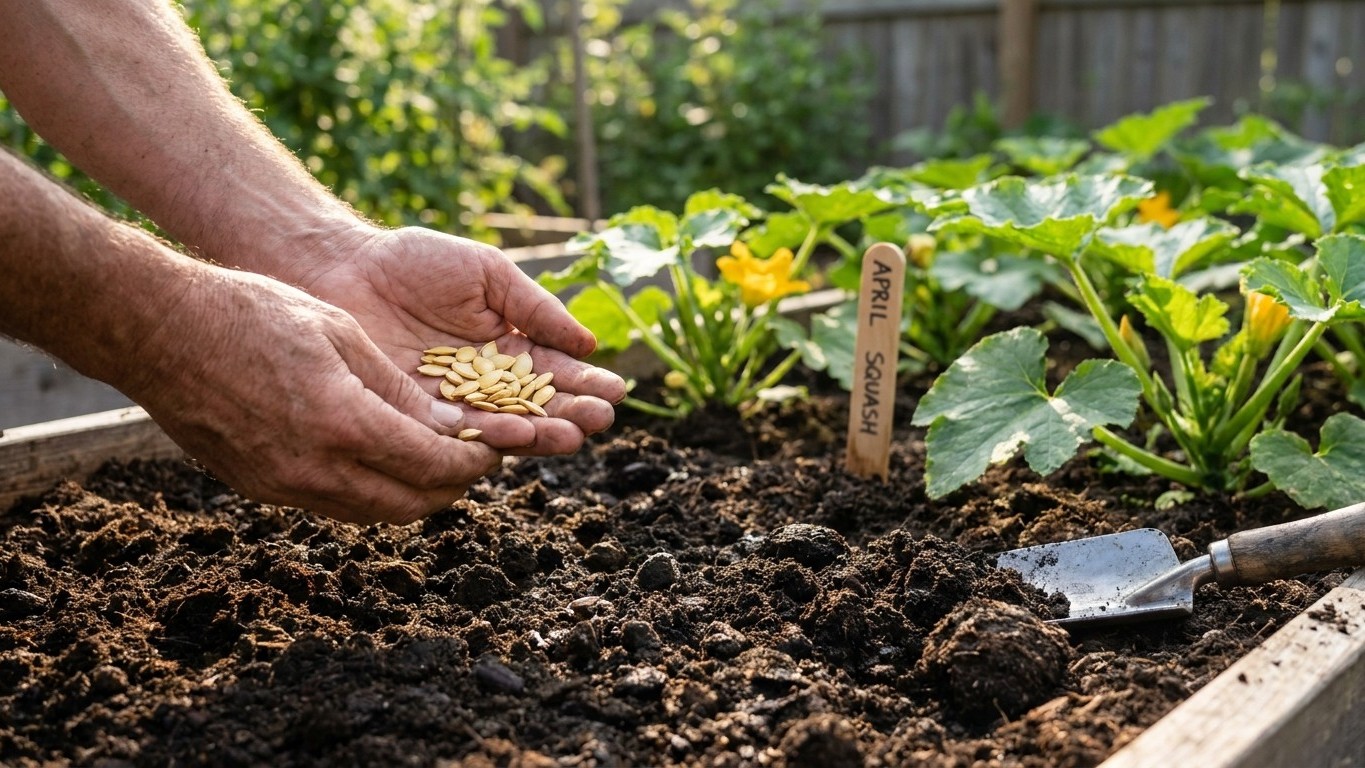

Summer squash goes into Mississippi soil after the last spring frost clears, which the reference data puts between March 6 and March 22 for the Jackson area. That gives most of the state a direct-seeding window from late March into early April, with room for a second planting in early summer before the heat peaks.
The short answer for Mississippi
Plant Summer Squash outdoors once the frost risk from that March 6 to March 22 window has passed. That date range isn’t a guarantee, it’s a probability band: NOAA’s 1991-2020 climate normals show a 30 to 70 percent chance of a 32F freeze occurring somewhere inside that stretch at the Jackson reference station. In practice, that means a gardener who seeds on March 10 is still gambling, while one who waits until March 25 or later has let most of the risk pass.
Summer squash doesn’t tolerate frost at all, not even a light one, so the safer play is to treat the back half of that window, closer to March 22, as the real starting line rather than the front edge. Direct seeding works well here because squash seedlings resent transplant shock, and Mississippi’s soil warms fast enough by late March that seeds germinate within a week in most years.
The other end of the calendar matters just as much. First fall frost at the same reference station falls between November 7 and November 22, which leaves a long stretch, seven months or more, between the two frost windows. Summer squash matures in roughly 45 to 55 days from seed, so that long frost-free stretch supports at least two full plantings: one in late March or April, and a second sown in June or early July for a fall harvest that beats the first frost with weeks to spare.
Heat is the variable that actually shapes the middle of the season here, more than frost does. The Jackson station averages 71.1 days a year at 90F or above, and most of those days land in July and August, right when a first planting is winding down and a second one needs to get established. That heat load is the reason experienced growers in this state often skip a mid-summer planting altogether and time the second round so it avoids germinating during the hottest stretch.
None of these dates are county-specific. They come from one weather station, and the caution attached to that data is worth repeating: suburban and rural gardens typically see their last spring frost later and their first fall frost earlier than an airport station records, sometimes by one to two weeks. Treat the numbers above as a starting estimate, not a fixed calendar.
What will not work here
Seeding too early into cold, wet soil is the most common way this fails. Summer squash seed rots in soil below the mid-60s, and jumping the gun before that March 6 to March 22 window has passed risks losing an entire seeding to a late freeze plus soggy ground. There’s no upside to racing the calendar with a crop this frost-sensitive.
On the other end, a watering routine built for a milder climate falls apart under Mississippi’s heat load. With 71.1 days a year at 90F or higher, evaporation pulls moisture out of topsoil fast, and a plant watered once a week will show stress, blossom drop, and stunted fruit well before that week is up. Summer rainfall doesn’t fully cover the gap either: the reference station averages about 14.1 inches across June, July, and August, but June, the driest of the three months, brings only 4.43 inches, and much of that arrives as thunderstorm bursts that run off rather than soak in. A garden on clay holds that rain longer; one on sandy soil can be bone dry within a day or two of a storm. Either way, relying on rainfall alone through the hottest stretch of summer is a losing bet.
Humidity and spacing
Close spacing is another failure point that’s easy to underestimate. Mississippi’s summer rainfall keeps humidity high, and squash planted too tightly doesn’t get enough airflow between leaves, which sets up ideal conditions for powdery mildew and other fungal issues by midsummer. Give plants more room than a seed packet written for a drier climate would suggest, and expect to thin more aggressively than instinct says is necessary.
Finally, don’t count on a single spring planting to carry the whole season. Squash plants slow down and often decline under sustained 90-plus-degree heat, well before the first fall frost arrives in November. Growers who plant once in spring and expect that same stand to produce through October are usually disappointed by August.
What changes across Mississippi
Mississippi spans USDA hardiness zones 7b through 9a, based on the USDA Plant Hardiness Zone Map’s 1991-2020 normals, which track average annual extreme minimum temperature. That’s a real spread within one state, and it means there’s no single answer to “when does the frost risk end” that applies from the hill country in the north down to the Gulf Coast.
A zone 7b location in the northern part of the state can expect a colder average extreme low than a 9a location near the coast, and that generally lines up with a later last frost date inland and an earlier one closer to the water, where the Gulf moderates winter temperatures. The frost window cited earlier, March 6 to March 22, comes from one reference station and shouldn’t be stretched to cover the whole zone range. A gardener in the northern hills should expect to wait longer into that window, or past it, before the frost risk has genuinely cleared, while someone on the coastal plain may see conditions ease earlier.
Elevation plays a smaller but real role too. Mississippi doesn’t have dramatic elevation change compared to mountain states, but even modest rises in the northeastern hill country can hold cooler air longer into spring than the surrounding lowlands, delaying that safe planting date by days rather than weeks.
None of this tells an individual reader which zone their own yard falls into, and this page isn’t the place to guess. The USDA’s zone map is built for exactly that lookup, and checking it by ZIP code takes less time than reading this paragraph twice. What matters here is the scale of the difference: a spread from 7b to 9a is wide enough that a calendar tuned to one end of the state can miss badly at the other.
Where to check this for your own county
Mississippi State University Extension is the state’s land-grant extension service, and it’s the source built for county-level answers this page can’t provide. Find it at extension.msstate.edu.
Two things are worth looking for once there. The first is a county or regional planting calendar, since Mississippi State’s county offices often publish sowing windows adjusted for local frost data rather than the single reference station cited above. The second is any variety trial information specific to the region, since extension programs frequently test which summer squash cultivars hold up best against local pest pressure, particularly squash vine borer and squash bug, both of which vary in severity across the state.
A county recommendation will always beat a state-level one, for a simple reason: it’s built on conditions closer to the actual garden. This page works from one weather station’s climate normals and a statewide hardiness zone range, which is useful for understanding the general pattern across Mississippi but isn’t a substitute for local frost records, soil type, and pest history that a county extension agent tracks year to year. If the guidance here and the county office’s calendar disagree by a week or two, follow the county office.
Extension offices also tend to know which problems are showing up locally in a given year, whether that’s a bad squash vine borer season or unusually wet spring soil, information that a static planting calendar can’t capture. A phone call or visit to the local office often settles a planting-date question faster than any written guide.
Checking this against your own garden
Every date on this page is an average built from decades of weather records. A gardener’s own observations, made in their own soil, outrank all of it, and three simple checks do most of the work.
Soil warmth by feel comes first. Reach a hand a few inches into the planting bed in the morning. If the soil feels cool and damp rather than merely cold, it’s likely warmed past the point where squash seed will rot rather than germinate. Waiting for that felt warmth, rather than a date on a calendar, catches the years when spring runs colder or warmer than the 30-year average suggests.
The first flush of male flowers is the second signal. Summer squash produces male blooms before female ones, usually by the second or third week of growth, and a strong early flush signals the plant has settled in well and found the growing conditions to its liking. A long delay in flowering, especially paired with pale or slow leaf growth, often points to soil that’s still too cool or nitrogen that’s running short.
The first true leaves round out the picture. The seed leaves that emerge first aren’t the plant’s real leaves; the true leaves that follow, with their characteristic rough, lobed shape, show whether germination has fully taken and the plant is ready to handle the transition into summer heat. Fast, sturdy true-leaf growth in the first two weeks is the best sign that the planting date, whatever it was, landed in the right window for that particular yard.