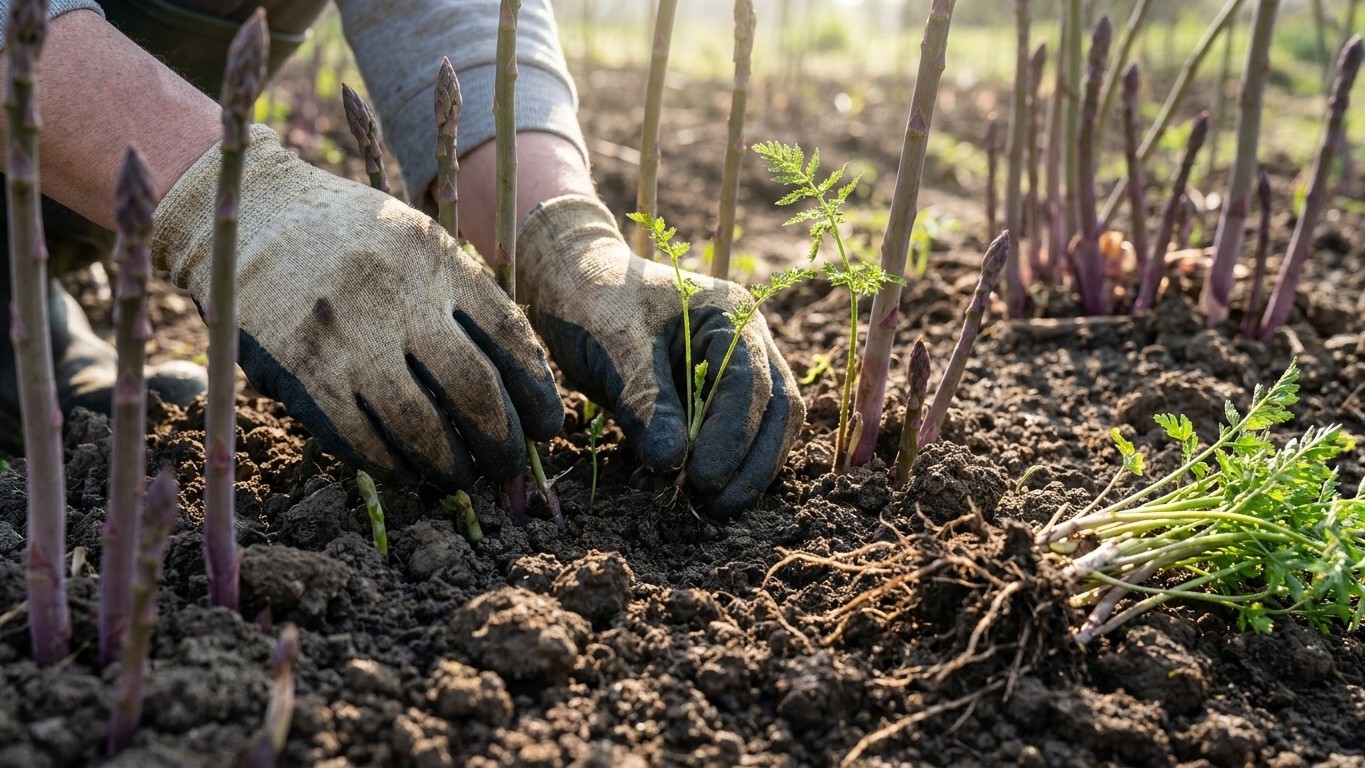

Purple Passion is an open-pollinated asparagus cultivar recommended by Clemson Cooperative Extension, planted from dormant crowns in early spring once the soil can be worked. It won’t hand you a harvest this year, or even next. Before that matters, though, the type of asparagus you’re planting, and how you plant it, decide whether the bed thrives for decades or struggles from the start.
Open-Pollinated vs. All-Male: What Purple Passion’s Type Actually Costs You
Asparagus cultivars split into two camps, and the difference isn’t cosmetic. An all-male hybrid sets no seed at all. Every bit of the plant’s energy goes into spears instead of berries, and the bed never reseeds itself into a tangle of volunteer seedlings.
Purple Passion doesn’t work that way. It’s open-pollinated, which according to Clemson Cooperative Extension means roughly half the plants in the row are female and will set berries. Those berries ripen, drop to the soil, and come up the following spring as seedlings scattered through the bed. That’s the trade-off of an open-pollinated variety, the same trade-off gardeners have made for generations with the old Washington series, which is open-pollinated too and still widely grown.
What this means in practice is maintenance, not failure. Each year you’ll need to walk the row and pull volunteer seedlings before they crowd out the crowns you actually planted. Skip that step for a season or two and the bed thickens with plants you didn’t choose, competing for light and nutrients. It’s a small, recurring chore, but worth planning for before the crowns go in the ground.
No seed company invented this trade-off to sell you something. It’s simply how open pollination works, and Clemson lists Purple Passion among its recommended cultivars with that characteristic clearly attached.
The Wait: Why Purple Passion Won’t Feed You This Year
Here’s the number that should shape every decision about this bed: Clemson Cooperative Extension states plainly that asparagus takes two to three years to begin production. Not weeks. Not one growing season. Years.
The extension service goes further, noting a new planting “may need two to three full growing seasons before limited harvesting can be done in the third or fourth year.” The phrase doing the real work is limited harvesting. That’s not a green light to start cutting spears the way you would from an established bed. It’s a narrow window, a handful of spears taken carefully so the crown can keep building the root reserves it needs to support a real harvest down the road.
What this means for anyone planting Purple Passion crowns this spring is a stretch of two or three seasons where the bed asks for weeding, watering, and patience, and gives back nothing you can put on a plate. Every spear the plant sends up in those early years is being redirected underground into the crown and root system instead of top growth. Cut it too early and you’re stealing from a plant that hasn’t built up enough reserve to spare it.
The payoff on the other side of that wait is real. A well-established asparagus bed can keep producing for fifteen to twenty years or more, which is the whole reason growers accept the slow start. No cultivar, Purple Passion included, changes that math. Anyone expecting a first-year crop is shopping for the wrong vegetable.
Planting Purple Passion Crowns: The Trench Method
The planting depth for asparagus crowns confuses a lot of first-time growers, mostly because the final number gets treated as a starting point. It isn’t.
Clemson’s guidance is specific: “Set the crowns 15 to 18 inches apart and 6 to 8 inches deep.” That’s the target spacing and depth, but not the depth you dig on planting day. The extension service spells out how you actually get there, and this is the part that separates a bed that thrives from one that rots: “continue to pull soil over the crowns (about 2 inches every two to three weeks) until the trench is filled, and the crowns are 6 to 8 inches deep.”
You dig a trench, set the crown at the bottom, and cover it with just a couple of inches of soil at first, not the full 6 to 8 inches all at once. As the spears emerge and grow, you gradually pull more soil over the crown until the trench fills in completely and it sits at its final depth.
Burying a crown at full depth on planting day is one of the more common ways a new asparagus bed fails to establish. The emerging spear has to push through too much soil before reaching light, draining reserves the crown hasn’t built up yet. The gradual fill method solves that by letting the young spear reach the surface quickly, then backfilling as the plant proves it’s growing.
Keep the spacing and depth as the ranges Clemson gives, 15 to 18 inches apart, 6 to 8 inches deep, rather than splitting the difference into a single number. Soil type, drainage, and row length all push a grower toward one end of that range or the other.
When to Stop Harvesting: The Pencil Test
Once a Purple Passion bed reaches full production, the question shifts from “when can I start” to “when do I stop,” and Clemson’s answer isn’t a date on a calendar. It’s a visual signal built into the spear itself.
The guidance: “Stop harvesting when the diameter of the spears has been reduced to pencil-size and allow the spear to grow to full height.” No week count, no cutoff date tied to the calendar. Just a diameter you can check with your eyes and fingers.
The mechanism behind that rule is straightforward. Each spear you cut during harvest season comes directly out of the crown’s stored energy reserves. Early in the season, when reserves are full, the bed sends up thick, vigorous spears. As harvest continues, the crown draws those reserves down, and the spears get progressively thinner. Once they’ve narrowed to about pencil width, that’s the crown signaling it’s running low. Continuing to cut would eat into the reserves the plant needs to grow its fern top and refill the crown before winter dormancy.
Letting the pencil-thin spears grow to full height instead lets the plant put up its fern, the tall, feathery top growth that captures sunlight and rebuilds underground reserves for next year’s harvest. Skip that recovery period, or keep cutting past the pencil signal, and the following year’s harvest comes in weaker across the whole bed.
This sign works the same way whether the bed is in coastal South Carolina or a cooler inland climate, because it’s tied to the plant’s own physiology rather than a fixed date. A calendar cutoff would need adjusting for every growing zone; the pencil test doesn’t.
Common questions
Is Purple Passion an all-male hybrid or open-pollinated?
Purple Passion is open-pollinated. Roughly half the plants will be female and set berries, and those berries drop seed that comes up as volunteer seedlings the following year, which need to be weeded out of the row.
How long before a Purple Passion bed produces asparagus?
Clemson Cooperative Extension states that asparagus takes two to three years to begin production, with limited harvesting possible in the third or fourth year. No yield figures or days-to-maturity numbers are published for this cultivar.
How deep should Purple Passion crowns be planted?
Clemson recommends setting crowns 15 to 18 inches apart at the bottom of a trench, then gradually pulling soil over them (about 2 inches every two to three weeks) until the trench fills and the crowns sit 6 to 8 inches deep.
When should I stop cutting spears each season?
Stop harvesting once the spears narrow to pencil-size diameter, and let the remaining spears grow to full height. That signal means the crown’s stored reserves are running low and it needs the fern top to rebuild them before the next season.