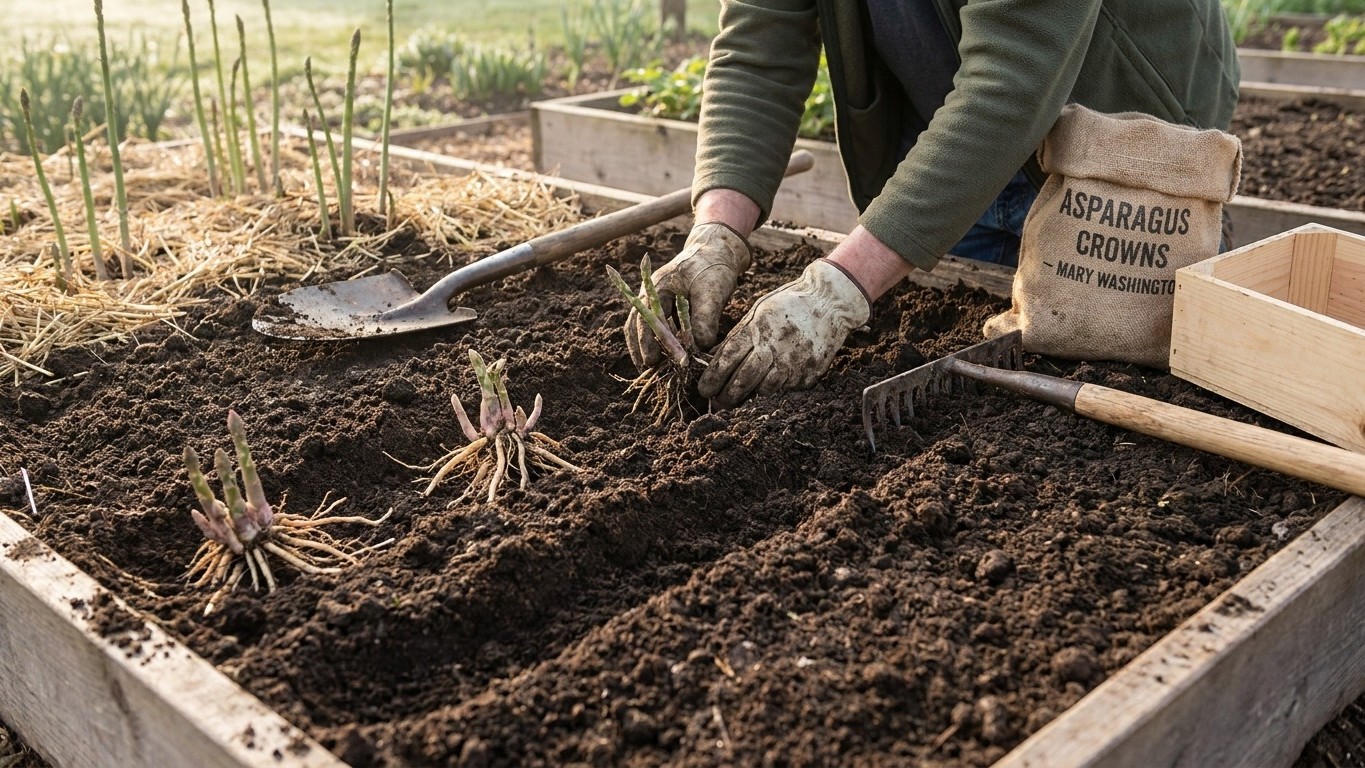

Mary Washington asparagus is an open-pollinated variety recommended by Clemson Cooperative Extension, and the planting window is simple: set dormant crowns in early spring, as soon as the soil can be worked and the threat of hard frost has passed. But the calendar date matters far less than the two-part trench technique and the multi-year wait that come with this variety, and that’s where most new asparagus beds go wrong.
Open-Pollinated vs. All-Male: What the Type Actually Costs You
Mary Washington is listed by Clemson Cooperative Extension as an open-pollinated cultivar, and that word choice matters more than most catalog descriptions let on. Open-pollinated means the seed strain hasn’t been bred to produce only male plants, so roughly half of what comes up in your row will be female. Female asparagus plants set berries. Those berries drop in late summer, overwinter in the soil, and sprout as volunteer seedlings the following spring, right in the crown row you spent years establishing.
That’s not a flaw in Mary Washington. It’s the trade-off that comes with growing an older, open-pollinated line instead of a modern all-male hybrid, which never flowers into berries and puts its energy into spear production instead of fruit. An open-pollinated variety spends some of that energy on seed, and the gardener spends some of theirs pulling volunteer seedlings out of the bed each spring.
No published yield number or days-to-maturity figure exists for Mary Washington from Clemson. What is documented is the maintenance difference: a bed of open-pollinated asparagus needs an annual pass to remove seedlings that a bed of all-male hybrids simply doesn’t produce. If you’ve chosen Mary Washington anyway, for its taste, its history, or the seed cost, that annual weeding pass is the price of admission, not a sign something went wrong.
The Wait Before the Harvest: Two to Three Years of Nothing
Before any spear reaches a dinner plate, there’s a stretch of time that has nothing to do with cutting and everything to do with patience. Clemson Cooperative Extension states it directly: asparagus takes two to three years to begin production. That’s the baseline timeline for a perennial crop that spends its early seasons building an underground root system strong enough to support decades of spring harvests.
Clemson goes further, noting that a new planting may need two to three full growing seasons before limited harvesting can be done in the third or fourth year. Limited harvesting is not the same as a full harvest, and it’s not the same as picking freely for six or eight weeks the way an established bed allows. In year three or four, a grower might take a handful of spears over a short window and then stop, letting everything else grow into fern so the crown can keep building strength.
This is the section that should decide whether Mary Washington asparagus belongs in your yard at all. A bed of tomatoes rewards a gardener within a single season. Asparagus asks for two or three seasons of bed prep, weeding, watering, and waiting before it gives back anything. What it gives back after that, though, is a productive bed for twenty years or more with minimal replanting. The math only works if you’re planning to stay put, or at least to leave a well-tended bed for whoever comes next.
Anyone tempted to rush this by harvesting heavily in year two is drawing down reserves the plant hasn’t built yet, and the payoff is a weaker bed for years afterward rather than a faster one.
Planting the Trench: Why the Crown Isn’t Buried Deep on Day One
The planting depth for Mary Washington crowns looks straightforward on paper and gets misapplied constantly in practice. Clemson’s guidance is specific: set the crowns 15 to 18 inches apart and 6 to 8 inches deep. Most gardeners read that, dig a trench 6 to 8 inches deep, drop the crown in, and backfill immediately. That’s the wrong move, and it’s one of the more common ways a new asparagus planting fails to establish.
The trench depth in that quote describes where the crown ends up, not where it starts. Clemson’s full instruction explains the process: after the crown is set in the bottom of the trench, the grower should continue to pull soil over the crowns, about 2 inches every two to three weeks, until the trench is filled and the crowns are 6 to 8 inches deep. The trench starts open and shallow, with only a couple of inches of soil covering the crown at first. As spears emerge and grow, more soil gets pulled over them gradually, a few inches at a time, over a period of weeks.
Burying a dormant crown at full depth immediately deprives emerging spears of the light and air exchange they need to push through, and it can smother a planting before it ever gets established. The gradual fill method mimics how the plant would naturally emerge from a shallow crown and slowly build soil depth around itself over a season. Spacing crowns 15 to 18 inches apart gives each plant enough room to expand its root mass without competing directly with its neighbors, which matters more with an open-pollinated variety also managing volunteer seedlings nearby.
When to Stop Cutting: The Pencil-Size Signal
Once a Mary Washington bed reaches full production, the question shifts from when to plant to when to stop harvesting each spring. Clemson’s rule isn’t tied to a calendar date or a fixed number of weeks. It’s tied to the spear itself: stop harvesting when the diameter of the spears has been reduced to pencil-size and allow the spear to grow to full height.
That signal exists for a mechanical reason. Every spear cut in spring comes directly from the crown’s stored carbohydrate reserves built up the previous summer and fall. Early in the harvest window, the plant sends up thick, vigorous spears because those reserves are full. As harvest continues, the crown draws those reserves down, and the spears it produces get progressively thinner. Pencil-size spears signal that it’s running low and needs to shift from producing food for the harvest basket to producing fern for photosynthesis.
Letting spears grow to full height and leaf out into fern after that point allows the plant to rebuild the reserves it just spent, storing energy in the crown through summer and fall so it has enough to push a strong harvest again the following spring. Cutting past the pencil-size signal, chasing a few more spears out of a weakening crown, is one of the surer ways to shorten the productive life of an asparagus bed.
No fixed number of weeks appears anywhere in Clemson’s guidance, and that’s intentional. A calendar date would work for one growing season in one location and fail the next, since harvest length shifts with weather, soil temperature, and how established the bed already is. The pencil-size sign works everywhere, in every season, because it comes from the plant rather than the calendar.
Common questions
Is Mary Washington asparagus an all-male hybrid?
No. It’s classified as open-pollinated by Clemson Cooperative Extension, which means roughly half the plants will be female and will set seed-bearing berries that drop and sprout as volunteers the following year.
How long before a Mary Washington asparagus bed produces a real harvest?
Clemson states that asparagus takes two to three years to begin production, and a new bed may need two to three full growing seasons before even limited harvesting can happen, usually in year three or four.
How deep should Mary Washington crowns be planted?
Crowns go 15 to 18 inches apart in a trench that ends up 6 to 8 inches deep, but that depth is reached gradually by pulling soil over the crowns about 2 inches every two to three weeks, not all at once.
When should I stop cutting asparagus spears in spring?
Stop once the spears narrow down to pencil-size diameter and let them grow to full height from that point on. That signal means the crown’s stored reserves are running low and need to rebuild through the fern for the rest of the season.