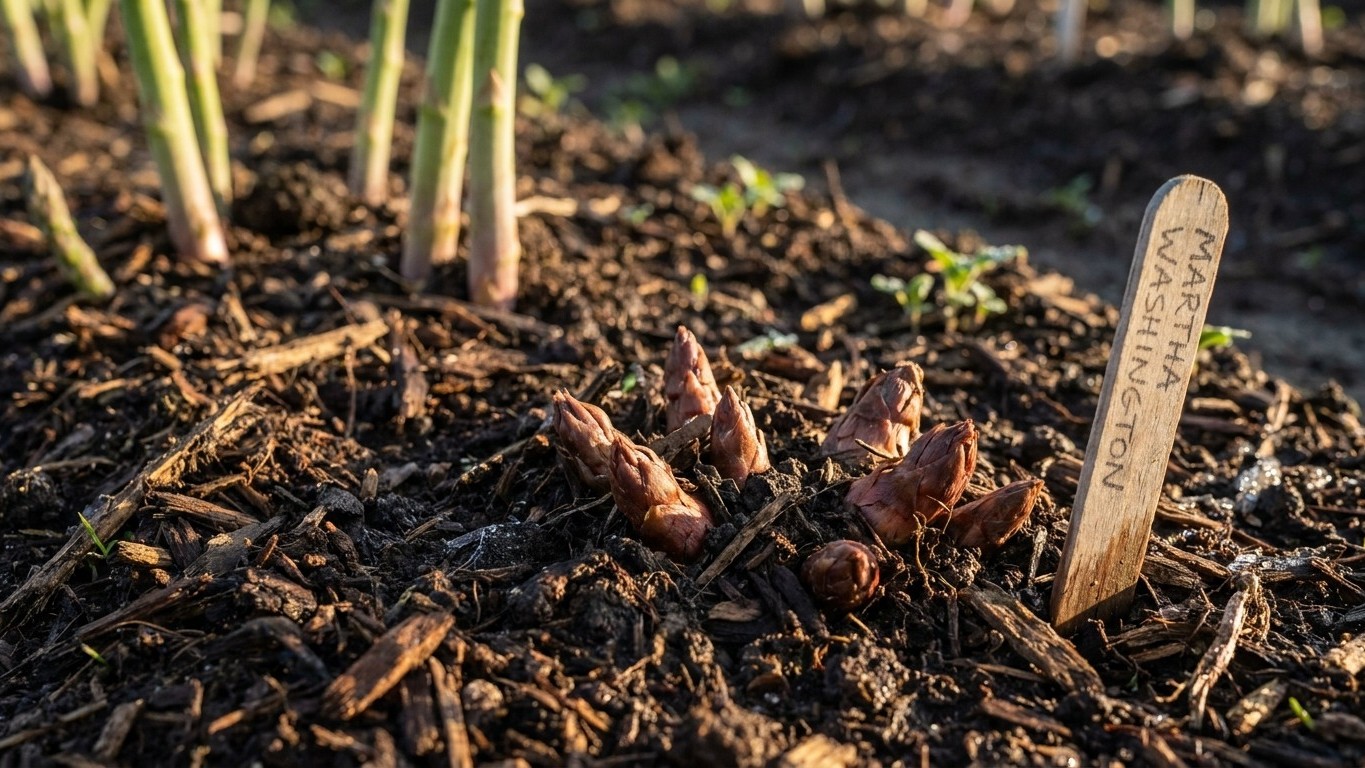

Martha Washington asparagus is one of the old open-pollinated varieties still sold today, decades after it first showed up in extension bulletins. It goes into the ground as dormant crowns in early spring, not seed, and it won’t hand you a single spear this year or even next. Clemson Cooperative Extension lists it among the varieties worth planting in Southern gardens, but the payoff sits two or three seasons down the road.
Open-Pollinated: What the Type Actually Costs You
Every asparagus cultivar falls into one of two camps, and the camp matters more than the name on the tag. Newer cultivars are bred as all-male hybrids. A plant with no female flowers sets no seed, so every bit of energy the crown pulls up goes into spears instead of berries, and the bed never reseeds itself into a tangle of volunteer seedlings.
Martha Washington sits in the other camp. It’s open-pollinated, meaning roughly half the plants in the row will be female and will set berries. Those berries ripen, drop, and the following spring you’ll find seedlings coming up between the rows where you don’t want them. That’s not a flaw so much as the trade that comes with an older, open-pollinated line: a little extra weeding each year, in exchange for a plant that’s been reliable in home gardens far Longer Than Most hybrids on the market.
Clemson Cooperative Extension, which recommends Martha Washington on its home garden list, doesn’t publish a yield figure or a days-to-maturity number for it, and neither does any other reliable source. Asparagus isn’t sold that way, because the crop isn’t judged by a single season. What’s published instead is the type and what it costs in maintenance. If you don’t want to pull volunteer seedlings out of the row every spring, an all-male hybrid is the better fit. If a little extra weeding doesn’t bother you, Martha Washington keeps producing for decades once it gets going.
The Wait: Two to Three Years Before Any Harvest
Here’s the part that catches new gardeners off guard, and it belongs near the top of any decision about whether to plant asparagus at all. Clemson Cooperative Extension states it plainly: “asparagus takes two to three years to begin production.” That’s not a worst-case estimate. It’s the baseline.
The same source spells out exactly what “beginning production” means in practice: crowns “may need two to three full growing seasons before limited harvesting can be done in the third or fourth year.” Notice the wording. It says limited harvesting, not a full harvest. In year three or four, a Martha Washington bed might give up a handful of spears over a short window, not the basketfuls an established planting produces once it matures fully.
So the honest version of the timeline looks like this: you dig a trench and set crowns in year one. You weed, water, and let the fern grow tall through year two, taking nothing. By year three, maybe year four, you cut a few spears here and there, still holding back most of the bed’s energy for root growth. Only after that does the planting settle into the long stretch of reliable spring harvests asparagus is known for, a stretch that can run fifteen years or more in a well-kept bed.
That’s the real commitment. Two or three seasons of tending a patch that gives nothing back, followed by decades of spears every spring. Anyone weighing whether to put in a Martha Washington bed should measure that wait against how long they plan to stay in the same yard.
Planting the Trench: Why the Crown Isn’t Buried Deep on Day One
The planting method is worth getting right, because a crown buried too deep too fast is a common way to lose a bed before it ever gets started. Clemson Cooperative Extension is specific about spacing and starting depth: “Set the crowns 15 to 18 inches apart and 6 to 8 inches deep.”
What that instruction doesn’t say on its own is that the trench isn’t filled in all at once. Crowns go into an open trench dug to that depth, spread out and covered with only a thin layer of soil at first, not packed solid to the bottom. Clemson spells out the rest: “continue to pull soil over the crowns (about 2 inches every two to three weeks) until the trench is filled, and the crowns are 6 to 8 inches deep.”
The crown reaches its full planting depth gradually, in step with the spears pushing up through the soil. Each time a couple of inches of soil gets pulled back over the row, the young shoots have to grow back up through that new layer before they reach daylight, which is exactly how the root system builds strength through the first season. Fill the trench completely on planting day, burying the crown 8 inches deep immediately, and those first shoots have a much harder climb, with no matching benefit.
Every one of these figures, the spacing, the starting depth, the pace of filling, is given as a range rather than a fixed number, and that’s deliberate. Soil type, crown size, and how fast shoots emerge all vary from one yard to the next, so Clemson leaves room to adjust within the range instead of locking gardeners into a single measurement.
When to Stop Harvesting: The Pencil-Size Sign
Once a Martha Washington bed reaches full production, the question shifts from “when can I harvest” to “when do I need to stop.” Clemson Cooperative Extension ties the answer to the plant itself, not the calendar: “Stop harvesting when the diameter of the spears has been reduced to pencil-size and allow the spear to grow to full height.”
The logic is worth understanding, because it explains why a fixed date would actually be worse advice. Every spear cut in spring comes out of stored energy the roots built up the previous summer and fall. As the harvest window rolls on, that reserve gets spent down, and the spears coming up get thinner to show it. Once they’ve narrowed to about the width of a pencil, the bed is signaling that it’s running low on stored energy and needs a break from cutting.
Letting spears grow past that point, up into full-height fern, gives the plant the leafy top growth it needs to photosynthesize and rebuild root reserves before winter dormancy sets in. Skip that recovery stretch, keep cutting thin spears anyway, and the bed weakens year over year instead of holding steady.
No fixed number of weeks appears anywhere in this guidance, because a pencil-size spear shows up on a different week depending on soil, weather, and how the winter behaved. A calendar date can’t account for any of that. The spear can, which is why the diameter, not the day of the month, is the signal worth watching.
Common questions
Is Martha Washington asparagus an all-male hybrid?
No. It’s open-pollinated, meaning roughly half the plants will be female and will set berries that drop seed into the bed. All-male hybrids are a separate, newer category of cultivar bred specifically to skip that step.
How deep do you plant asparagus crowns?
Clemson Cooperative Extension recommends setting crowns 15 to 18 inches apart and 6 to 8 inches deep, but not all at once. Soil gets pulled over the crowns gradually, about 2 inches every two to three weeks, until the trench fills and reaches that final depth.
When can I start harvesting asparagus after planting?
Asparagus takes two to three years just to begin production, and even then, Clemson notes crowns may need two to three full growing seasons before limited harvesting is possible in year three or four. That’s a light harvest, not a full one.
Will open-pollinated asparagus varieties like Martha Washington come true from seed?
Not reliably. Seedlings that sprout from dropped berries are a mix of the parent plants’ genetics, not identical copies, and they typically come up as unwanted volunteers in the row rather than a plant worth keeping.