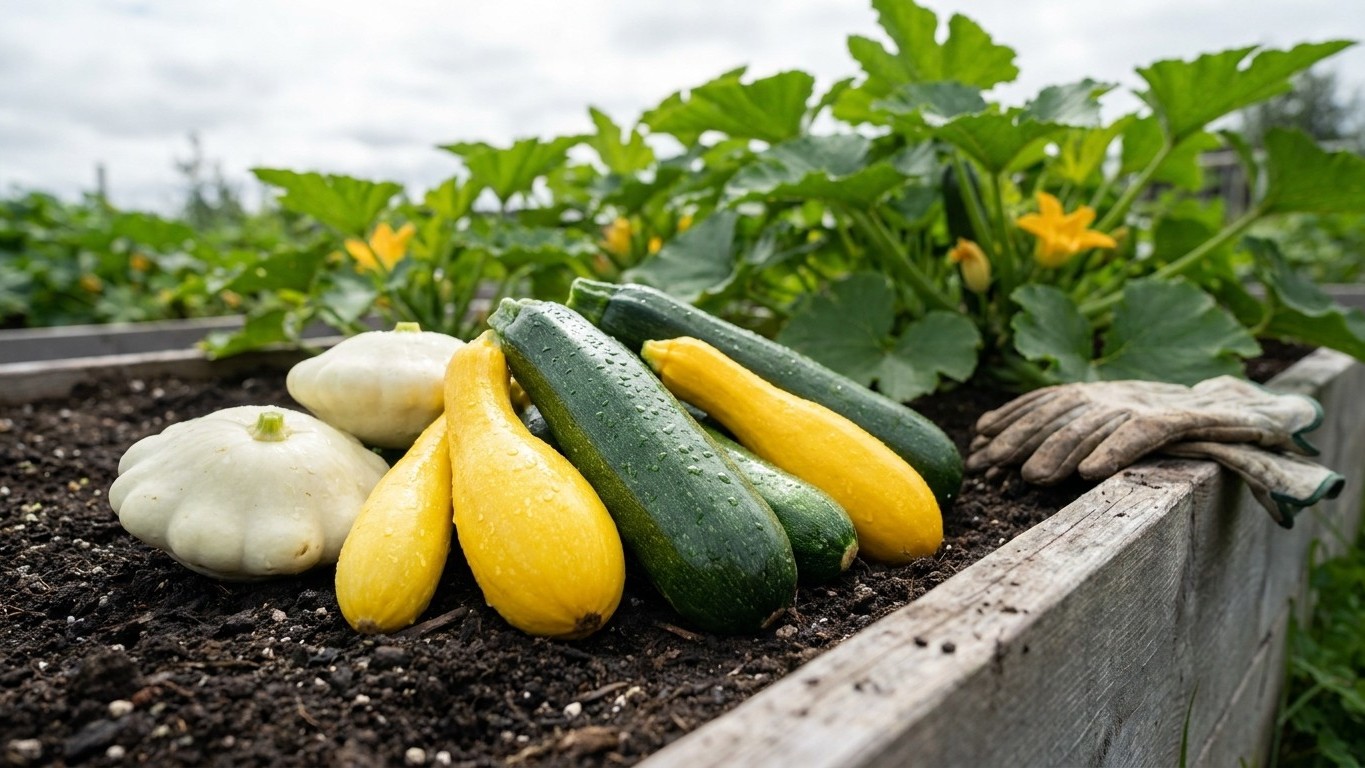

Bush-type summer squash, zucchini, yellow crookneck, yellow straightneck, and pattypan, are the safe bet in New Hampshire. Their 45- to 55-day maturity fits easily inside the state’s frost-free window, even the shorter, cautious version of it. Vining or long-season squash types are the ones to skip.
The short answer for New Hampshire
Start with the numbers that actually decide this. At the reference station in Manchester, the last spring freeze falls somewhere between April 16 and April 27, and the first fall freeze arrives between October 13 and October 26. Take the tightest, most conservative pairing of those dates (April 27 to October 13) and you still get roughly 169 days without a killing frost. Even after subtracting the one-to-two-week margin that suburban and rural gardens typically lose on both ends compared to an airport weather station, most New Hampshire gardens are working with something in the neighborhood of 140 to 160 frost-free days most years.
Summer squash doesn’t need anywhere close to that. A bush zucchini or yellow crookneck reaches its first harvest in 45 to 55 days from seed, sometimes faster with black plastic mulch or a transplant head start. That leaves enormous slack in the season, which matters less for whether the crop survives and more for how many pickings a gardener gets before vines wear out or mildew sets in during August.
Heat load is the other half of the equation, and it points the same direction. Manchester averages only 10.9 days a year at 90F or above. That’s a modest heat load compared to warmer regions, and it means squash varieties bred for long, blazing summers, ones that need sustained heat to set fruit reliably or to develop full flavor, simply don’t get what they’re bred for here. Bush summer squash, by contrast, sets fruit fine in the 70s and low 80s that make up most of a New Hampshire July and August.
So the type-level decision is straightforward: bush habit over vining, fast maturity over long-season, and standard zucchini, straightneck, crookneck, or pattypan varieties over specialty types bred for hotter climates. This page doesn’t have county-by-county maturity trial data for New Hampshire, so treat the 45-to-55-day window as the state-level guideline and confirm anything more specific with the source in the fourth section below.
What will not work here
Long-vining summer squash types are the first casualty. They need real estate and time to sprawl before they start producing heavily, and in a season that may run closer to 140 days once local frost timing is accounted for, that establishment period eats into a harvest window that’s already tight. A vining variety planted the same week as a bush type will often still be building leaf canopy when the bush plant is already dropping its third or fourth squash.
Heat-dependent varieties
Some squash varieties, summer and winter alike, are selected for regions where sustained heat drives both fruit set and flavor development. With only 10.9 days a year above 90F at the reference station, New Hampshire simply doesn’t deliver that kind of heat load. Varieties that depend on it tend to produce fewer fruit per plant and less of the richness they’re known for elsewhere. This isn’t a frost problem. It’s a heat-accumulation problem, and no amount of season-extension fabric fixes it.
Tight spacing in a humid summer
Summer rainfall across New Hampshire averages about 10.7 inches over June, July, and August, with July the driest month at 3.3 inches. That’s a moderate, fairly reliable rainfall pattern, not a drought pattern. But that same humidity, combined with cool overnight temperatures typical of inland New England, creates ideal conditions for powdery mildew on squash leaves. Varieties or planting layouts bred for close spacing, meant to maximize yield per square foot in drier climates, lose airflow here and mildew out earlier in the season. Wider spacing than a seed packet from a warmer region suggests is usually the safer call.
Finally, anything billed as a 70-plus-day summer squash is pushing its luck. It’s not that the frost-free window can’t technically fit it. It’s that a cool, wet stretch in June, common in New Hampshire, can delay germination and early growth by a week or two, and a slow-maturing variety has no buffer left if the first fall frost lands on the early side of its range.
What changes across New Hampshire
New Hampshire’s USDA Plant Hardiness Zones (based on the USDA Plant Hardiness Zone Map, 2023 edition, using 1991-2020 normals) span from 3b up through 6a. That’s not a narrow range. It’s the difference between a short, harsh growing season in the North Country or at elevation and a noticeably milder, longer one closer to the southern tier and the seacoast. There is no single frost-free season length that applies to the whole state, and any recommendation that treats New Hampshire as one climate is skipping a step.
The frost dates and heat figures used above come from the Manchester reference station, which sits well south of the coldest zones. A gardener in a colder part of the state, whether that’s northern New Hampshire or a higher-elevation valley, should expect a shorter frost-free window than the Manchester figures suggest, on both ends of the season. Practically, that means leaning toward the fastest-maturing bush varieties available, starting seed indoors or buying transplants rather than direct-seeding, and treating early June rather than mid-May as the safer outdoor planting point.
A gardener closer to the milder end of the state’s range, nearer the coast or in the warmer southern valleys, has more room to experiment: a slightly longer-season variety, a second succession planting in July, or direct-seeding a week or two earlier than the statewide guideline would suggest.
None of this can be resolved from a state-level page. The zone range itself, 3b to 6a, is the evidence that one answer doesn’t cover New Hampshire. Checking the USDA Plant Hardiness Zone Map for a specific address is the only way to know which end of that range applies to a given garden, and that step belongs to the reader, not to this page.
Where to check this for your own county
The University of New Hampshire Cooperative Extension is the state’s land-grant extension service, and its site is the right next stop. This page has given the type-level answer, bush over vining, fast-maturing over long-season, and the state-wide frost and heat figures behind it. What it can’t give is a county-level planting calendar or a list of squash varieties actually trialled in a specific New Hampshire county, and that’s exactly what the extension service is built to provide.
Once there, look specifically for two things. First, a local or regional vegetable planting calendar, which will translate the frost-date ranges used on this page into dates that account for local topography, something a single Manchester weather station can’t do for the whole state. Second, look for variety trial results or recommended-variety lists for vegetable gardens, since county extension offices and master gardener programs often track which specific zucchini, crookneck, or pattypan varieties have performed well in local trial gardens, not just which types tend to work in general.
A county-level recommendation will always beat a state-level one, because it accounts for local frost pockets, soil conditions, and microclimate effects that a statewide page like this one has no way to capture. This page has done the work of narrowing the decision down to squash type and general timing based on New Hampshire’s climate normals. The extension service is where that general answer gets sharpened into something specific to one county, or one garden.
Checking this against your own garden
Every date and figure on this page is a normal, an average built from three decades of weather records at one station. A gardener’s own observations, made right in the bed where the squash will actually grow, outrank all of it. Three things are worth watching before committing to a planting date.
Soil warmth by feel comes first. Squash seed sulks in cold soil and can rot before it germinates. Pushing bare fingers a couple inches into the planting row, if the soil feels cool and damp rather than just cool, it likely hasn’t warmed enough yet, regardless of what the calendar says about the last frost having passed.
The first flush of male flowers is the second signal. Squash plants typically produce male flowers before females, and a strong early showing of them signals the plant has moved past the vulnerable seedling stage and into active growth. No male flowers appearing well after the seedlings look established can point to a plant that’s been slowed by a cooler-than-usual stretch, or a spot in the garden that runs shadier or cooler than the rest.
The first true leaves matter too, not just their appearance but their color and vigor. Pale, slow-to-expand true leaves on an otherwise healthy-looking seedling often mean the soil hasn’t warmed as much as the calendar suggests, or that a particular corner of the yard runs cooler than the rest of the property, information no state-level frost date can supply. Watching for these three things over a single season tells a gardener more about their own microclimate than any regional average ever will.