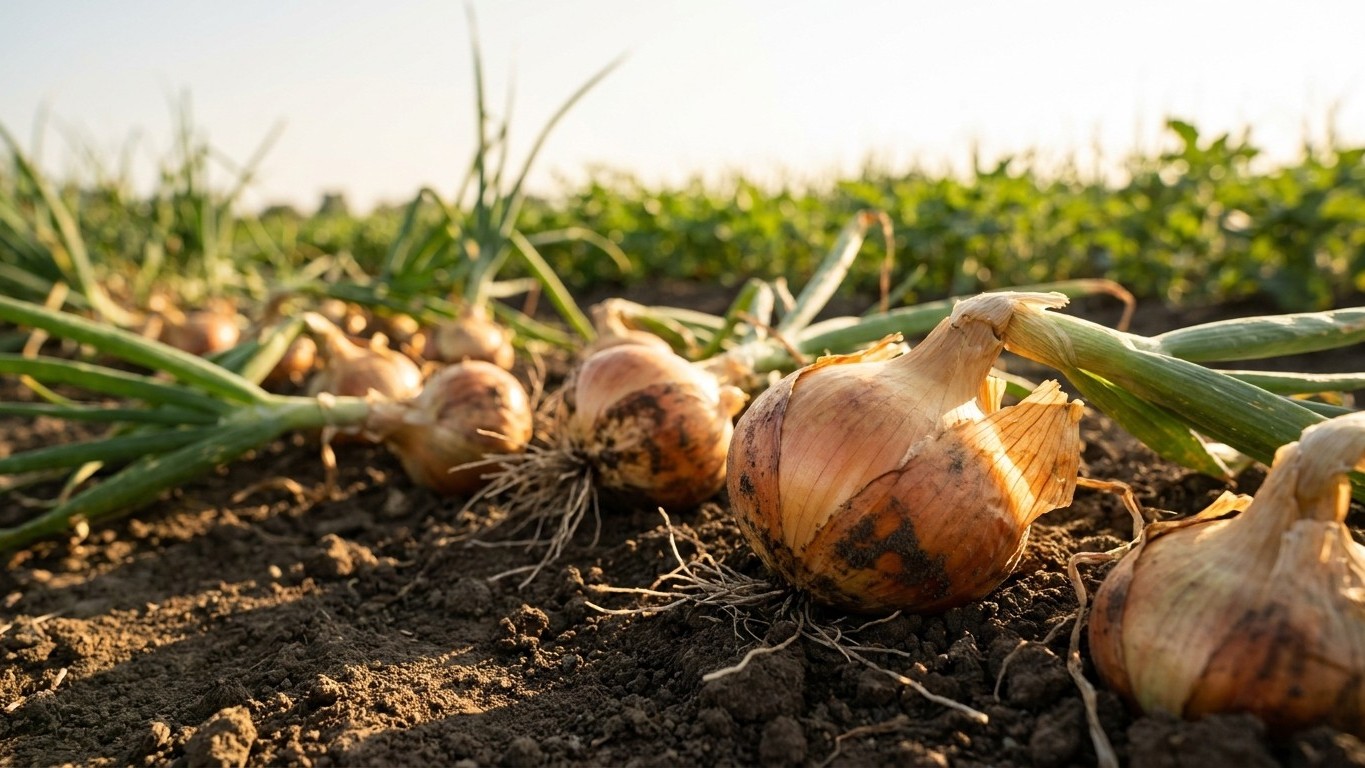

In Oregon, onion pests arrive in a sequence that follows the onion’s own calendar. Maggot flies and damping-off diseases go after seedlings in spring, thrips move in as bulbs swell in summer, and rot fungi take over once the crop is out of the ground. The sequence is predictable because it runs on day length, and Oregon’s day length is long. Here is how each stage works and what to watch for.
The short answer for Oregon
Portland sits at 45.59 degrees north, and on the longest day of the year it gets 15 h 30 of daylight. That number sets the whole onion calendar here. Bulbing is triggered by day length, not warmth. A long-day variety waits for 14 to 16 hours of light before it stops making leaves and starts swelling a bulb, and Oregon’s June days clear that bar. A short-day variety starts bulbing at about 12 hours, according to Clemson Cooperative Extension, so it bulbs early and stays small this far north.
The pests follow that clock. The plant spends spring building leaf, then switches to bulb once the days stretch past the threshold. Each phase is vulnerable in a different way. No state-wide pest calendar with dates is published here, because the timing shifts by county and by year. The order, though, rarely changes.
Spring: seedlings and young plants
The onion maggot is the early threat. Adult flies lay eggs near the base of young plants, and the larvae tunnel into the stem and bulb. A row that looks fine on Monday can have gaps by the weekend, with seedlings wilting, yellowing and pulling out of the soil with hollowed bases. Cool, wet springs favor the same stretch of weeks for downy mildew, which shows up as pale, fuzzy patches on leaves. Floating row cover laid at planting keeps flies off, and rotating onions away from last year’s bed keeps overwintering pests from being right under the new crop.
Early summer: thrips as bulbs swell
Onion thrips are tiny, slender insects that rasp the leaf surface and leave silvery streaks. They build up in warm, dry weather, which is exactly what arrives as bulbs begin sizing up. Heavy feeding cuts the green leaf area the plant uses to fill the bulb, so the damage shows up later as smaller onions rather than as dead plants. Thrips hide in the folds near the neck, so look there, not just at leaf tips.
Late summer into storage: rot
Once tops fall over, the threat changes from insects to fungi. Neck rot gets in through necks that were never allowed to dry down. Curing comes first: bulbs go into storage only once the necks are tight and the skins are papery, never straight from the ground. Skip that step and no storage setup will save the crop.
What will not work here
Planting the wrong day-length group is the mistake with the clearest outcome in Oregon. Short-day onions are bred for southern states where the longest day is shorter than Portland’s 15 h 30. Put them in a Willamette Valley bed and they hit their 12-hour trigger early in the season, while the plant is still small. Whatever size the plant has reached when day length triggers bulbing is the size of the bulb. So you get a small onion, a long stretch of summer with a stunted plant in the ground, and a thrips season to get through with little leaf to spare.
These are the groups to leave out of an Oregon garden:
- Granex-type (Vidalia-style) sweet onions: short-day, so they bulb at about 12 hours and stay small this far north, and as sweet types they do not keep.
- Texas-bred short-day sweets: same trigger, same early bulbing, same small bulb, with a soft texture that won’t last the winter.
- Short-day types sown in spring to “catch up”: a spring sowing meets the 12-hour mark before the plant has built any real leaf, so the bulb is tiny.
Timing mistakes behave the same way. Planting late does not delay the harvest, it shrinks it. A late-set onion has fewer weeks of leaf growth before the days trigger bulbing, so you pull a smaller bulb on roughly the same schedule. The When to Plant Onions in Oregon page covers the season in detail, and The Best Onion Varieties for Oregon names the long-day varieties that suit this latitude.
One storage habit also fails every time: putting uncured onions in a damp cellar beside the carrots. Onions want it dry, and a root cellar tuned for carrots is the wrong room for them.
What changes across Oregon
Oregon is not one latitude. It runs from the California border in the south to the Columbia River in the north, and the figures above belong to Portland, the reference city for this page. A garden in the Rogue Valley sits well south of Portland, so its longest day is a little shorter. A garden along the Columbia sits close to the reference figures. Exact latitudes and day lengths for other towns are not published here, so check yours.
| Area | Latitude | Longest day | What it changes |
|---|---|---|---|
| Portland (reference city) | 45.59 degrees north | 15 h 30 | Long-day onions bulb on schedule; short-day types bulb too early |
| Southern Oregon | Lower than Portland; look up your own | Slightly shorter than 15 h 30 | Long-day types still suit most gardens, but planting may start earlier in mild-winter valleys |
| Far north, along the Columbia | Close to Portland’s; look up your own | About the same as the reference city | Follow the Portland advice; cold snaps matter more than day length |
Day length is only half the picture for pests. The cool, wet western valleys favor maggots and mildew in spring, while the drier country east of the Cascades gives thrips more warm weather to build in. Winter cold also differs enough that planting windows can sit weeks apart between two Oregon gardens, even where the day length is nearly the same. The state-level overview at Onions in Oregon ties these regional differences together.
Sweet now, or onions that last
Oregon’s latitude pushes you toward pungent, long-keeping onions, and the reason is chemistry. The bite of an onion comes from volatile sulfur compounds, and those same compounds protect the bulb in storage. University of Missouri Extension states it plainly: “As a rule, ‘sweet’ onions do not store as well as the more pungent types.” A sweet variety has fewer of those compounds. It tastes better raw, but it will not last the winter, and no curing routine changes that.
The pattern lines up with day length. Short-day types run sweeter and long-day types keep longer, so a southern garden gives onions to eat soon, while a northern one gives onions that feed you into March. Oregon gardeners using long-day varieties are closer to the second group.
Look at your pantry in March. Pungent long-day bulbs, cured properly and held at the conditions Clemson Cooperative Extension gives (“Ideal conditions are between 45 °F and 55 °F, and 50 to 60 percent humidity”), should still be firm and papery, with a sharp bite for cooking. A bin of sweet onions will be a different story, with soft spots, sprouts or a sour smell well before spring. Rot organisms thrive in the warmth and dampness that a storage failure creates, so a well-cured crop is also the best defense against the last stage of the pest sequence. The source for the storage guidance is Clemson’s onion, leek, shallot and garlic factsheet.
If you want sweet onions, plan on eating them first, in late summer and fall, and keep the pungent ones for the winter shelf.
Checking this against your own garden
Portland’s numbers are a reference point, not a verdict on every Oregon bed. The 15 h 30 figure is geometric daylight; atmospheric refraction adds roughly seven minutes of real daylight that is not counted here. Before you rely on any of it, run through these checks this week:
- Look up your latitude. If you live far south of Portland, say in the Rogue Valley or near the California line, your longest day is shorter than 15 h 30, and your planting dates may sit weeks away from the reference city’s.
- Find your last spring frost and first fall frost dates for your own town, not a state-wide average.
- Call your county extension office and ask which onion pests are active locally and when. Timing for thrips and maggot flies varies by county and by year.
- Check the variety tags on anything you buy. If it says short-day, it is the wrong group for Oregon.
- Measure the temperature and humidity where you plan to store onions. You want 45 °F to 55 °F and 50 to 60 percent humidity, and a hygrometer costs little.
- Look at last year’s onion bed and plan a rotation so this year’s crop is not planted into the same soil.
No pest calendar with specific dates or spray thresholds is published here, because those numbers change with location and weather. Your extension office is the right place for them.
Common questions
What eats onions most often in Oregon?
Onion maggots and thrips are the two pests gardeners meet most often. Maggots go after seedlings and young bulbs in spring, while thrips feed on leaves as bulbs swell in summer. Fungal rots are the third threat, and they show up after harvest in poorly cured bulbs.
When should I start looking for pests?
Start at planting, because maggot flies lay eggs near young plants in spring. Keep checking through early summer, when thrips build up in warm, dry weather and the bulbs are sizing up. Ask your county extension office for the local timing.
Do short-day onions have fewer pest problems in Oregon?
No. They bulb early at 12 hours of daylight and stay small, which leaves weak plants in the ground through the whole growing season. The mismatch with Oregon’s 15 h 30 longest day costs you size, not pest protection.
Can I store sweet onions through winter?
Not reliably. Sweet onions carry fewer of the volatile sulfur compounds that protect pungent onions in storage. Eat them first, and keep pungent long-day bulbs for winter, cured and held at 45 °F to 55 °F with 50 to 60 percent humidity.