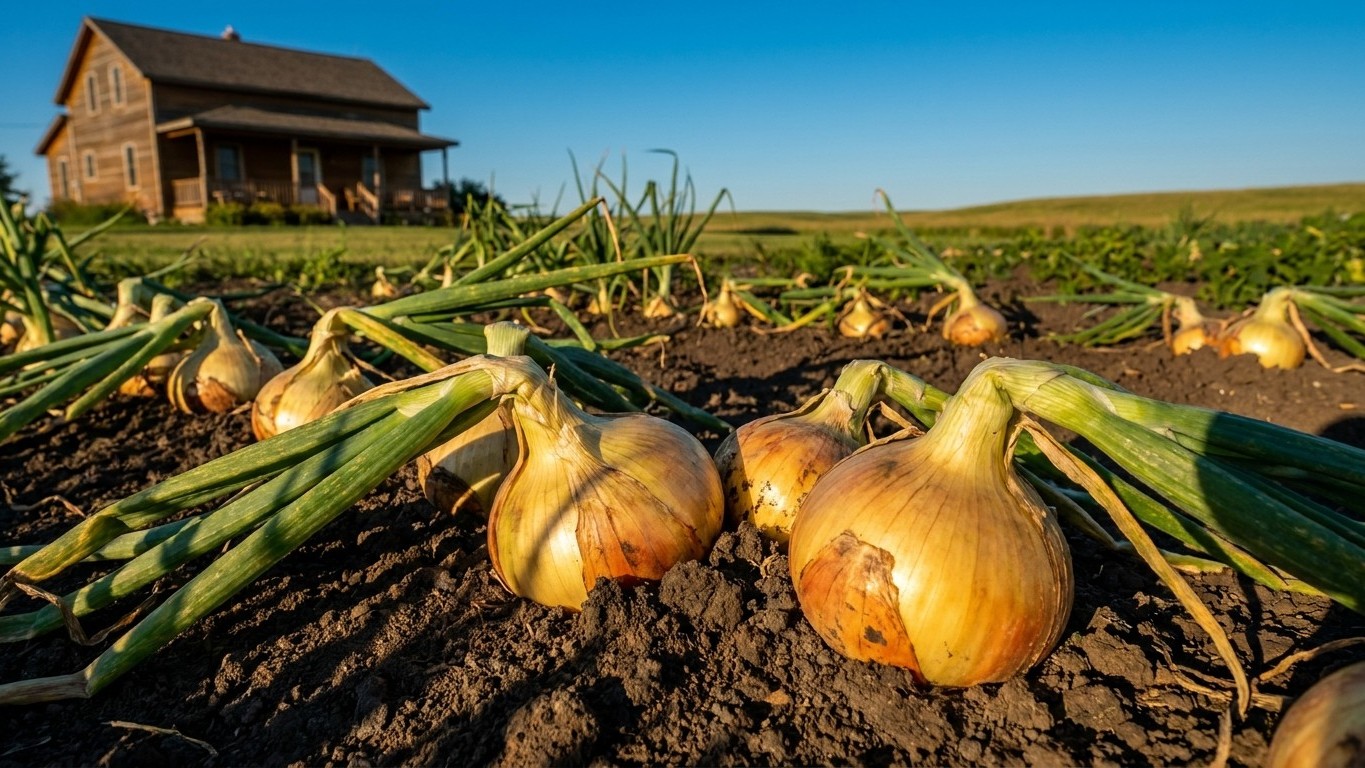

Lift onions in Minnesota when the tops fall over on their own and the necks go soft, then cure the bulbs until the necks are tight and the skins papery. Only then do they go into storage, somewhere dry that holds between 45 °F and 55 °F. The calendar matters less than the plant. Day length decides when a bulb forms, the bulb decides when you harvest, and the quality of your curing decides whether you’re eating onions in November or still slicing them in March.
The short answer for Minnesota
The figures here come from Minneapolis–St. Paul, at 44.88 degrees north (the coordinates of NOAA NCEI station USW00014922, the same station the climate normals use). On the longest day of the year that latitude gets 15 h 25 of daylight, calculated with the standard sunset hour-angle formula at the June solstice and measured to the geometric horizon. Real daylight runs about seven minutes longer because the atmosphere bends light over the horizon, and that isn’t counted.
That number is the whole story. A short-day onion starts bulbing at about 12 hours of daylight, a threshold published by Clemson Cooperative Extension. A long-day onion waits for 14 to 16 hours. Minneapolis–St. Paul clears that bar with room to spare, so long-day types get their trigger here. Warmth has little to do with it. The plant counts hours of light, stops pushing out leaves, and starts swelling the base.
Reading the tops
Once the bulb has finished filling, the neck weakens and the green tops flop over. This is the plant telling you it’s done. Start lifting when most of the tops in the row have fallen, not when the first one has. Choose a dry day and loosen the soil with a fork rather than yanking by the leaves, because a nicked or bruised bulb is where rot starts. Frost dates vary by garden and aren’t published here, so rely on the tops, not a date on the calendar.
Curing comes before storage
A bulb fresh from the ground is still a wet, living thing. Curing dries the outer skins into paper and seals the neck so moisture and rot organisms can’t get in. Spread the onions in a single layer somewhere warm, shaded and airy, out of the rain. A covered porch, a garage with the door open, or a screen laid across sawhorses all work. The test is physical: the neck should be tight and dry with no give when you squeeze it, and the outer skins should rustle. How many days that takes depends on weather and bulb size, and I won’t pin it to a number the sources here don’t carry. Your county extension office can tell you what local conditions usually need.
After that, trim the dried tops and roots and move the bulbs to storage. Clemson Extension puts ideal storage conditions at “between 45 °F and 55 °F, and 50 to 60 percent humidity.” Onions want dry air. For a broader look at growing them here, see Onions in Minnesota.
What will not work here
Most failed onion harvests in Minnesota come from a handful of predictable mistakes, and each one has a mechanism behind it.
Planting late shrinks the bulb
Planting late does not delay the harvest. It shrinks it. Day length triggers bulbing whether the plant is ready or not, and whatever size the plant has reached on that day is the size the bulb will be. An onion with only a few leaves when the trigger arrives builds a small bulb, because each leaf feeds a ring of the bulb. You can’t make up the difference with fertilizer in July. Short-day types make the same problem worse: they trigger at about 12 hours, long before Minnesota’s days peak, so they bulb early and stay small. The varieties that suit the state are covered in The Best Onion Varieties for Minnesota.
What to leave out of your plan
- Short-day varieties as a main crop: they bulb at about 12 hours of daylight, so they set small bulbs early and waste a Minnesota summer that offers 15 h 25 at its peak.
- Sweet onions meant for winter: they carry fewer of the sulfur compounds that protect a bulb, so they soften and sprout well before spring.
- Bulbs pulled straight from the ground into a crate: the necks are still wet, and rot enters through them.
- Cutting the tops off before curing: an open, green stub is a doorway for decay.
- A damp root cellar shared with carrots: roots like humid air, onions want 50 to 60 percent humidity, and one space holds neither well.
- Storing bulbs with nicks, soft necks or pest damage: what chewed on them in July becomes rot in January (see What Eats Onion in Minnesota, and When).
Eat the damaged and thick-necked bulbs first. A thick neck often means the bulb was still growing when the tops fell, and it will never dry as tight as the rest.
What changes across Minnesota
The 44.88 degrees north figure belongs to Minneapolis–St. Paul, not to the state. Minnesota stretches several degrees of latitude from the Iowa line to the Canadian border, and day length climbs as you go north. The far north gets more summer daylight than the south, which is why long-day onions are a fit across the whole state, and why a gardener near the border has even less reason to consider short-day types.
What shifts with latitude is mostly timing. Day length is only one of two clocks, and the other is the season: a northern garden starts later and finishes under a shorter frost-free window. Exact day lengths for towns other than the reference city aren’t published here, so the table shows direction, not invented numbers.
| Location | Latitude | Longest-day length | What it changes |
|---|---|---|---|
| Minneapolis–St. Paul (reference) | 44.88° N | 15 h 25 | Long-day onions get their trigger; short-day types still bulb early and small |
| Southern Minnesota | Lower than the reference | Slightly shorter | Long-day types still bulb, a touch later in the season, with a longer frost-free stretch for filling |
| Northern Minnesota | Higher than the reference | Longer | Long-day trigger arrives sooner, but a shorter season leaves less time to size up and cure |
A reader near either edge should look up their own latitude rather than borrow the reference city’s. Near the northern border the practical risk is a cool, short fall: cure under cover, because you can’t count on warm, dry weather finishing the job outdoors.
Sweet now, or onions that last
The trade is chemistry, not luck. The bite of an onion comes from volatile sulfur compounds, and those same compounds are what protect the bulb once it’s in storage. As University of Missouri Extension puts it in its guide to planting, growing and harvesting onions (G6355): “As a rule, ‘sweet’ onions do not store as well as the more pungent types.” A sweet variety carries fewer of those compounds. That makes it better raw and worse in the cellar.
Day length lines up with this. Short-day types run sweeter and long-day types keep longer, which is why southern gardens give onions to eat soon and northern ones give onions that feed you into March. Minnesota sits on the keeping side of that line. Grow a long-day, pungent onion, cure it well, and it earns its place in the pantry.
Picture that pantry in March. The pungent bulbs are still firm, skins dry, with only an occasional sprout to be used up first. A sweet variety harvested the same day would be gone by then: soft spots, sprouting, a sour smell from the crate. If you want a few sweet onions for summer salads, grow them, eat them in the first weeks after harvest, and don’t count them toward winter. Never promise yourself a sweet onion that stores.
Checking this against your own garden
Everything above rests on one reference city. Your garden may sit a degree or two away, with its own frost dates and its own quirks. A few checks you can do this week:
- Look up your garden’s latitude and compare it with 44.88 degrees north. The farther you are from Minneapolis–St. Paul, the less you should trust the day-length figure as written.
- Find your local first and last frost dates, since they aren’t published here. They set how much season you have to size up and cure.
- Call or visit your county extension office and ask what curing time and storage conditions work in your part of the state.
- Check what you actually planted: if the seed packet doesn’t say long-day or short-day, find out before you plan on storing anything.
- Measure the humidity where you intend to store the crop, and keep it away from damp root vegetables.
Common questions
How do I know it’s time to lift my onions?
Watch the tops. When most have fallen over and the necks have gone soft, the bulbs have finished growing. Lift on a dry day, loosen the soil first, and handle the bulbs gently to avoid bruises.
Do I have to cure onions before storing them?
Yes. Curing dries the neck and outer skins so rot can’t get in. Bulbs go into storage only once the necks are tight and the skins are papery, never straight from the ground.
What are the right storage conditions?
Clemson Extension gives ideal conditions as 45 °F to 55 °F and 50 to 60 percent humidity. Onions want it dry, the opposite of carrots and other root crops, so keep them in a separate spot.
Why do my sweet onions rot before winter?
They have fewer of the volatile sulfur compounds that protect a bulb in storage. Sweet onions are for eating early, while pungent long-day types are the ones that last into March.